by Joel V Webb | Jul 7, 2026 | Free Methodism, History, Methodism, Orthodoxy Matters, Theology & Practice
Recently a friend of mine, David Wiesner wrote a fantastic article titled “The Wesleyan Quadrilateral Need to Go”, detailing past and current voices in the Methodist movement, along with his own arguments as to why the term coined by Albert Outler should cease to be a framework for theological discernment in the Methodist-Wesleyan tradition. I think he has a very compelling argument, and there are certainly points that I agree with him, and his sources on. Yet, I have my own reasons that I think support the notion that the Quad should stay as the framework for discerning theology and consensus in our pan-Methodist world.
To lay the groundwork, I will quote from Wiesner’s article concerning the origin and definition of the quad, and take specific note of the historic foundations of this framework that Wesley would have derived from his Anglican heritage:
“Outler created the phrase “Quadrilateral” as a way of trying to describe how Wesley came to his theological conclusions and thus as a means for Methodists to likewise do the same. Outler selected scripture, reason, tradition, and experience as the four “legs” of the Quadrilateral based on his understanding of Wesley’s writings and his perception of how Wesley thought, not from anything explicit that Wesley said. Insofar as Wesley remained a devoted Anglican his entire life, it’s more than fair to say Wesley was familiar with the use of scripture, reason, and tradition because (as noted in the quote above) that was and remains the Anglican Trilateral formulation (or Triad) for discerning theology, and adding experience to the mix certainly reflects the importance Wesley placed on spiritual or converting experience within the Christian life.”
There are two arguments of the seven made in Wiesner’s article that I wish to address, and in the order that he did as well. The first, and what I think is the most compelling of these arguments is the misuse of the Quadrilateral. One of the most obvious realities to anyone with eyes is that the United Methodist Church abused and bastardized the Wesleyan Quadrilateral. I am not mincing my words here because there is no way around it. The theological desolation and rejection of Christian orthodoxy that has been seen in the last generation is a result of theological liberalism abusing the quadrilateral to bend orthodox interpretation of Scripture using experience.
Because of this, the Global Methodist Church (GMC) has taken steps away from the quad. This is witnessed in the sourcing of David Watson and others in Wiesner’s article. And I totally and completely understand this move. To see how Outler’s synthesis was abused to allow for everything it did (something Outler himself admitted and regretted towards the end of his life), it makes sense to want to separate from that synthesis and move to a different framework.
That being said, the abuse or misuse of something does not delegitimize the value or goodness of that thing. Just like people blame the Church for the ills and wrongs done to them presently and historically, that in very many cases is true, does not make the Church bad. But it does show the need we have for Christ. And, I would argue the same is true for the quad. The misuse of it by the UMC and others does not negate the need and goodness of it. As we examine its misuse and abuse, we see how its wrong application has wrought the fruit we see now.
The primary problem was how Scripture was relegated to the same level as the other elements of tradition, reason & experience. To understand the quad with Scripture as equal is to not understand the Protestant theological framework, nor is it to understand how Wesley would have understood how to come to the right understanding and doctrine.
I am not in the Sola Scriptura camp. To be of the Anglican heritage, having the synthesis of theologians such as Robert Hooker in his Laws of Ecclesiastical Polity, which would have been foundation to Wesley and his framework (thus the three-legged stool) is to know that the issue is not the truth and reliability of Scripture. The place of diversion comes down to the interpretation of said Holy Scriptures. Hooker at the time of his writing was primarily locked in a theological back and forth with the Puritans who were dogmatically grounded in Continental European Calvinistic theology, and thus if it wasn’t plainly in Scripture then it was wrong (a simplification, but fundamentally true).
Rather, Hooker wrote, “What Scripture doth plainly deliver, to that the first place both of credit and obedience are due; the next whereunto is whatsoever any man can necessarily conclude by force of reason; after these the voice of the Church succeedeth.” (Laws of Ecclesiastical Polity). He also wrote, ““It sufficeth therefore that Nature and Scripture do serve in such full sort, that they both jointly and not severally either of them be so complete, that unto everlasting felicity we need not the knowledge of any thing more than these two may easily furnish our minds with on all sides.” In providing this framework, we see that the issue is not the authority of Scripture, but what we do with interpretation, and with things that scripture does not expressly address.
The reason we must have an avenue of theological synthesis is because heretics use the same Scripture we do. If you listen to the Road to Nicea podcast, or go deeper down the rabbit trail and actually read the Church Fathers (something I think EVERY pastor should be required to do), you see how the argument of the heretics such as the Arians, Gnostics and the like have their root in Scripture. As wrong and faulty as their theology is, it is the interpretation of Scripture that leads to the wrong theology.
So again, the issue is not Scripture itself, but how we come to understand what Scripture is teaching. Because if you have talked theology with someone with aberrant or heretical theology (like I have), they quote Scripture left right and center until their faces are blue. The diversion is that what they believe is not found in the Grand Deposit of faith, handed down to the saints by the saints who have come before, ultimately found in the teaching of the Apostles. That is why we need the Quadrilateral.
It is with this understanding that our conception of the Quadrilateral needs realignment. Scripture must be the unrivaled head of the quad. Yes, tradition, reason & experience are used in the synthesis of what Scripture is saying, but they can never go against what Scripture plainly teaches. And so my encouragement for both David, and those in the GMC (I have both family and dear friends apart of it), is that the problem is not the quad in and of itself, it is the abuse of the tool. Correct the imbalance in the framework of interpretation, don’t jettison the baby with the bathwater (don’t get me started on the paedobaptism discussion, I’m always ready to defend this Scriptural and historic Christian practice!).
Then we come to the second main augment that Wiesner makes, “The reality of how the Church determines theology is a collective and Spirit-infused enterprise, and we should encourage that corporate method instead of the implicitly-individualized method of the Quadrilateral”. My biggest contention with this is that I feel this is a category error. Wiesner commits a category error if he assumes the Quadrilateral’s purpose is to describe exactly the procedural forms the apostles used in Acts, rather than to articulate a method that makes the Spirit‑infused and corporate enterprise of the church intelligible and applicable today.
Again, the concern of this argument is the over individualization of the process that I believe is corrected by right weighting of Scripture as the highest authority, and then I would even posit that experience is the bottom of the pile, with it needing to be ultimately subject to Scripture first, then tradition & reason, before we interject what our experience says.
Part of the reason I am so ardent about this is because I grew up in a theological landscape that had no real and discernable process for making or synthesizing theological decisions outside of the personal experiential authority of a few key leaders. It was not a process or a framework that anyone would be held to if they deviated away from it. Just like how every Sunday in my church’s liturgy we declare the Nicene Creed following my sermon. And, I have explicitly told my congregation the purpose of doing so is that if I preach something contrary to the truths we are declaring, I am to be held to it and corrected.
The quad, I believe, is supposed to function as such for us in the pan-Methodist world. It is a framework that we run ideas, concepts and theologies through to see if it is in concert with true Christian doctrine. As an example, I can take the new Social Standards that the UMC passed just a few years ago following the mass disaffiliation to the new GMC and other similar denominations (like my own parish!). We don’t actually have to go any deeper in the quad than Holy Scripture to see how what was passed is in direct violation of the clear teachings and passages (granted, when you buy into process theology and open-theism, anything is possible). But let’s explore the other elements if we correctly use the quad as intended. As soon as you look at tradition, you will then see that the changes are in clear and direct violation of what the Church has ALWAYS taught, with no grey areas or equivocation. Then with reason and experience, the same conclusion remains: these revisions do not represent a deeper or more faithful reading of Christian truth, but a departure from the settled witness of the Church, the moral logic of Scripture, and the lived moral discernment of the Christian tradition. In other words, when the Quadrilateral is used properly, it does not become a license to baptize novelty; it becomes a means of testing whether a proposed teaching can actually stand within the whole Christian inheritance, and in this case it cannot.
It should be acknowledged that the Church has never discerned theology in a vacuum. Councils, synods, and canonical processes are all legitimate expressions of the Church’s corporate, Spirit-led judgment, and they provide an essential check against purely individual interpretation. The point of the Quadrilateral is not to replace those ecclesial realities, but to give them a coherent theological grammar: Scripture remains the final authority, while tradition, reason, and experience serve the Church as shared and accountable means of discernment. In practice, then, the Quad works alongside the Church’s conciliar life rather than against it, helping to ensure that theological judgments are not merely private opinions, but conclusions tested within the common witness of the body of Christ.
Part of my concern is what is the alternative if the Quadrilateral is done away with? My argument is that the Quadrilateral represents how the Holy Spirit works collectively to bring us to the true doctrine of Christ’s Church. There is a lot of uncharted water if we go a different direction. I have been on the Charismatic/generic Evangelical side of the aisle, where if it process was written down honestly, it would look a heck of a lot like the Quadrilateral. Just like in the Church we need structures and frameworks to operate (like the episcopate), we likewise need to same for discerning how the Holy Spirit is speaking and working in the life and belief of the Church. And I believe the Quadrilateral best represents that vision.
And so, as Methodism in the 21st Century is seeking to figure out who we are, we need the Quadrilateral more than ever. Correctly contextualized and utilized as we seek to determine and define the truth of “the faith entrusted once for all to the saints.” (Jude 1:3 BSB).
by Joel V Webb | Jun 16, 2026 | History, Theology & Practice
Have you ever had those moments when prayer feels lonely? You may be surrounded by people and still feel like you are the only one praying. At other times, the greater struggle is not loneliness but silence—seasons when life weighs so heavily that we do not know what to say to God. Pressures, fears, and the relentless forward march of time can make us feel like we are holding our breath, not knowing what comes next.
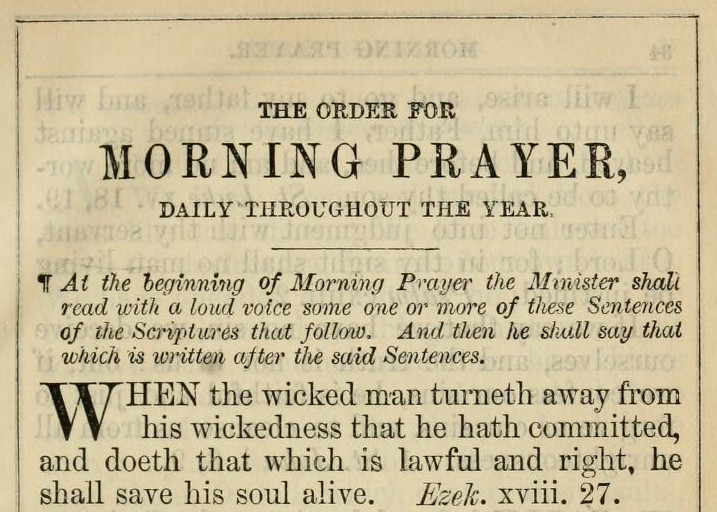
In those moments, it is a gift to remember that we do not pray alone. We can pray with the entire “great cloud of witnesses” who have gone before us [Hebrews 12:1]. This pattern is found in the structured daily office of the Book of Common Prayer. The flows and prayers of Morning and Evening Prayer have their roots in the early church and took definite shape during the English Reformation in the 16th century.
These are the prayers that shaped John Wesley’s spiritual life. As a priest in the Church of England, Wesley was dedicated to praying Morning and Evening Prayer every single day. His journals record innumerable instances of his participation in the daily office, both individually and corporately.
Yet as Free Methodists, we may ask: Why structured prayer? If the Spirit is meant to speak to and through us, won’t preset prayers and a set order inhibit that flow?
The concern is understandable, but it rests on a false opposition. Structure and Spirit are not enemies. In fact, the history of the Church suggests the opposite: the Spirit has consistently formed God’s people through shared patterns of prayer.
Scripture itself gives us structured prayer. The Psalms were not spontaneous utterances in the moment—they were prayed, sung, repeated, and handed down across generations. Israel learned how to pray by being given words. Jesus himself gave a set prayer to his disciples: “When you pray, say…” [Luke 11:2]. The early church did not abandon form in pursuit of freedom; rather, they received forms as gifts that shaped their freedom rightly.
The daily office is not a script that replaces authentic prayer; it is a trellis that helps it grow.
A trellis does not produce fruit, but without it, growth often becomes tangled and stunted. In the same way, the daily office gives shape to our prayer so that it can mature over time. It holds us in a pattern of Scripture, confession, praise, and intercession that gradually forms our hearts.
When words fail us, the office gives us words. When our emotions are chaotic, it steadies us. When our faith feels thin, it lends us the faith of the Church. It teaches us to pray not only from our own experience, but from the full range of human experience before God—joy and sorrow, confidence and doubt, repentance and praise.
This is one of its quiet strengths: it refuses to let us reduce prayer to whatever we happen to be feeling in the moment. Left to ourselves, we often circle around the same concerns, the same anxieties, the same limited vocabulary. The daily office stretches us. It brings us into contact with the breadth of Scripture and the depth of the Church’s prayer across centuries.
There is also a profoundly communal dimension to this practice, even when it is prayed alone.
When you pray the psalms appointed for the day, you are praying words that are being prayed by Christians around the world. When you follow the lectionary readings, you are hearing the same Scriptures that are shaping countless other lives that day. When you pray the familiar collects, you are joining your voice to generations who have carried these prayers through times of persecution, renewal, doubt, and awakening.
This is what it means, in part, to belong to the communion of saints. The daily office makes that communion tangible.
It also reorients our sense of time. Modern life trains us to experience time as something we manage, spend, or lose. It becomes fragmented, driven by urgency and distraction. The daily office gently resists this formation by sanctifying time itself.
Morning Prayer declares that the day begins with God, not with our notifications, responsibilities, or anxieties. Evening Prayer gathers the fragments of the day and returns them to God in thanksgiving and repentance. Over time, this rhythm begins to reshape our awareness. We start to see our lives not as a series of disconnected moments, but as something held within God’s presence.
This is not about adding another burden to already busy lives. It is about receiving a pattern that, paradoxically, lightens the burden by grounding us.
And far from stifling the Spirit, this rhythm often creates space for deeper attentiveness. Many who pray the office regularly discover that spontaneous prayer does not diminish—it becomes richer. The language of Scripture and the cadences of historic prayer begin to inhabit the heart, shaping how we speak to God even outside the set forms.
We might say it this way: structured prayer trains the imagination so that spontaneous prayer can flourish.
There are, of course, common objections beyond concerns about the Spirit.
Some worry that written prayers can become rote or mechanical. That danger is real—but it is not unique to liturgical prayer. Spontaneous prayer can become just as repetitive and inattentive. The issue is not the form, but the heart we bring to it. The daily office, when engaged with even a modest level of attentiveness, can actually cultivate deeper focus precisely because it does not depend on our ability to generate meaningful words in the moment.
Others feel that such practices are too formal or distant from their tradition. Yet for those in the Wesleyan family, this is not foreign ground. Wesley himself never abandoned the rhythms of the Book of Common Prayer. He saw no contradiction between heartfelt religion and structured devotion. In fact, he understood the liturgy as a means of grace—a channel through which God forms and sustains his people.
Recovering the daily office, then, is not about becoming something we are not. It is about reclaiming a means of grace that has always been available to us, though often neglected.
In a time when many feel spiritually isolated, unsure how to pray, or spiritually fatigued, the daily office offers a simple and profound invitation: join the prayer that is already happening.
You do not need to invent the words. You do not need to wait until you feel spiritually strong. You do not even need to feel particularly focused on any given day. You simply step into the stream of prayer that has been flowing long before you arrived.
And over time, that stream begins to carry you.
You are not the first to pray these words. You are not praying them alone. And you are not carrying the weight of prayer by yourself.
The Church is praying—with you, for you, and alongside you—morning and evening, day after day, generation after generation.
And in that shared rhythm, we may find not only words, but rest. Not only structure, but freedom. Not only discipline, but grace.
by Joel V Webb | May 15, 2026 | History, Methodism, Sacraments, Uncategorized
Whenever a movement or a group of people is looking back to make an assessment of where they are and where they’ve come from, part of doing that correctly is doing so honestly. It’s not about dishonoring the past or those who were faithful in the past with what they had. But we should be able to rightly see where they may not have been, how they should have been, and course-correct from there.
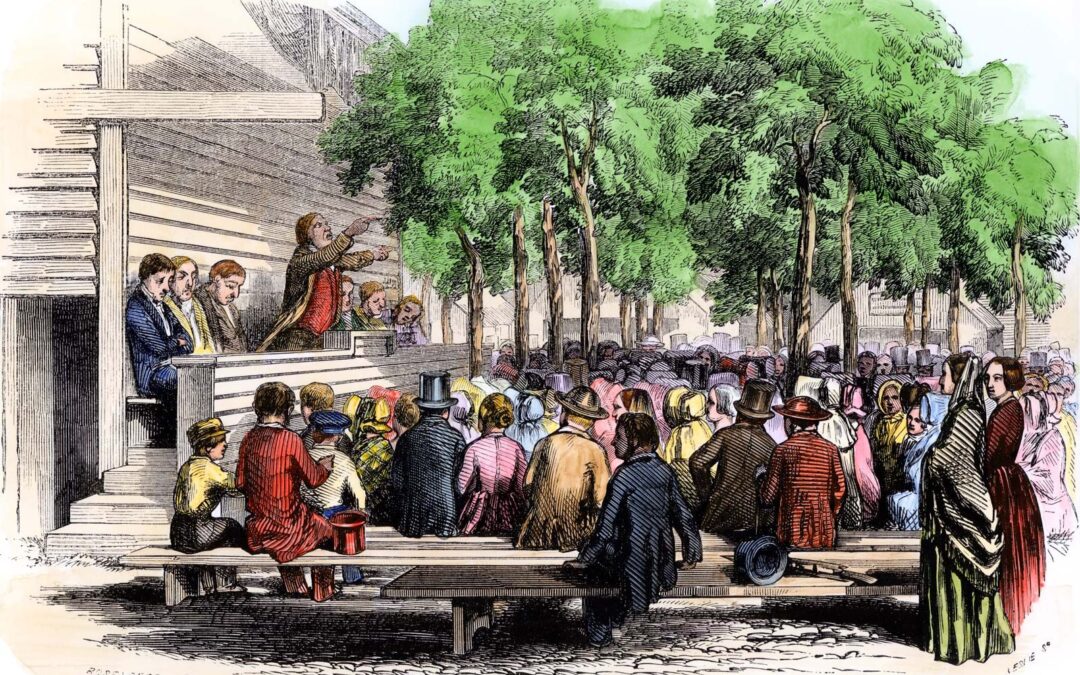
Recently, I have been taking something of a deep dive into early Methodist history. Specifically looking at not just John Wesley himself, but the early pioneers of American Methodism. As someone who did not grow up in the movement, I take seriously the responsibility to understand the place I now call my ecclesiastical home. There is so much of American Methodism to look at with thankfulness to God, for how those faithful trailblazers spread with the pioneers to bring the Gospel to the frontiers of America, leading Methodism to represent the biggest American denomination by the early 19th century.
Yet, with that heritage and legacy, when we look at Methodism today, we see a different story. With about 50 different Methodist/Wesleyan denominations in existence, with a broad range of theological takes and reasons for why they split, including more recent divisions, what has happened here?
In a paper about sacraments in early American Methodism, Paul Sanders writes this:
“Early Methodism in America had failed to achieve sufficient coherence to enable it to preserve the marrow of its legacy while at the same time adapting it to the demands of a new time and a new land. Although maintaining a halting loyalty to its Wesleyan heritage, the church was clearly more concerned with evangelism than with sacramentalism. Wesley’s synthesis was dissolved. As revivalism was not the same as Wesley’s evangelical ministry, so the confused sacramental
teaching and erratic sacramental practice of the Americans was not the same as Wesley’s own. The loss of the fertilizing vitality which results from keeping each close to the other was serious enough; but the loss was finally more serious. The church had been rendered peculiarly vulnerable to the infiltration of alien ideologies, and would find itself unable to maintain either evangelicalism or sacramentalism under the impact of the rise of rational idealism.”
I know there’s a lot going on in that paragraph, and I highly encourage you to look up and read Sanders’ paper, as he does a deep dive into Wesley’s sacramental theology and the importance it played in his life and ministry. And it is this major component that was missing for American Methodism, that didn’t allow for the “marrow” of Wesley’s legacy to endure in totality.
Looking at the reasons that led to this, I get it. You’re in America; you don’t have enough clergy to rightly administer the sacraments (both communion and baptism were an issue), and so very quickly the pragmatic realities set in. Even if you think things like weekly communion are important, you simply can’t do them, and they fall out of practice. And in this, I don’t fault my predecessors for how history went down. Could they have done something differently? Maybe. But I can’t make that call. All I can do is see where there were potential issues and try to course-correct from there.
So that leads us to the question. What was the fatal flaw? In my mind, from the research I have done, the fatal flaw was that early American Methodism didn’t solidify its identity because it failed to maintain the sacramental reality of Wesley’s life and ministry along with his evangelical zeal.
Because there was a lack of this cohesive identity grounded in the table, Sanders suggests—and I would agree and posit—that the multiplicity in American Methodist denominations exists because the sacramental grounding of the movement was not solidified. The focus became the practical necessity of expanding with rapidly growing America. And in this growth, cultural influences were able to weave themselves in at various times and in various places, leading to the muddled landscape we have today.
Now, in the 21st century, the Methodist movement has a new opportunity. With the major realignment of Methodism in the Global Methodist Church, the possibility is open for us across the board to look at where we came from, reassess who we actually are, and then put our noses to the plow of the Gospel work we have to do.
So what is this new path forward?
Recenter the table.
Now, it is a bit more complicated than that, but not by much.
As Methodists, we need to recapture the Spirit-fueled heart of our movement, which was the encounter with the Risen, Ascended, and Reigning Christ that takes place at Holy Communion. It means our pastors and our laypeople need to not just practice and participate, but also understand the how and why. To not just come and remember, but to come and receive the fullness of the work of Christ that He offers to His Church.
Yes, we need excellent preachers, and those who have a passion for evangelism to go out and proclaim the Word. That will always be essential, as it was for Wesley. But backing that up must be a thoroughly grounded understanding and practice of the means of grace. Not just as a catchphrase we use when talking about Wesleyan theology, but as the heartbeat of what we are about.
Looking back at our Methodist forebears, we have so much to be thankful for. They loved and served Christ faithfully. It is not to denigrate their lives and work for the Kingdom, but rather to see the fruit of what they themselves truly desired to see: an American nation captivated by the Gospel, and the power of Christ flowing to every believer as they receive Him week by week.
In the limited scope in which I’ve read the life and works of B. T. Roberts, I am thankful to be a Free Methodist. We have a place and a role in the Kingdom of God to accomplish His will on earth. And through recapturing the heart of Wesley’s life and ministry in the Table, we can bring to fullness what Roberts and others desired to see: a people who lived lives of holiness and set captives free.
What better place to do that than the meal that Christ instituted where it started for us all?
by Joel V Webb | Mar 3, 2026 | History, Theology & Practice
“War…war never changes.”
This haunting quote from a video game franchise I’ve played captures the harsh reality of human conflict. No matter the epoch of history, or the technology available, war is a horrible and terrible thing. I truly believe that violence grieves the heart of God because it is a destruction and violation of his image bearers. One of the promises given to humanity in the New Heavens and Earth is a place where, “They will beat their swords into plowshares, and their spears into pruning hooks. Nations will not take up the sword against other nations, and they will no longer train for war” (Isaiah 2:4 NET). Oh what a place that will be! To not have to deal with the threat of violence and death. And for us as Christians now, we have a role to play in working as the Church in being the people of God to the world as His hands and feet in seeing that come about at his return.
But what does this mean for us in the here and now?
It means acknowledging the tension of living in a fallen world where sin’s curse lingers, and evil doesn’t lay down its arms just because we pray for peace. The Bible doesn’t present violence as neutral, it’s a tragic consequence of our rebellion against God—but neither does it demand pacifism in the face of slaughter. There are times when force, even lethal force, becomes a moral imperative to protect the innocent, restrain wickedness, and restore justice. As a pastor wrestling with Scripture, I’ve come to see this through the lens of biblical texts that frame violence not as vengeance (which God reserves for Himself, Romans 12:19), but as protective duty and restorative order.
The Biblical Case for Protective Violence
Scripture repeatedly calls God’s people to defend the vulnerable, using strength when words fail and threats loom. Consider Exodus 22:2-3, where a homeowner who kills a nighttime thief bears no guilt, self-preservation is presumed righteous amid darkness and danger, though daytime restraint honors life. Nehemiah 4:14 captures this urgency as the wall-builders arm themselves: “Fight for your brothers and your sons and your daughters and your wives and for your homes.” Here, violence isn’t aggression; it’s the shield for family and faith against marauders. Proverbs 24:11-12 drives it home: “Rescue those who are being taken away to death; hold back those who are stumbling to the slaughter. If you say, ‘Behold, we did not know this,’ does not he who weighs the heart perceive it?” God holds us accountable for inaction—turning a blind eye to genocide or tyranny makes us complicit.
Psalm 82:3-4 echoes this divine mandate to rulers: “Give justice to the weak and the fatherless; maintain the right of the afflicted and the destitute. Rescue the weak and the needy; deliver them from the hand of the wicked.” These aren’t abstract ideals; they’re commands to wield authority forcefully when oppressors strike.
Restorative Force and the Sword of Justice
The Bible also entrusts restorative violence to governing powers as agents of God. Romans 13:4 is unflinching: the state “does not bear the sword in vain. For he is the servant of God, an avenger who carries out God’s wrath on the wrongdoer.” This isn’t a call to personal vendettas but to ordered justice, echoed in Genesis 9:6 (“Whoever sheds the blood of man, by man shall his blood be shed”) and the Mosaic laws balancing retribution with mercy. Ecclesiastes 3:8 speaks plainly: there’s “a time for war, and a time for peace,” timed by divine wisdom in a broken creation.
Unchecked violence thrives when red lines are drawn, crossed, and met with nothing, emboldening aggressors, as history shows from appeasement before WWII to modern escalations where impunity begets atrocity. Scripture warns against this passivity.
Jesus Himself models measured force, driving out moneychangers with a whip (John 2:15) and telling disciples, “Let the one who has no sword sell his cloak and buy one” (Luke 22:36), preparing for peril, even as He rebukes Peter’s impulsive strike (John 18:11). These aren’t endorsements of endless conflict but of principled resistance.
Toward a Just War Framework
This scriptural thread weaves into just war theory, a tradition rooted in Augustine and Aquinas but grounded in the Bible’s own principles. War is justifiable (jus ad bellum) only with legitimate authority (Romans 13), just cause like defending innocents (Proverbs 24:11; Nehemiah 4:14), and right intention aimed at peace (Isaiah 1:17). In conduct (jus in bello), it demands proportionality (Deuteronomy 20:10-19, offering terms first) and discrimination (sparing non-combatants). This doesn’t mean every action in a just war is perfect—soldiers sin, leaders err, atrocities occur—but a righteous cause remains righteous, calling for repentance where wrong amid the fight for good.
Unchecked evil, like Pharaoh’s armies drowning innocents or Amalek’s raids, forces a choice: stand idle or intervene. When bullies test boundaries and face no consequence, violence metastasizes; Proverbs 24:12 indicts the silent witness. Loving your neighbor (Mark 12:31) sometimes means rolling in the tanks, not out of hatred, but to halt the butcher’s blade. Jesus’ Sermon on the Mount, “turn the other cheek” (Matthew 5:39), “give to the one who sues you and give your cloak as well” (5:40), “go the extra mile” (5:41), “do not resist the evil person” (5:39), is contextual genius: in Roman-occupied Judea, these subvert oppressors non-violently. Turning the cheek defies dehumanizing slaps (right-hand backhand), offering the left challenges norms; surrendering cloak strips the suing exploiter; walking the extra mile mocks forced labor. It’s bold resistance through grace, not surrender to tyrants or passivity before slaughter.
History’s Echo: The Crusades as Just Response
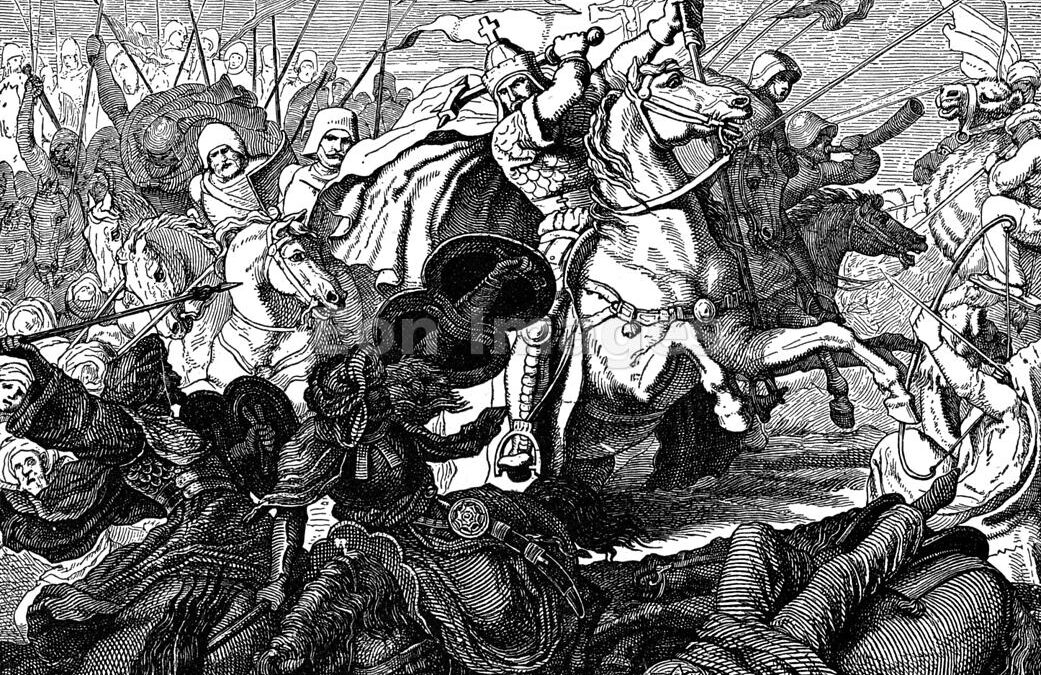
This framework isn’t theoretical, history tests it. Consider the Crusades, often maligned as mindless aggression. In reality, they were a delayed Christian counteroffensive after four centuries of Islamic conquests that devoured two-thirds of the Christian world: from Muhammad’s 630 Tabuk raid on Byzantines, to Jerusalem’s fall (638), North Africa’s seizure, Spain’s invasion (711), and Tours halted only by Charles Martel (732). By 1071, Seljuk Turks crushed Byzantium at Manzikert, threatening Constantinople and pilgrims; Emperor Alexius begged Pope Urban II for aid—red lines crossed repeatedly with no response until then.
The First Crusade (1095-1099) liberated Jerusalem not as imperialism, but reclamation of stolen lands, much like Nehemiah’s wall or Abraham’s rescue (Genesis 14). Papal calls framed it defensively: aid Eastern Christians under “brutal Muslim rule,” halt jihad’s tide. Yes, abuses happened, the responses and actions of those involved weren’t always perfect or right, with cruelties and excesses that demand our sorrow and repentance—but this doesn’t remove the just cause of the entire movement: legitimate authority (Pope/emperor), just defense against expansion (post-Manzikert Seljuk surge), intent to restore pilgrimage access and borders. Without Crusades, Europe might have fallen as Spain nearly did; they bought centuries for Christendom to regroup, proving consequences deter unchecked violence.
Implications for Today: Peace Through Principled Strength
What does this mean practically for Christians in 2026? It calls us to a relentless pursuit of peace; diplomacy, de-escalation, mercy wherever possible, while recognizing that true peacemaking (Matthew 5:9) often demands the courage to confront evil head-on. We’re always working for peace, praying for reconciliation, supporting negotiations, and building bridges across divides. But when aggressors reject peace, slaughter image-bearers, and threaten annihilation, like Russia’s invasion of Ukraine (ignoring red lines from Crimea to full assault), Hamas’s October 7 atrocities, or rising authoritarian threats, the just extension of protection is violence. Not gleefully, but grievously; not endlessly, but proportionately; not vengefully, but restoratively. Even here, individual sins or tactical wrongs don’t negate a war’s moral foundation, we grieve them, seek accountability, but stand firm on rescue. When nothing happens after violations, violence thrives; deterrence saves lives.
This isn’t license for hawkishness or endless wars, Scripture tempers us with “Blessed are the merciful” (Matthew 5:7) and warnings against trusting in chariots (Psalm 20:7). Churches should advocate ceasefires where viable, aid refugees, and disciple nations toward justice. Yet inaction before tyrants echoes the wicked silence of Proverbs 24:12, forfeiting our mandate to rescue the stumbling. In self-defense laws, military service, or policy debates, we uphold the state’s sword (Romans 13) as God’s reluctant gift in a Genesis 3 world. Vote for leaders who prioritize peace through strength; support alliances that deter aggression; pray for enemies even amid the tanks’ rumble.
Peacemaking in the Mud
Being a peacemaker isn’t passive, it’s active pursuit of shalom, which crushes chaos. In our era of rogue regimes, terror networks, and genocides, Christians must champion this dual path: diplomacy first, resolve when atrocities demand response. War never changes, but our calling does, to grieve its necessity while embracing the fight when Scripture bids us stand.
The eschatological hope of Isaiah 2:4 fuels our labor now, but until Christ returns, sometimes the plowshare must wait while we shoulder the sword.