
Have you ever had those moments when prayer feels lonely? You may be surrounded by people and still feel like you are the only one praying. At other times, the greater struggle is not loneliness but silence—seasons when life weighs so heavily that we do not know what to say to God. Pressures, fears, and the relentless forward march of time can make us feel like we are holding our breath, not knowing what comes next.
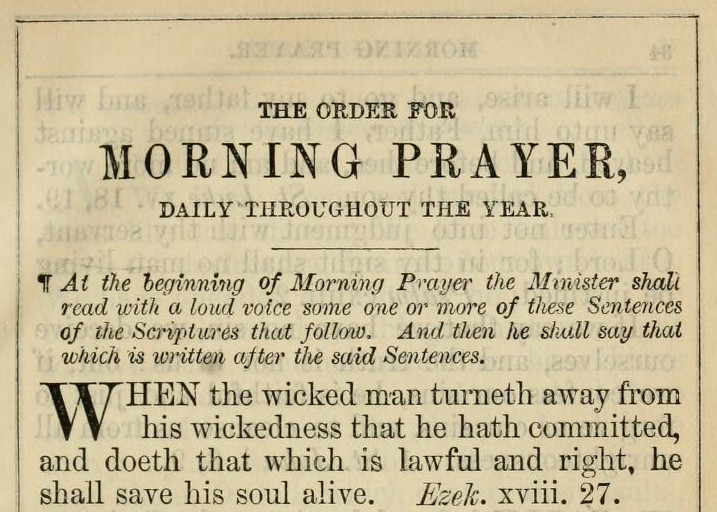
In those moments, it is a gift to remember that we do not pray alone. We can pray with the entire “great cloud of witnesses” who have gone before us [Hebrews 12:1]. This pattern is found in the structured daily office of the Book of Common Prayer. The flows and prayers of Morning and Evening Prayer have their roots in the early church and took definite shape during the English Reformation in the 16th century.
These are the prayers that shaped John Wesley’s spiritual life. As a priest in the Church of England, Wesley was dedicated to praying Morning and Evening Prayer every single day. His journals record innumerable instances of his participation in the daily office, both individually and corporately.
Yet as Free Methodists, we may ask: Why structured prayer? If the Spirit is meant to speak to and through us, won’t preset prayers and a set order inhibit that flow?
The concern is understandable, but it rests on a false opposition. Structure and Spirit are not enemies. In fact, the history of the Church suggests the opposite: the Spirit has consistently formed God’s people through shared patterns of prayer.
Scripture itself gives us structured prayer. The Psalms were not spontaneous utterances in the moment—they were prayed, sung, repeated, and handed down across generations. Israel learned how to pray by being given words. Jesus himself gave a set prayer to his disciples: “When you pray, say…” [Luke 11:2]. The early church did not abandon form in pursuit of freedom; rather, they received forms as gifts that shaped their freedom rightly.
The daily office is not a script that replaces authentic prayer; it is a trellis that helps it grow.
A trellis does not produce fruit, but without it, growth often becomes tangled and stunted. In the same way, the daily office gives shape to our prayer so that it can mature over time. It holds us in a pattern of Scripture, confession, praise, and intercession that gradually forms our hearts.
When words fail us, the office gives us words. When our emotions are chaotic, it steadies us. When our faith feels thin, it lends us the faith of the Church. It teaches us to pray not only from our own experience, but from the full range of human experience before God—joy and sorrow, confidence and doubt, repentance and praise.
This is one of its quiet strengths: it refuses to let us reduce prayer to whatever we happen to be feeling in the moment. Left to ourselves, we often circle around the same concerns, the same anxieties, the same limited vocabulary. The daily office stretches us. It brings us into contact with the breadth of Scripture and the depth of the Church’s prayer across centuries.
There is also a profoundly communal dimension to this practice, even when it is prayed alone.
When you pray the psalms appointed for the day, you are praying words that are being prayed by Christians around the world. When you follow the lectionary readings, you are hearing the same Scriptures that are shaping countless other lives that day. When you pray the familiar collects, you are joining your voice to generations who have carried these prayers through times of persecution, renewal, doubt, and awakening.
This is what it means, in part, to belong to the communion of saints. The daily office makes that communion tangible.
It also reorients our sense of time. Modern life trains us to experience time as something we manage, spend, or lose. It becomes fragmented, driven by urgency and distraction. The daily office gently resists this formation by sanctifying time itself.
Morning Prayer declares that the day begins with God, not with our notifications, responsibilities, or anxieties. Evening Prayer gathers the fragments of the day and returns them to God in thanksgiving and repentance. Over time, this rhythm begins to reshape our awareness. We start to see our lives not as a series of disconnected moments, but as something held within God’s presence.
This is not about adding another burden to already busy lives. It is about receiving a pattern that, paradoxically, lightens the burden by grounding us.
And far from stifling the Spirit, this rhythm often creates space for deeper attentiveness. Many who pray the office regularly discover that spontaneous prayer does not diminish—it becomes richer. The language of Scripture and the cadences of historic prayer begin to inhabit the heart, shaping how we speak to God even outside the set forms.
We might say it this way: structured prayer trains the imagination so that spontaneous prayer can flourish.
There are, of course, common objections beyond concerns about the Spirit.
Some worry that written prayers can become rote or mechanical. That danger is real—but it is not unique to liturgical prayer. Spontaneous prayer can become just as repetitive and inattentive. The issue is not the form, but the heart we bring to it. The daily office, when engaged with even a modest level of attentiveness, can actually cultivate deeper focus precisely because it does not depend on our ability to generate meaningful words in the moment.
Others feel that such practices are too formal or distant from their tradition. Yet for those in the Wesleyan family, this is not foreign ground. Wesley himself never abandoned the rhythms of the Book of Common Prayer. He saw no contradiction between heartfelt religion and structured devotion. In fact, he understood the liturgy as a means of grace—a channel through which God forms and sustains his people.
Recovering the daily office, then, is not about becoming something we are not. It is about reclaiming a means of grace that has always been available to us, though often neglected.
In a time when many feel spiritually isolated, unsure how to pray, or spiritually fatigued, the daily office offers a simple and profound invitation: join the prayer that is already happening.
You do not need to invent the words. You do not need to wait until you feel spiritually strong. You do not even need to feel particularly focused on any given day. You simply step into the stream of prayer that has been flowing long before you arrived.
And over time, that stream begins to carry you.
You are not the first to pray these words. You are not praying them alone. And you are not carrying the weight of prayer by yourself.
The Church is praying—with you, for you, and alongside you—morning and evening, day after day, generation after generation.
And in that shared rhythm, we may find not only words, but rest. Not only structure, but freedom. Not only discipline, but grace.