by Joel V Webb | Apr 16, 2026 | Orthodoxy Matters, Theology & Practice
Whenever we open up the book of Revelation we immediately put on the glasses of “THE END OF THE WORLD!”, and in doing so we interpret everything that St. John writes is speaking to some future event(s) that will happen in a certain way. And while yes, there certainly are parts of Revelation yet to happen (in my view we are in-between chp. 20 & 21) that have yet to take place at the final consummation and the restoration of Eden throughout the whole world as we who are redeemed are raised to life in new resurrected bodies..
But what if in only at looking at Revelation this way is actually pigeon-holing the vision that St. John received. That by assigning only future value to what is written in the words of the strangest and most mis-understood book in Scripture we are missing out on the beauty and strength that the Holy Spirit has for the Church as we continue as faithful workers in the harvest field until He comes again?
I propose, rather than seeing the images as just future events, we instead look at Revelation as a rallying call for us here and now. Not just as a description of events in the first-century back then, or a future-century ahead of us…but rather as an immensely captivating stained-glass kaleidoscope of what we as believers living here and now are called to participate in. Revelation is not just an image of the end, but actually of the beginning that started in Acts 2 and carries on to us today through to Christ’s coming again.
The picture that St. John paints are not of literal future literal bowls, trumpets, beasts and destruction; but rather as prophetic and otherworldly icon of the worship of the Church as we join in endless worship of the Creator, Sustainer and Savior. The call to this kind of worship is to be faithful in the face of whatever the devil and world throw our way. Not as a get outta dodge at the last moment.
The Throne and Living Creatures
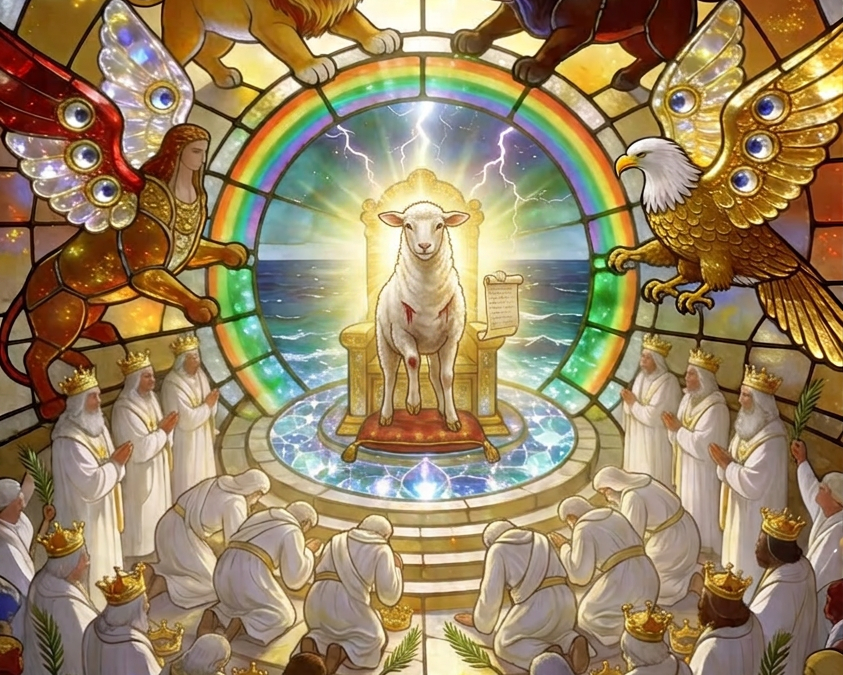
Revelation 4:2-11 (NIV) – At once I was in the Spirit, and there before me was a throne in heaven with someone sitting on it. And the one who sat there had the appearance of jasper and ruby. A rainbow that shone like an emerald encircled the throne. 4 Surrounding the throne were twenty-four other thrones, and seated on them were twenty-four elders. They were dressed in white and had crowns of gold on their heads. From the throne came flashes of lightning, rumblings and peals of thunder. In front of the throne, seven lamps were blazing. These are the seven spirits of God. Also in front of the throne there was what looked like a sea of glass, clear as crystal. In the center, around the throne, were four living creatures, and they were covered with eyes, in front and in back. The first living creature was like a lion, the second was like an ox, the third had a face like a man, the fourth was like a flying eagle. Each of the four living creatures had six wings and was covered with eyes all around, even under its wings. Day and night they never stop saying: “‘Holy, holy, holy is the Lord God Almighty,’ who was, and is, and is to come.” Whenever the living creatures give glory, honor and thanks to him who sits on the throne and who lives for ever and ever, 10 the twenty-four elders fall down before him who sits on the throne and worship him who lives for ever and ever. They lay their crowns before the throne and say: “You are worthy, our Lord and God, to receive glory and honor and power, for you created all things, and by your will they were created and have their being.”
Imagine the transcendent majesty of God’s throne, resplendent in jasper, carnelian, and an emerald rainbow encircling its glory, surrounded by a vast crystal sea and flashes of lightning that proclaim His eternal power. At its center stand the four living creatures, lion, ox, man, and eagle (the 4 images associated with each of the Gospel accounts), covered with eyes signifying divine omniscience, each with six wings veiling their forms as they ceaselessly intone, “Holy, holy, holy is the Lord God Almighty, who was and is and is to come!” In reverent response, the twenty-four elders, clothed in white robes and bearing golden crowns, prostrate themselves, casting their crowns before the throne while declaring, “Worthy are you, our Lord and God, to receive glory and honor and power, for you created all things, and by your will they existed and were created.” The early church fathers, such as Irenaeus, interpreted these creatures as emblematic of animated creation itself, representing noble wildness, faithful servitude, rational humanity, and swift spiritual insight, united in perpetual praise around the divine presence. This vision models the Church’s priestly vocation: vigilant, Trinitarian doxology that shapes our earthly liturgy, inviting believers today to join heaven’s ceaseless anthem with eyes attuned to God’s holiness amid the world’s distractions.
The Slain Lamb
Revelation 5:6-14 (NIV) – Then I saw a Lamb, looking as if it had been slain, standing at the center of the throne, encircled by the four living creatures and the elders. The Lamb had seven horns and seven eyes, which are the seven spirits of God sent out into all the earth. He went and took the scroll from the right hand of him who sat on the throne. And when he had taken it, the four living creatures and the twenty-four elders fell down before the Lamb. Each one had a harp and they were holding golden bowls full of incense, which are the prayers of God’s people. And they sang a new song, saying: “You are worthy to take the scroll and to open its seals, because you were slain, and with your blood you purchased for God persons from every tribe and language and people and nation. You have made them to be a kingdom and priests to serve our God, and they will reign on the earth.” Then I looked and heard the voice of many angels, numbering thousands upon thousands, and ten thousand times ten thousand. They encircled the throne and the living creatures and the elders. In a loud voice they were saying: “Worthy is the Lamb, who was slain, to receive power and wealth and wisdom and strength and honor and glory and praise!” Then I heard every creature in heaven and on earth and under the earth and on the sea, and all that is in them, saying: “To him who sits on the throne and to the Lamb be praised and honor and glory and power, for ever and ever!” The four living creatures said, “Amen,” and the elders fell down and worshiped.
From this sovereign scene emerges the Lamb, standing as though slain yet radiant with seven horns of perfect power and seven eyes, the seven Spirits of God, taking the sealed scroll from the right hand of Him who sits upon the throne. Instantly, myriads upon myriads of angels encircle in thunderous acclaim: “Worthy is the Lamb who was slain, to receive power and wealth and wisdom and might and honor and glory and blessing!” Their voices swell as every creature in heaven and on earth, under the earth and in the sea, echoes back eternal “Amen,” while elders and living beings fall prostrate in clouds of incense-filled worship. Early interpreters like Victorinus of Pettau regarded this as the unveiled mystery of the gospel following Christ’s Incarnation, where the Lamb’s sacrificial triumph shifts creation’s praise from Creator alone to the Redeemer who conquers through blood. This Christocentric liturgy typifies the Church as the Lamb’s Bride, empowered to sing the “new song” of salvation in our sacraments; it calls us to Eucharistic participation today, savoring redemption’s foretaste and anticipating the great marriage supper of the Lamb in heavenly consummation.
The Global Multitude
Revelation 7:9-17 (NIV) – After this I looked, and there before me was a great multitude that no one could count, from every nation, tribe, people and language, standing before the throne and before the Lamb. They were wearing white robes and were holding palm branches in their hands. And they cried out in a loud voice:“Salvation belongs to our God, who sits on the throne, and to the Lamb.” All the angels were standing around the throne and around the elders and the four living creatures. They fell down on their faces before the throne and worshiped God, saying: “Amen! Praise and glory and wisdom and thanks and honor and power and strength be to our God for ever and ever. Amen!” Then one of the elders asked me, “These in white robes—who are they, and where did they come from?” I answered, “Sir, you know.” And he said, “These are they who have come out of the great tribulation; they have washed their robes and made them white in the blood of the Lamb. Therefore, “they are before the throne of God and serve him day and night in his temple; and he who sits on the throne will shelter them with his presence. ‘Never again will they hunger; never again will they thirst. The sun will not beat down on them,’ nor any scorching heat. For the Lamb at the center of the throne will be their shepherd; ‘he will lead them to springs of living water.’ ‘And God will wipe away every tear from their eyes.’”
Before the throne and Lamb appears a great multitude that no one could number, drawn from every nation, tribe, people, and language, standing robed in white with palm branches of triumph, their voices united in exultation: “Salvation belongs to our God who sits upon the throne, and to the Lamb!” Angels, elders, and living creatures encircle them, ascribing blessing, glory, wisdom, thanksgiving, honor, power, and might forevermore, revealing the blood-washed throng eternally shepherded, hungering and thirsting no more beside the river of life. The patristic tradition, linking this to Ezekiel’s life-giving river and Pentecost’s tongues of fire, understood it as the sealed Church emerging victorious through tribulation, the full harvest of souls waving palms in eschatological joy. This image embodies our present calling as a diverse priesthood in creation: conformed to heavenly citizenship now, our worship becomes a defiant conqueror amid chaos, embodying Pentecost’s promise until the final victory when every knee bows and every tongue confesses the Lamb’s reign.
A Call to Worship
These three prophetic images of the throne’s living creatures chanting Holy, holy, holy, the slain Lamb receiving universal blessing, and the global multitude waving palms in victory offer just a glimpse of the breathtaking beauty the Holy Spirit unveils through St. John. They reveal Christ’s Church, from the Spirit’s outpouring at Pentecost in Acts 2 to His glorious return in Revelation 22, perpetually joined in cosmic worship of the Lamb who was slain yet now reigns victorious forever on heaven’s throne.
Read Revelation this way; as Sacred Scripture truly intends and the glasses of fear and end-times dread shatter. In their place rises wonder, enchantment, and holy awe at God’s matchless beauty who He is: the Creator enthroned, rainbow-girded, eyes ever watchful. And what He’s done: redeeming us through the Lamb’s blood to sing the new song with every creature in sea and sky. This vision doesn’t paralyze; it propels. Our worship becomes defiant Hallelujahs! amid tribulation’s seals, trumpets, and bowls, faithful labor in the harvest fields where souls still ripen for the kingdom. We preview the throne-room marriage feast, robed in white, palms raised, as the Bride made ready.
Church, this is our calling now: to live these heavenly patterns on earth. Next week: How is Revelation’s worship reflected when you gather to hear the Word, receive the Sacraments and go into the world as a faithful witness of Christ our Lord?
by Joel V Webb | Apr 1, 2026 | Orthodoxy Matters
Teachers in Christ’s church wield the sacred Scriptures with immense responsibility. As James soberly warns, “Not many of you should become teachers, my brothers, for you know that we who teach will be judged with greater strictness” (James 3:1, NET). A couple Scripture examples we will look at are Ezekiel 37, Acts 2, and John 7:38, that could be used more as launchpads for personal application than anchors in their biblical storyline. These verses, ripped from context, morphed into endorsements for declaring miracles, forcing revival, and tapping prosperity. The presentation may be compelling, yes, but faithful? That is the question we must press with great care: Does this approach honor the original author’s intent to his immediate audience, and God’s timeless purpose for His covenant people?
Ezekiel 37: Dry Bones as Proof Text for Personal Decrees?
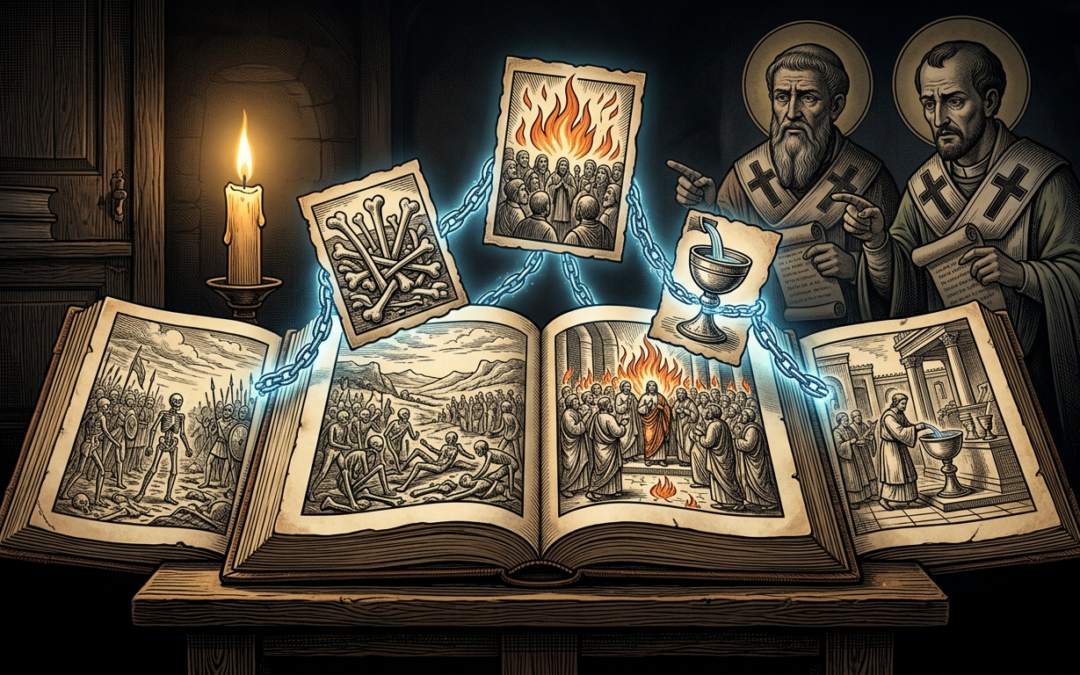
“God told Ezekiel to prophesy to dry bones, so now you speak life to your business, your marriage, your kids!” Ezekiel 37 flashes on the screen, fueling urgent calls to command outcomes through bold declarations. It stirs hope in the hearers, no doubt. But rewind to Judah’s desperate world in 593 BC. Ezekiel, himself exiled in Babylon, addresses a defeated nation doubting any return from divine judgment for their idolatry (Ezek. 36:31-32). The valley of bones symbolizes national death after Jerusalem’s catastrophic fall, not individual pep talks for modern challenges. God alone breathes life into the scene: “I will put breath in you” (v. 5, NET), promising restoration to the covenant land as a witness to the nations (vv. 21-28).
The prophet obeyed a direct vision from the Lord (v. 1), not some freelance exercise of faith. For Judah, this foretold both physical return from exile and spiritual renewal under a new covenant with heart-surgery from God (Ezek. 36:26), all as His sovereign act, culminating ultimately in Christ who calls the dead to life (John 5:25-29).
Yanking Ezekiel for “speak life” formulas skips entirely over God’s righteous judgment on idolatry and His gracious initiative in restoration. What God meant for His people: Trust Yahweh’s faithfulness to restore Israel, pointing forward to the Messiah’s greater valley-conquest over sin and death.
Acts 2: Pentecost as Revival Blueprint?
“Acts 2 shows us, pray, tarry, tongues, fire! Do this to break revival’s dam in our region.” It sounds powerful and practical. But step into 30 AD Jerusalem for the full picture. Post-resurrection, 120 disciples awaited the promised Spirit (Acts 1:4-5), fulfilling Joel 2 for last-days witness to the ends of the earth (Acts 2:17-21). The event arrives “suddenly” from heaven (v. 2, NET), with no human technique dictating the timing. Peter’s sermon indicts Israel’s sin, exalts the crucified Jesus as Lord and Christ (vv. 22-36), yielding 3,000 baptisms into a repentant, sharing community (vv. 41-47).
The broader context matters deeply: Israel’s feast of harvest (Lev. 23:15-21), reversing Babel’s division (Gen. 11) for a global gospel advance. This was not a repeatable strategy for regional breakthroughs, but the birth of the Church, now God’s chosen people to bear His image to the world.
Treating Acts 2 as a checklist ignores Pentecost’s once-for-all inauguration of the kingdom age. God’s point to His people: The Spirit empowers witnesses of the crucified Messiah amid opposition, building one holy nation called out from the world (1 Pet. 2:9).
John 7:38: Living Waters as Prosperity Rivers?
“Out of your belly flow rivers!” , tying it to Eden’s gold-laden stream (Gen. 2:11). Activate your spirit-man for healing, joy, “financial prosperity,” we’re urged. It invigorates the listeners. But John 7 unfolds at the Feast of Tabernacles (v. 2), where Jesus cries out amid the water-pouring rite symbolizing future blessing (Zech. 14:8). To the thirsty believer, He says, “Come to me” (v. 37). Those rivers? The Spirit poured out on parched Israel post-exile, as living water quenching ultimate thirst (Isa. 44:3; Jer. 2:13), fulfilled at the crucifixion when blood and water flow from His side (John 19:34).
John’s Gospel frames Jesus as the new temple (John 2:21), the new exodus rock (John 4:14). No Eden gold here; eternal life fuels mission (John 20:21).
Morphing “rivers” into wealth or positive outcomes skips Jesus’ immediate audience: skeptical Jews needing the true Messiah amid temple ritual. God’s design for His people: Spirit from the smitten Rock (1 Cor. 10:4) quenches soul-thirst, equips disciples for witness.
Patristic Exegesis: Context as Safeguard Against Distortion
The church fathers modeled contextual exegesis with unwavering commitment, ensuring Scripture’s unity across its grand narrative of creation, fall, redemption, and consummation. Augustine, in his City of God, unpacked Ezekiel 37 not as a technique for personal breakthroughs, but as eschatological hope for bodily resurrection, a promise shadowed in Israel’s restoration yet fully realized in Christ’s empty tomb and our future glorification. He warned against those who “twist” texts to fit private interpretations, urging readers to trace prophecies through salvation history (City of God, Book XX).
Chrysostom’s Homilies on Acts delve deeply into Pentecost’s historical moment: Peter’s sermon as bold apologetics amid ridicule, the Spirit’s outpouring fulfilling Old Testament feasts while launching the church against temple-centric Judaism. He stressed the sermon’s Christocentric thrust—crucifixion, resurrection, lordship—not a formulaic repeat, but a divine pattern for preaching repentance in every generation. For Chrysostom, ignoring this context reduced the Spirit to a tool for spectacle rather than the sanctifier of God’s new covenant people.
Origen, the Alexandrian scholar, laid foundational principles in On First Principles: Begin with the literal-historical sense—Ezekiel’s vision amid Babylonian exile, Pentecost at Passover’s close—before ascending to spiritual typology. He critiqued Gnostics who detached verses for esoteric secrets, insisting the Spirit illuminates Scripture’s cohesive storyline, with Christ as its scarlet thread. John 7’s rivers, for Origen, evoked baptismal grace filling the church as new Israel, not individual material gain (Commentary on John).
Irenaeus championed recapitulation: All Scripture converges in Christ’s person and work. Ezekiel’s dry bones recast Adam’s fall, revived by the second Adam; Acts 2 fulfills the prophets for Jew and Gentile alike; John’s waters reverse Eden’s curse through the Word-made-flesh (Against Heresies). These fathers echoed Paul’s charge in 2 Timothy 2:15: “rightly handling the word of truth,” handling it as a unified tapestry where exile foreshadows cross, Pentecost ignites mission, and living water satisfies eternal thirst.
When preachers pluck verses free from this arc, of covenant judgment and mercy, Israel’s story fulfilled in Jesus, we forfeit God’s intended medicine for His people: humility before sovereignty, mission amid weakness, hope beyond this age.
Demand Faithful Interpretation
Paul urged earnestly: “Test everything; hold fast what is good” (1 Thess. 5:21, NET). The Bereans did this in Acts, and we must do the same today.
Ask your teacher these vital questions:
- Do they frame texts in redemptive history, or pluck them for punchlines?
- Do they honor the author’s audience and intent, or overlay modern wants?
- Do they trace promises to Christ as fulfillment, or freeze them in isolation?
- Do they echo fathers’ contextual depth, or skim the surface for effect?
Nicene exegetes preserved storyline unity: Old foreshadows New. Distortion fractures it irreparably.
Jesus rebuked the Sadducees: “You err, not knowing the Scriptures nor the power of God” (Matt. 22:29, NET). Fruits of decontextualized texts? Self-focused faith, fleeting excitement. Or humble obedience, Christ-centered hope enduring forever?
Church, probe graciously, steadfastly. Rally to expositors stewarding context with care. The true gospel thrives in the story’s full arc, grace weaving exile to glory, Christ our exile’s end.
by Joel V Webb | Mar 31, 2026 | Orthodoxy Matters, Theology & Practice
What sort of benefits does the cross of Christ provide us?
It certainly is an appropriate question to ask as we are just days away from Good Friday and Easter. Jesus died on the cross, something happened, and now because of it things are different for us. Throughout Church history there certainly have been a variety of understandings of that what, and for the most part they have been fairly consistent with each other. But something happened in the 20th century that provided a very different spin on what the work of Christ means for us in this life, and the next.
Any Christian who affirms the Nicene Creeds affirms that the work of Christ is for the forgiveness of our sins. Because Christ took our sins, we receive the blessing and benefit of having them no longer on us. Now we have to ask the question: what does that look like and mean? Classically, that question has been answered by the Church as proclaiming that we now receive new life, free from the curse through and because of Christ that enables us to become like Him in a way that was not possible before His once for all sacrifice.
The early Christian witness is remarkably unified: the cross is the place where God’s love, justice, and mercy converge. Paul writes, “God made him who had no sin to be sin for us, so that in him we might become the righteousness of God” (2 Cor 5:21). In Colossians he adds that God has “forgiven us all our trespasses, having canceled the record of debt that stood against us with its legal demands. This he set aside, nailing it to the cross” (Col 2:13–14, ESV). The cross, then, is the hinge of both forgiveness and new creation. We are no longer under the curse of the law, yet we are not left to drift into easy moral license; instead, we are placed into a new story—death to sin, life in Christ, formation into holiness.
The Church Fathers amplify this picture. St. Irenaeus speaks of Christ as the “last Adam” who recapitulates human life, summing up and redeeming every stage of our fallen history so that “what Adam rendered a slave he might make lord” (cf. Adv. Haer. 5.1.1). The cross is the definitive act through which Christ undoes the pride of the first Adam and restores human nature to communion with God. St. Augustine, writing in the 4th–5th century, similarly stresses that the cross is the place where God’s love and righteousness coincide: the innocent Son bears the punishment we deserve, and in that very act love is shown to be greater than our sin. As he puts it in one of his sermons, the cross bends the head to kiss us, extends the arms to embrace us, and opens the heart to receive us.
St. John Chrysostom, preaching in the 4th century, declares that the cross is not only the salvation of the Church but also “the boast of those who hope in it” (cf. his homilies on the Cross). For him, the cross frees us from enmity with God, breaks the authority of the devil, and delivers us from death and destruction. Through the cross, he says, we learn piety, discover the true nature of God, and are taught to die for others as Christ first died for us. In this ancient vision, the cross is never a mere event in the past; it is the living center of a transformed life and a reconciled world.
But in the 20th century, a new story attached itself to the cross. The so‑called “prosperity gospel” teaches that Christ’s death purchased not only spiritual salvation, but also material abundance, physical health, and social success. In this way of thinking, the atonement covers not just sin and guilt, but also poverty, sickness, and misfortune. Advocates of this view claim that if you have faith, give generously, and “confess” God’s promises, you will be rewarded with wealth, health, and a life free from suffering. The cross thus becomes less about reconciliation and more about a transaction in which God is obligated to grant earthly prosperity to those who “activate” their faith.
This message is a radical departure from Scripture. The apostles promise suffering, not immunity from it (Rom 8:17; 1 Pet 4:12–13). Jesus says, “If anyone would come after me, let him deny himself and take up his cross and follow me” (Matt 16:24), not “follow me and I will guarantee you comfort.” Paul writes that “if we are children, then we are heirs—heirs of God and co‑heirs with Christ, if indeed we share in his sufferings in order that we may also share in his glory” (Rom 8:17). The New Testament repeatedly pits the way of the cross against the way of the world, warning that those who love money stand in danger of idolatry (1 Tim 6:10; cf. Matt 6:19–21).
The prosperity gospel also distorts the biblical doctrine of the Abrahamic covenant. It claims that believers are Abraham’s heirs and therefore entitled to material prosperity as part of God’s covenant blessing. But when Paul speaks of “the blessings of Abraham” falling on the Gentiles in Christ, he immediately explains that this blessing is the promise of the Spirit through faith (Gal 3:14). The covenant is fulfilled spiritually in reconciliation, adoption, and the indwelling of the Spirit, not primarily in bank accounts or real estate.
The Bible sounds a clear warning against the idolatry of wealth and the illusion that faith is a lever for acquiring it. Jesus warns that “no one can serve two masters… You cannot serve God and money” (Matt 6:24). The apostle John exhorts, “Little children, keep yourselves from idols” (1 John 5:21) a phrase that early Christian moralists read as a summons to flee the idolatry of greed. The pastoral letters likewise warn that the love of money is a root of many evils and can lead believers to wander from the faith (1 Tim 6:9–10). The Fathers echo these warnings. St. Augustine repeatedly warns against the “lust of the eyes” and the danger of treating wealth as a sign of God’s favor, pointing instead to the cross as the true mark of Christian identity. Likewise, St. John Chrysostom rails against the obsession with riches among his flock, urging them to see Christ crucified rather than Caesar adorned. For the Fathers, the cross is the final answer to the world’s false promises: it is the place where God exposes the emptiness of power, status, and wealth and offers something far greater: union with himself.
The prosperity gospel is not simply a different emphasis on the Christian life; it is a different gospel altogether. By teaching that the atonement guarantees material prosperity, it turns the relationship between God and human beings into a quid pro quo transaction: you give, you speak, you believe, and God must pay. This view undermines the very nature of grace, which is the unmerited favor of God. If prosperity is automatically attached to faith, then grace becomes a tool, and God becomes a kind of cosmic vending machine, programmed to dispense rewards when the right buttons are pressed. Moreover, the prosperity gospel misrepresents the nature of faith itself. The New Testament portrays faith as trust in the person and promises of Christ, not as a “spiritual force” that manipulates God. Yet many prosperity teachers speak of faith as a self‑generated power that can be harnessed to make God give. This is far removed from the Pauline picture of faith as the instrument by which we receive forgiveness, righteousness, and the Spirit (Gal 3:14; Eph 2:8–9). It is also alien to the apostolic view of prayer, which is directed to “Your will be done,” not to getting God to serve our desires (Matt 6:10; James 4:3).
The true gospel offers something more profound and lasting than the prosperity gospel’s glittering promises. The cross secures for us not an escape from suffering, but a share in the life of the risen Christ. St. Paul can write, “I have been crucified with Christ. It is no longer I who live, but Christ who lives in me. And the life I now live in the flesh I live by faith in the Son of God, who loved me and gave himself for me” (Gal 2:20). This is the heart of the gospel‑centered alternative: the Christian life is not about maximizing personal gain, but about being conformed to the image of Christ, even through the cross.
The cross brings us:
- Reconciliation with God: “We were reconciled to God by the death of his Son” (Rom 5:10) and “the Cross is the reconciliation of enemies to God” (Chrysostom).
- Deliverance from sin and death: the cross annuls the power of sin, breaks the hold of death, and unmasks the petty calculations of the devil.
- Sanctification and holiness: the Spirit is poured out on those who are joined to Christ, enabling us to walk in newness of life (Rom 6:4; Tit 3:5–7).
- Eternal inheritance: the cross is the pledge of resurrection and the promise of a new heavens and a new earth, where sorrow and pain will be no more (Rev 21:4).
For the Fathers, the cross is the icon of both God’s love and our vocation: it is the place where God stoops low enough to save, and where we are called to stoop low enough to serve. It is the standard raised against the world’s values, the pattern of true discipleship, and the guarantee of glory to come.
As we approach Good Friday and Easter, the prosperity gospel should not be our tutor. The cross did not come to make us rich by the world’s standards, but to make us heirs of God and joint‑heirs with Christ (Rom 8:17). It did not come to free us from suffering, but to give our suffering meaning by joining it to the body of the Crucified One. The benefits of the cross are spiritual, eternal, and relational: forgiveness, adoption, the Spirit, communion with God, and the hope of resurrection.
The true prosperity of the believer is to be like Jesus, to love as he loved, to serve as he served, to forgive as he forgave, and to hope as he hoped, even when the world calls it foolishness. As we walk toward the cross and the empty tomb, may we receive the cross’s real gifts, reject the false promises of the prosperity gospel, and live in the light of the one who, though rich, became poor for our sake, that we through his poverty might become truly rich in every way that matters (2 Cor 8:9).
by Joel V Webb | Mar 27, 2026 | Orthodoxy Matters, Sacraments, Theology & Practice
Easter is just around the corner, and for the first time I’ll have the honor of administering the sacrament of baptism on Easter Sunday, one of the traditional days the Church has welcomed those into the Church. The discussion and debates in the church over baptism are a fascinating one. For every Christian, baptism is the universally recognized entrance into life in the people of God, but especially since the Reformation, certain elements of the Church, while acknowledging its importance, have lessened its impact, and flattened the reality and beauty of baptism to a simple, “tell people that you love Jesus.” But what Scripture, and the history and tradition of the Church demonstrates, it is so much more than that.
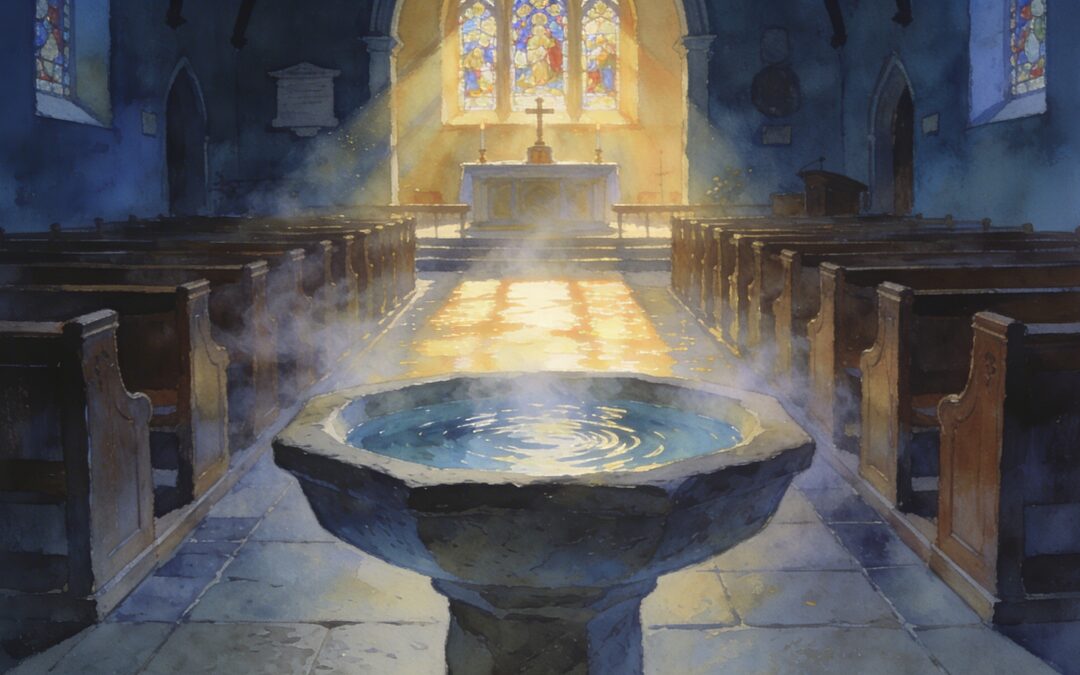
Before addressing anything more specifically, I want to quickly touch the base that Baptism is a Sacrament. In the Free Methodist Church, the denomination I am in, we recognize the two sacraments of Christ, the Eucharist and Baptism. They are the means of grace that Christ has given His Church. Eucharist (Communion or the Lord’s Supper), as spoken of by John Wesley is the ongoing and continual means by which God provides grace to the Christian in their life (see his sermon The Duty of Constant Communion). And, it is Baptism, as spoken of above, that serves as the rite of entrance into the people of God. In my church, the baptismal font is located at the back of the sanctuary, in direct line with the chancel of the altar, representing the truth that you must first pass through baptism to come into the life of the Church.
The word sacrament in this discussion is important because it focuses on the work of God that takes place as we engage in these means that Christ has given us. Yes, we are commanded to keep them in obedience to His word (Christ’s command to baptize in the Great Commission, and His command to keep the table in continual remembrance of Him). It is the witness of Scripture and the early undivided Church that these acts are much more than us doing, they are the avenue and channel of God to work in and through His people. Physicality matters because we are in a physical world, and God stepped in through the incarnation. So thus, God does not stop working through the physical, rather He has given to His people physical signs through which His graces flow. This is why I distinctively use the language of sacrament, rather than something else such as ordinance.
Now back to the main discussion.
Of all the verses, one of the most controversial is 1 Peter 3:21, “this water symbolizes baptism that now saves you also—not the removal of dirt from the body but the pledge of a clear conscience toward God. It saves you by the resurrection of Jesus Christ.” In this verse, Peter does not mince words—he articulates something that should cause modern evangelicals, especially those of a “believer’s baptism only” persuasion, to slow down and read again. “Baptism now saves you.” It’s hard to argue that Peter could have spoken more plainly. But immediately, he anticipates our misunderstanding: it is not “the removal of dirt from the body.” It’s not a magical washing, or a mere ritual dealing with externals. Peter wants us to understand that baptism’s efficacy is grounded not in ritual precision but in the resurrection of Jesus Christ. In other words, baptism saves, not because of water alone, but because in baptism we are united to the saving work of Christ—the same Christ who plunged into death and rose up into new life.
The apostle’s words echo other deep currents running through the New Testament. Paul declares in Romans 6 that “all of us who have been baptized into Christ Jesus were baptized into his death.” Baptism links the believer personally and mysteriously with the passion and resurrection of the Lord. It is not simply a symbol we perform to show our commitment; it is a real participation in Christ’s own redemptive act. Through it, we are joined to his dying and rising—our old self is buried, and a new self, reborn by grace, comes into being. In this way, baptism is not an optional external mark, but an entrance into life in Christ, a sacramental sharing in his work of salvation.
Here is where much of our modern understanding falters. We have come to think of baptism primarily as an expressive act—something we do to communicate something about ourselves: our faith, our repentance, our decision. But biblically and historically, baptism is primarily receptive. It is something God does in and for us. Yes, we approach in faith; yes, it is a sign of commitment to follow Christ—but at its core, baptism is an encounter with the divine initiative, not a declaration of human resolve.
This shift in emphasis is not a matter of semantics. It shapes our entire theology of grace and discipleship. If baptism is my declaration, then my faith stands primarily on the strength of my sincerity and memory of having “made a decision.” But if baptism is Christ’s act toward me, then my faith stands on divine promise and covenant faithfulness. The former centers on my experience, the latter on God’s grace. And this distinction lies close to the heart of the Reformation concern: that our salvation rests not on our performance but on the steadfast mercy of God.
John Wesley, of course, understood this sacramental tension well. In his sermon The New Birth, he draws together faith and baptism in a deeply practical way. He insists that baptism is both a sign and a means of grace—a vehicle through which God works regeneration. But he also recognizes that the waters alone do not automatically confer salvation; they must be received by faith. Wesley’s nuanced view allowed for both divine action and human response, and it serves the Church today as a helpful corrective to both extremes: the notion that baptism functions mechanically without faith, and the opposing view that it is merely a symbol without power.
Throughout Scripture, water is not a neutral or comforting image—it is chaotic, cleansing, and creative all at once. From the primordial deep in Genesis, to the floodwaters in Noah’s day, to the Red Sea and the Jordan River, God repeatedly uses water as the boundary between old life and new creation. It both destroys and delivers. Peter, drawing on the Noah narrative in the preceding verses of 1 Peter 3, connects baptism directly to this cosmic pattern: just as Noah passed through the waters of judgment into a new world, so too we are borne through the waters of baptism into the new creation of Christ.
The early Church Fathers grasped this profoundly. Tertullian, writing in the second century, called baptism the “seal of faith,” by which the Spirit marks and protects the believer. Cyril of Jerusalem described baptism as a “participation in the death and resurrection of Christ,” an event so transformative that he instructed catechumens to remove their garments before baptism as a sign of laying aside the old self, and then clothe themselves anew as a symbol of their resurrection life. These ancient witnesses saw baptism not as an addendum to salvation but as its visible threshold—the place where the promises of God and the faith of the believer meet in a sacrament of grace.
When I think about standing by the baptismal font this Easter, I can’t help but reflect on how baptism folds each of us into the larger story of redemption. It is not merely our story, it is Christ’s story, into which we are grafted. That’s why the baptismal liturgy traditionally includes the Apostles’ Creed, confessing the faith “once delivered to the saints.” In being baptized, a person doesn’t just say, “I believe in Jesus.” They are, more profoundly, saying, “I believe in the God of Abraham, Isaac, and Jacob; I believe in the Father, Son, and Holy Spirit, and I take my place among His people.”
The Church, in her wisdom, locates baptism at this communal crossroads. It’s never a private ceremony, because baptism ushers us into the Body of Christ. We are baptized into one Body, as Paul says in 1 Corinthians 12:13. The Church becomes the womb from which new Christians are born and the family into which they are adopted. That’s why the placement of the font at the entrance, aligned with the altar is so fitting. The believer enters through those waters to approach the table of grace, joining in the full life of the Church.
This brings us, inevitably, to the question of who should be baptized. For many evangelicals, the assumption is that baptism belongs strictly to those old enough to make a personal declaration of faith. And yet, the witness of the early Church and of Scripture itself offers a broader perspective. When Peter finishes preaching on Pentecost, his message concludes with a promise: “The promise is for you and for your children and for all who are far off” (Acts 2:39). Households are baptized, not just individuals. The covenantal logic that once applied to circumcision now unfolds in baptism. It is the sign of belonging to the covenant community—a sign that anticipates faith as much as it springs from it.
This doesn’t mean that faith is unimportant; rather, it means baptism operates within the economy of grace. For infants, it is a sign planted in hope, to be nurtured and fulfilled by future faith. For adults, it is the sacramental seal of faith received. In both cases, what matters is not the sequence of events but the grace of God uniting them.
John Wesley himself baptized infants with full conviction, but always with pastoral care, urging parents and the Church to raise those baptized children in the nurture of the faith. In that sense, baptism begins a process, not ends one. It marks the beginning of the journey of sanctifying grace, that ongoing “going on to perfection” that Wesley so cherished.
Peter’s grounding phrase, “by the resurrection of Jesus Christ,” cannot be overemphasized. Baptism saves because Christ’s resurrection gives it power. Every baptism is, in fact, a mini-Easter. The movement down into the waters mirrors the death and burial of Jesus; the rising up out of them signifies participation in his resurrection. This is why the early Church baptized converts at sunrise, and often on Easter—those being baptized would literally face the East, toward the rising sun, confessing that they were turning away from the darkness of sin and turning toward the Light of Christ.
Theologically, this resurrection motif tells us that baptism is not a static act but a dynamic participation in life eternal. We are not simply cleansed of sin, we are set free for righteousness. The grace received in baptism calls and empowers us to live differently. As Paul reminds us, “just as Christ was raised from the dead through the glory of the Father, we too may live a new life” (Romans 6:4). Baptism, then, is both forgiveness and new vocation. It is an identity-forming event.
Every time a Christian witnesses a baptism or dips their fingers into the font and makes the sign of the cross, it is a renewal of that truth: “I have died with Christ; I have been raised with Him.” Baptism, while once-for-all, continues to shape the believer’s spiritual imagination. Martin Luther, when plagued by temptation or despair, would often cry out, “I am baptized!”—not “I was baptized,” but “I am.” The reality of that moment endured for him as a present-tense grace.
So when the Free Methodist Church, or any church, remembers the baptized, it is a way of re-rooting our faith not in our wavering emotions but in God’s covenantal promise. Whether we were baptized as infants or as adults, in a river or a font, the same divine life is at work. God’s act remains true even when ours falter. Baptism allows us to locate our lives within that steadiness, to live out of an identity that has already been defined by God’s promise.
What, then, does it mean to “live baptismally”? It means living daily out of the truth that we have been united to Christ. It means resisting sin not from guilt or fear but from identity: “that is not who I am anymore.” It means recognizing the Church not as a voluntary association of like-minded individuals but as the family into which we were birthed through water and Spirit. It means approaching the table each week as those who have entered through the font—as resurrection people who have been called out of darkness into marvelous light.
To live baptismally is also to live missionally. The Great Commission does not end with “make disciples”; it continues, “baptizing them… and teaching them.” Baptism and discipleship are inseparable. Every act of evangelism, every act of mercy, every proclamation of the gospel flows from our baptismal identity—those who have been joined to Christ and sent to embody His Kingdom in the world.
As the early Church would declare at the baptismal font: “You are buried with Christ; you are raised with Christ; you are sealed by the Spirit; you belong to God.” This is not mere poetic flourish—it is the substance of Christian life.
So when Peter writes, “baptism now saves you,” he is not contradicting the gospel of grace, he is articulating it sacramentally. Baptism does not replace faith; it embodies it. It does not operate apart from the resurrection; it manifests it. It does not substitute obedience; it initiates it. The water does not save by itself, but by the divine power that has chosen to work through it.
This Easter, as you prepare to stand beside the font and welcome new believers into the family of faith, you participate in an unbroken story stretching back to the Jordan River, to Pentecost, to the empty tomb. The water that splashes from the font bears witness to the same grace that parted seas and burst forth from graves. It is the water through which the Spirit hovers once again, bringing new creation from chaos. And every drop proclaims the gospel in miniature: Christ has died. Christ is risen. Christ will come again.
by Joel V Webb | Mar 10, 2026 | Orthodoxy Matters, Theology & Practice
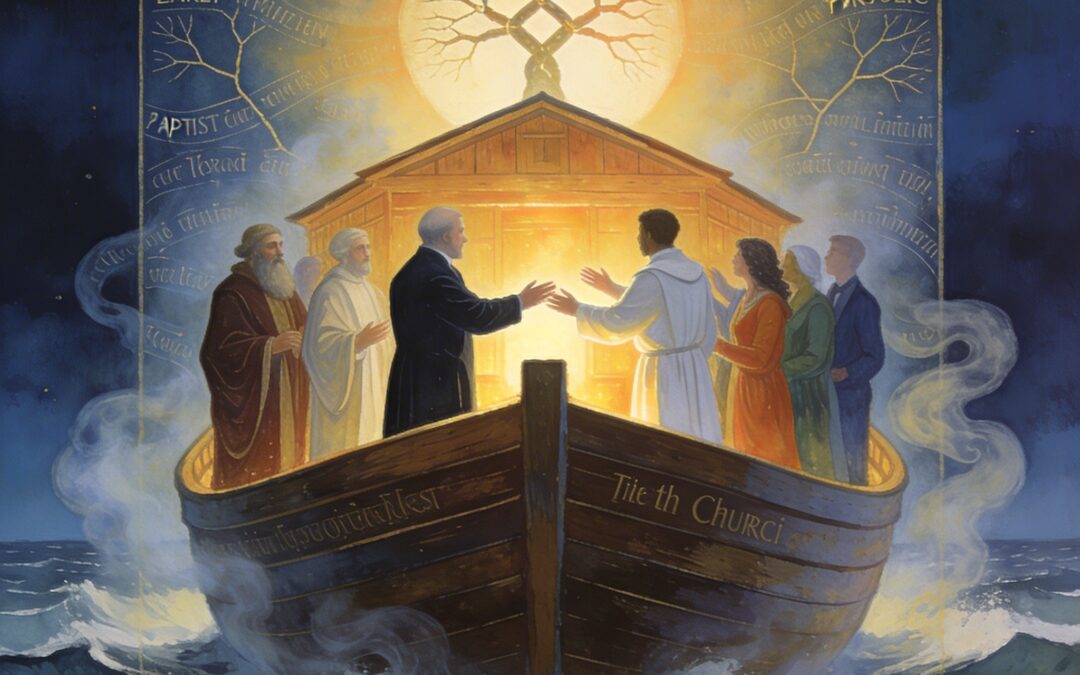
One of the prayers I think every Christian prays for that echoes the words of Christ from St. John’s Gospel, chapter 17: “I pray that they will all be one, just as you and I are one—as you are in me, Father, and I am in you. And may they be in us so that the world will believe you sent me.” (v.21). Where things get sticky is what we all mean by “one.” If you are a Roman Catholic, Orthodox, or Anglican, your ecclesiology (theology of the Church) differs from that of your run-of-the-mill Evangelical or Baptist. For the traditional Christian, the Church is often visualized as an ark (like Noah’s ark) that is sailing through history, with people getting on and off as time passed. Whereas, in a low-church understanding, “the Church” is not a single entity, but a blueprint found in the Bible that is made to be reproduced. Because of these different understandings, the answer to the prayer to “be one” looks different.
In the New Testament, the Church is described as a body—many members, but one life. The image St. Paul gives in 1 Corinthians 12 goes far beyond metaphor: it is the reality of what the Holy Spirit does with the people of God. There aren’t multiple bodies of Christ, only one. When we are baptized, we are joined not merely to Christ but to one another, across all ages, cultures, and nations. Congregations are expressions of that one Body, not separate bodies with their own identity. To be a Christian, then, is never an individual or local affair—it is to belong to something both visible and historical.
But the Church through time has not always lived that reality well. It has divided again and again—sometimes for tragic reasons, sometimes for necessary ones. In truth, some divisions have been like emergency surgeries: painful, but at times necessary to save life. Others, however, have been the result of human ego, political pressure, or differing cultural forms. Once the crisis passes, though, the call remains the same—to heal what has been torn.
Take, for example, our own Methodist heritage. John Wesley never intended to start a new church. A lifelong Anglican priest, he described the Methodist movement as an effort “to reform the nation, particularly the Church, and to spread scriptural holiness throughout the land.” Methodism in its origin was not a schism—it was a renewal movement within the Church of England. Lay preachers, class meetings, and field preaching were ways to reawaken the life of grace in ordinary believers. It was only after the American Revolution, when Anglican clergy were scarce and Wesley reluctantly sent Thomas Coke to ordain new ministers for the colonies, that Methodism took on a distinct ecclesial form—the Methodist Episcopal Church. Even then, Wesley saw Methodism as a continuation of the one Church, not a replacement for it. The split was pastoral and practical, not theological.
A century later, the Free Methodist Church emerged from the Methodist Episcopal Church in the 1860s. The reasons were morally serious and historically necessary: a stand against slavery sympathizers, a desire for “free seats” when pew rentals had become a social barrier for the poor, and a concern to preserve holiness preaching when the larger body was becoming formal and complacent. B. T. Roberts and others didn’t separate to rebel, but to stay faithful to the Spirit’s movement within Methodism itself. The goal was not to leave the people called Methodists—it was to keep their original fire alive.
This is where we must recover a patristic vision of the Church: not as disconnected islands of believers floating independently through time, but as one unified body moving inexorably through history under Christ’s headship. The early fathers—like Ignatius, Irenaeus, and Cyprian—taught that the Church is a single, organic reality, handed down from the apostles, growing and correcting itself across generations. Splits may scar the body, but they do not create new bodies; the one Church persists, calling her wounded members back into communion. For low-church Protestants, this doesn’t mean hierarchy or ritualism—it means seeing our local assembly as a vital part of that ancient, living organism, linked by baptism, creed, and Scripture to every faithful Christian from Pentecost to today.
But the question we must ask today, with gratitude for those who came before us, is whether the reasons that once made divisions necessary still remain. The Church of England that Wesley knew is not the same as the Anglicanism that exists today. Interestingly, the Anglican Church in North America (ACNA) has been deeply shaped by the kind of Spirit-led, Scripture-centered renewal that Methodism championed in the eighteenth century. Anyone looking at ACNA congregations can see strong echoes of early Methodism’s heartbeat—biblical preaching, small-group discipleship, evangelistic zeal, and a hunger for holiness. In a sense, Wesley’s children have helped their Anglican mother recover her vitality. Perhaps that mutual influence is a sign that old wounds might be ready for healing.
Likewise, within Methodism itself, we find new alignments forming. The rise of the Global Methodist Church (GMC) represents a desire to reclaim both scriptural faithfulness and Wesleyan integrity. The brokenness that once split Methodism in the nineteenth century over moral and doctrinal drift may be resolving in our own time through renewed clarity, holiness, and mission. If the theological and moral crises that once necessitated fracture have given way to faithful reform, then perhaps it is time to ask not how to multiply more branches, but how those branches might graft once more into one living tree.
Christian unity doesn’t mean uniformity. It doesn’t mean abandoning our distinctives. It means recognizing that the Body of Christ is one—not only across geography, but across history. It means realizing that our hope lies not in our denominational franchises but in our shared participation in the life of Christ. If the Free Methodist, the Global Methodist, and the Anglican find themselves proclaiming the same gospel and pursuing the same holiness, perhaps it is time to start praying and working toward a visible unity that testifies to the world: Jesus truly is Lord.
Our divisions may have had their reasons, but when those reasons die, so should our excuses for staying apart. The Church is one Body, sailing through time like an ark on God’s mission of redemption. It’s time for those who have stepped off along the way to start rowing toward one another again—until the ship of the Church, battered but unsinkable, carries us all home together.
by Joel V Webb | Dec 10, 2025 | Orthodoxy Matters, Theology & Practice, Uncategorized
Modern Christians love to sing about “tradition” when Tevye belts it out in Fiddler on the Roof, but many of us grow uneasy when the same word comes up in church. We instinctively feel the pull of Tevye’s point: tradition gives shape, identity, and continuity to a people; take it away, and everything wobbles. Yet when it comes to the Christian faith, we often imagine we can live on “Bible alone” in a way that somehow bypasses tradition altogether. The irony is that, just like the villagers of Anatevka, we already live by powerful inherited patterns—ways of worshipping, reading Scripture, praying, and organizing church life—that were handed down to us, even if no one ever called them “tradition.”
One of the cornerstones of the Protestant Reformation was the reclamation of Scripture as the central infallible rule of faith. Meaning that no matter what, Scripture is the ultimate authority in all things of faith and practice. As someone in a tradition downstream from Anglicanism, we see this in Article 6 of the 39 Articles (which are the confessional and theological foundation of Anglicanism, and were as well for early Methodism), “Holy Scripture containeth all things necessary to salvation: so that whatsoever is not read therein, nor may be proved thereby, is not to be required of any man, that it should be believed as an article of the Faith, or be thought requisite or necessary to salvation.”
And I agree with this. Scripture is essential and of all importance because it is to us a direct revelation of God. Yet, from this also stems a primary frustration. For some Protestants there is always that ‘dirty word’ hiding in the corner…tradition. Like many, I grew up believing that tradition is bad, if not evil, and that tradition is what keeps people away from God. Whenever tradition came up, it always had something to do with those Catholics, Orthodox, Lutherans, Anglicans, or other Christians who dressed funny, and certainly didn’t worship “in the Spirit”, because they were all bound up by their traditions.
Well, for anyone who has known me the last several years, you know I now have a very different answer. Tradition is not bad. Ironically, WE ALL HAVE TRADITION! The question we often fail to ask is, “do I acknowledge my own traditions”. Because, if we don’t, we are actually more controlled by those traditions than we realize, because they are hidden. And this is the fatal deceit we Protestants often fall prey to. We think tradition is bad, and that tradition is not an authority.
But again, we can’t get away from the truth that tradition is always going to be there. And here’s the other thing we must realize. Interpretation of Scripture outside of tradition is just as likely to lead us into heretical teachings that it is into orthodox ones. Just ask Joseph Smith, Charles Taze Russell, Ellen G. White, and the list goes on. As Protestants we must have tradition, otherwise we will continue into an endlessly featuring web of church splits and every more specified denominations over small matters of interpretation.
Now, this is not to say there are no reasons for separation. There certainly are. But when we fail to understand that tradition is authoritative, sometimes we look to as a rule of interpretation, it can help us in maintaining true Christian unity.
Over the last few years, I’ve come to see that tradition, properly understood, is not a rival to Scripture but a servant of it. The great creeds and confessions of the Church were not written to replace the Bible, they were written to safeguard its message, to offer faithful summaries of what the Church across time and place has understood Scripture to teach. When we recite the Apostles’ Creed or the Nicene Creed, we are not adding to the Bible; we are joining our voices to a two‑thousand‑year chorus of believers who have wrestled with the same questions, doubts, and heresies we face today.
At its simplest, tradition functions like a set of guardrails on a mountain road. It does not confine us; it keeps us from tumbling into error while still allowing for movement, discovery, and growth. It gives us perspective—reminding us that the Church did not begin with our generation, nor with the Reformers, nor even with the apostles, but with the eternal purpose of God carried out through time. When we cut ourselves off from that inheritance, we risk spiritual amnesia.
The irony, of course, is that the Reformers themselves were deeply traditional. Luther and Calvin constantly appealed to the early Fathers—Augustine, Chrysostom, Athanasius—not because they thought those writers were infallible, but because they knew that faithful interpretation does not happen in a vacuum. “Sola Scriptura” never meant “Solo Scriptura.” The former places Scripture at the center of authority; the latter isolates it from the Church that bears witness to it.
Many modern Christians assume they have escaped “tradition” simply because they don’t follow a written liturgy or historic creed, but that does not mean they are tradition‑free; it just means their traditions are invisible to them. The way a church structures its services, chooses its music, teaches about salvation, organizes leadership, and even dresses on Sunday are all patterns that have been received, repeated, and defended over time, that is, they are traditions. When these homegrown traditions go unacknowledged, they are rarely tested against Scripture or the wider wisdom of the Church, and so they can quietly harden into non‑negotiable identity markers. The more Protestants distance themselves from historic Christian tradition; creeds, catechisms, classical liturgy, and a common sacramental life, the more each community is forced to invent itself from scratch, which only accelerates fragmentation, doctrinal confusion, and church splits. If this trajectory continues, the body of Christ will become increasingly divided into isolated tribes, each mistaking its own unexamined habits for pure, tradition‑less Christianity, rather than humbly receiving and discerning the tested traditions that once held believers together.
Healthy Christian tradition is not just anything that has been done for a long time; it is the Church’s tested, communal wisdom about how to believe and live the gospel under Scripture. Good tradition gathers up biblical teaching in stable forms—creeds, catechisms, liturgies, patterns of discipleship—that help ordinary believers confess the faith clearly and avoid well‑worn errors. At the same time, because Scripture remains the final norm, even long‑standing practices and assumptions must stay open to correction and reform. Naming this explicitly helps people see that the choice is not between “Bible or tradition,” but between unexamined, private traditions and accountable, Scripture‑shaped ones.
If tradition is to be received and discerned wisely, it has to be held by more than isolated individuals; it belongs to the Church as a concrete, visible community across time and space. Councils, confessions, agreed forms of worship, and recognized teachers are ways the Church has historically said, “This is what we together hear in Scripture,” rather than leaving every question to personal improvisation. When the gathered Church, under the Word and in dependence on the Spirit, tests and hands on tradition, it offers a shared framework that can restrain fragmentation and correct local excesses. Recovering this sense of the Church as a real, tradition‑bearing body helps modern Protestants move from “me and my Bible” toward “we, the Church, listening together to the Scriptures,” which is where genuine unity and faithful reform become possible.
Ultimately, the goal is not to exalt tradition for its own sake, but to love and know Christ more faithfully. Scripture is God’s Word written; tradition is the Church’s memory of how that Word has been lived and confessed. We need both if we are to remain rooted and flourishing in a fragmented world. Perhaps the way forward for Protestantism is not to abandon its Reformation principles, but to deepen them—to see in the Reformers not just critics of the past, but faithful heirs of a much older and larger communion of saints.