Whenever we open up the book of Revelation we immediately put on the glasses of “THE END OF THE WORLD!”, and in doing so we interpret everything that St. John writes is speaking to some future event(s) that will happen in a certain way. And while yes, there certainly are parts of Revelation yet to happen (in my view we are in-between chp. 20 & 21) that have yet to take place at the final consummation and the restoration of Eden throughout the whole world as we who are redeemed are raised to life in new resurrected bodies..
But what if in only at looking at Revelation this way is actually pigeon-holing the vision that St. John received. That by assigning only future value to what is written in the words of the strangest and most mis-understood book in Scripture we are missing out on the beauty and strength that the Holy Spirit has for the Church as we continue as faithful workers in the harvest field until He comes again?
I propose, rather than seeing the images as just future events, we instead look at Revelation as a rallying call for us here and now. Not just as a description of events in the first-century back then, or a future-century ahead of us…but rather as an immensely captivating stained-glass kaleidoscope of what we as believers living here and now are called to participate in. Revelation is not just an image of the end, but actually of the beginning that started in Acts 2 and carries on to us today through to Christ’s coming again.
The picture that St. John paints are not of literal future literal bowls, trumpets, beasts and destruction; but rather as prophetic and otherworldly icon of the worship of the Church as we join in endless worship of the Creator, Sustainer and Savior. The call to this kind of worship is to be faithful in the face of whatever the devil and world throw our way. Not as a get outta dodge at the last moment.
The Throne and Living Creatures
Revelation 4:2-11 (NIV) – At once I was in the Spirit, and there before me was a throne in heaven with someone sitting on it. And the one who sat there had the appearance of jasper and ruby. A rainbow that shone like an emerald encircled the throne. 4 Surrounding the throne were twenty-four other thrones, and seated on them were twenty-four elders. They were dressed in white and had crowns of gold on their heads. From the throne came flashes of lightning, rumblings and peals of thunder. In front of the throne, seven lamps were blazing. These are the seven spirits of God. Also in front of the throne there was what looked like a sea of glass, clear as crystal. In the center, around the throne, were four living creatures, and they were covered with eyes, in front and in back. The first living creature was like a lion, the second was like an ox, the third had a face like a man, the fourth was like a flying eagle. Each of the four living creatures had six wings and was covered with eyes all around, even under its wings. Day and night they never stop saying: “‘Holy, holy, holy is the Lord God Almighty,’ who was, and is, and is to come.” Whenever the living creatures give glory, honor and thanks to him who sits on the throne and who lives for ever and ever, 10 the twenty-four elders fall down before him who sits on the throne and worship him who lives for ever and ever. They lay their crowns before the throne and say: “You are worthy, our Lord and God, to receive glory and honor and power, for you created all things, and by your will they were created and have their being.”
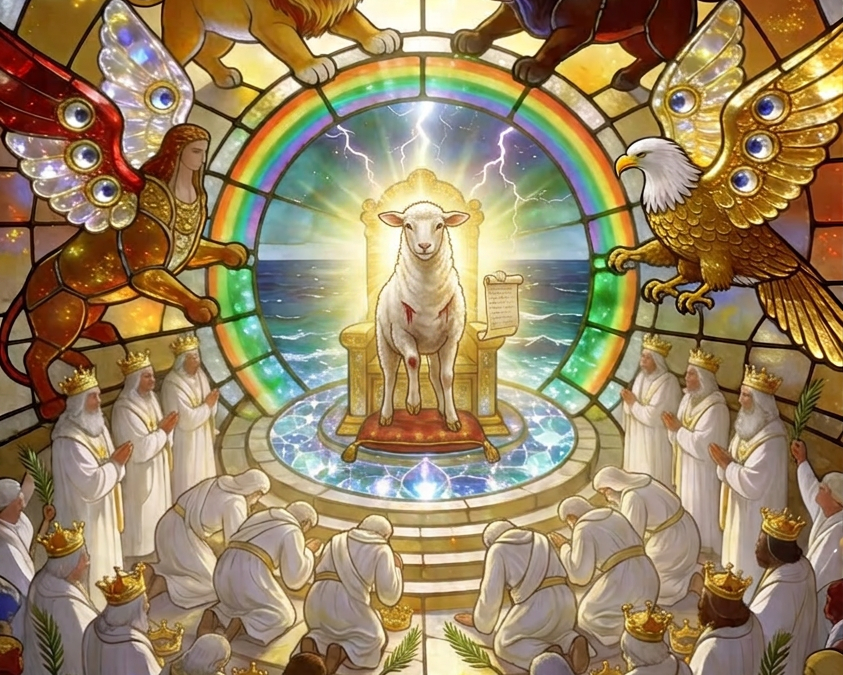
Imagine the transcendent majesty of God’s throne, resplendent in jasper, carnelian, and an emerald rainbow encircling its glory, surrounded by a vast crystal sea and flashes of lightning that proclaim His eternal power. At its center stand the four living creatures, lion, ox, man, and eagle (the 4 images associated with each of the Gospel accounts), covered with eyes signifying divine omniscience, each with six wings veiling their forms as they ceaselessly intone, “Holy, holy, holy is the Lord God Almighty, who was and is and is to come!” In reverent response, the twenty-four elders, clothed in white robes and bearing golden crowns, prostrate themselves, casting their crowns before the throne while declaring, “Worthy are you, our Lord and God, to receive glory and honor and power, for you created all things, and by your will they existed and were created.” The early church fathers, such as Irenaeus, interpreted these creatures as emblematic of animated creation itself, representing noble wildness, faithful servitude, rational humanity, and swift spiritual insight, united in perpetual praise around the divine presence. This vision models the Church’s priestly vocation: vigilant, Trinitarian doxology that shapes our earthly liturgy, inviting believers today to join heaven’s ceaseless anthem with eyes attuned to God’s holiness amid the world’s distractions.
The Slain Lamb
Revelation 5:6-14 (NIV) – Then I saw a Lamb, looking as if it had been slain, standing at the center of the throne, encircled by the four living creatures and the elders. The Lamb had seven horns and seven eyes, which are the seven spirits of God sent out into all the earth. He went and took the scroll from the right hand of him who sat on the throne. And when he had taken it, the four living creatures and the twenty-four elders fell down before the Lamb. Each one had a harp and they were holding golden bowls full of incense, which are the prayers of God’s people. And they sang a new song, saying: “You are worthy to take the scroll and to open its seals, because you were slain, and with your blood you purchased for God persons from every tribe and language and people and nation. You have made them to be a kingdom and priests to serve our God, and they will reign on the earth.” Then I looked and heard the voice of many angels, numbering thousands upon thousands, and ten thousand times ten thousand. They encircled the throne and the living creatures and the elders. In a loud voice they were saying: “Worthy is the Lamb, who was slain, to receive power and wealth and wisdom and strength and honor and glory and praise!” Then I heard every creature in heaven and on earth and under the earth and on the sea, and all that is in them, saying: “To him who sits on the throne and to the Lamb be praised and honor and glory and power, for ever and ever!” The four living creatures said, “Amen,” and the elders fell down and worshiped.
From this sovereign scene emerges the Lamb, standing as though slain yet radiant with seven horns of perfect power and seven eyes, the seven Spirits of God, taking the sealed scroll from the right hand of Him who sits upon the throne. Instantly, myriads upon myriads of angels encircle in thunderous acclaim: “Worthy is the Lamb who was slain, to receive power and wealth and wisdom and might and honor and glory and blessing!” Their voices swell as every creature in heaven and on earth, under the earth and in the sea, echoes back eternal “Amen,” while elders and living beings fall prostrate in clouds of incense-filled worship. Early interpreters like Victorinus of Pettau regarded this as the unveiled mystery of the gospel following Christ’s Incarnation, where the Lamb’s sacrificial triumph shifts creation’s praise from Creator alone to the Redeemer who conquers through blood. This Christocentric liturgy typifies the Church as the Lamb’s Bride, empowered to sing the “new song” of salvation in our sacraments; it calls us to Eucharistic participation today, savoring redemption’s foretaste and anticipating the great marriage supper of the Lamb in heavenly consummation.
The Global Multitude
Revelation 7:9-17 (NIV) – After this I looked, and there before me was a great multitude that no one could count, from every nation, tribe, people and language, standing before the throne and before the Lamb. They were wearing white robes and were holding palm branches in their hands. And they cried out in a loud voice:“Salvation belongs to our God, who sits on the throne, and to the Lamb.” All the angels were standing around the throne and around the elders and the four living creatures. They fell down on their faces before the throne and worshiped God, saying: “Amen! Praise and glory and wisdom and thanks and honor and power and strength be to our God for ever and ever. Amen!” Then one of the elders asked me, “These in white robes—who are they, and where did they come from?” I answered, “Sir, you know.” And he said, “These are they who have come out of the great tribulation; they have washed their robes and made them white in the blood of the Lamb. Therefore, “they are before the throne of God and serve him day and night in his temple; and he who sits on the throne will shelter them with his presence. ‘Never again will they hunger; never again will they thirst. The sun will not beat down on them,’ nor any scorching heat. For the Lamb at the center of the throne will be their shepherd; ‘he will lead them to springs of living water.’ ‘And God will wipe away every tear from their eyes.’”
Before the throne and Lamb appears a great multitude that no one could number, drawn from every nation, tribe, people, and language, standing robed in white with palm branches of triumph, their voices united in exultation: “Salvation belongs to our God who sits upon the throne, and to the Lamb!” Angels, elders, and living creatures encircle them, ascribing blessing, glory, wisdom, thanksgiving, honor, power, and might forevermore, revealing the blood-washed throng eternally shepherded, hungering and thirsting no more beside the river of life. The patristic tradition, linking this to Ezekiel’s life-giving river and Pentecost’s tongues of fire, understood it as the sealed Church emerging victorious through tribulation, the full harvest of souls waving palms in eschatological joy. This image embodies our present calling as a diverse priesthood in creation: conformed to heavenly citizenship now, our worship becomes a defiant conqueror amid chaos, embodying Pentecost’s promise until the final victory when every knee bows and every tongue confesses the Lamb’s reign.
A Call to Worship
These three prophetic images of the throne’s living creatures chanting Holy, holy, holy, the slain Lamb receiving universal blessing, and the global multitude waving palms in victory offer just a glimpse of the breathtaking beauty the Holy Spirit unveils through St. John. They reveal Christ’s Church, from the Spirit’s outpouring at Pentecost in Acts 2 to His glorious return in Revelation 22, perpetually joined in cosmic worship of the Lamb who was slain yet now reigns victorious forever on heaven’s throne.
Read Revelation this way; as Sacred Scripture truly intends and the glasses of fear and end-times dread shatter. In their place rises wonder, enchantment, and holy awe at God’s matchless beauty who He is: the Creator enthroned, rainbow-girded, eyes ever watchful. And what He’s done: redeeming us through the Lamb’s blood to sing the new song with every creature in sea and sky. This vision doesn’t paralyze; it propels. Our worship becomes defiant Hallelujahs! amid tribulation’s seals, trumpets, and bowls, faithful labor in the harvest fields where souls still ripen for the kingdom. We preview the throne-room marriage feast, robed in white, palms raised, as the Bride made ready.
Church, this is our calling now: to live these heavenly patterns on earth. Next week: How is Revelation’s worship reflected when you gather to hear the Word, receive the Sacraments and go into the world as a faithful witness of Christ our Lord?