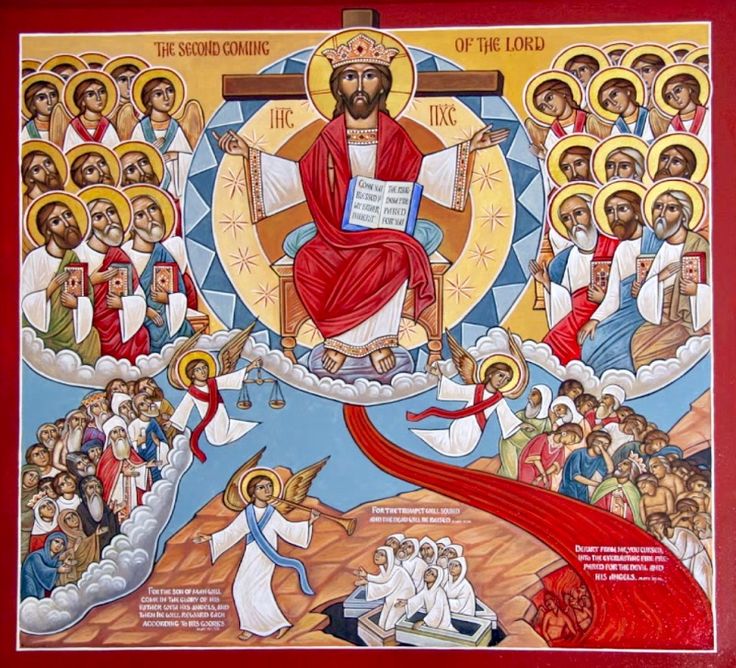
by Joel V Webb | Nov 21, 2025 | Orthodoxy Matters, Theology & Practice
One of the perennial issues of discussion, disagreement, and consternation in modern Christianity is how to solve a “problem” like the book of Revelation (cue The Sound of Music). It is one of the most talked-about and also one of the most misunderstood books of the Bible, precisely because of what makes it so beautiful. It is mysterious, symbolic, imaginative, and at first glance feels opaque enough that Christians often fall back on whatever interpretive framework they inherited. And for many in the Western church, that inherited lens is some version of the dispensational, end-times schema popularized by the Left Behind series.
Recently, a parishioner asked me how to understand Revelation, and I realized quickly that a simple five-minute conversation wouldn’t be enough. The questions behind Revelation are not only about interpretation but about imagination. We need to untangle what the text actually says from the assumptions we bring to it. And this is difficult, because for many Christians even those who do not personally identify as dispensational, our cultural imagination has been shaped by that system. The idea of a seven-year tribulation, an individual Antichrist, a secret rapture, and a sequence of future political events culminating in Armageddon often feels like it “must” be biblical because we’ve heard the system so often and so confidently.
But when we slow down, open the Scriptures, read Revelation in its own historical and literary context, and listen to the witness of the early Church, we discover something surprisingly simple: Revelation is not about decoding a timeline. It is about unveiling the triumph of Jesus Christ and the call for His people to remain faithful in a world that often opposes the Lamb.
It is striking that the book opens not with a puzzle but with a blessing: “Blessed is the one who reads aloud the words of this prophecy” (Revelation 1:3). The early Church never treated Revelation as a secret codebook but as a proclamation, prophetic imagery meant to comfort persecuted Christians, strengthen their worship, and remind them that the Lamb reigns even when Rome seems unshakable.
This is precisely how the earliest Christian writers approached the book. Irenaeus, writing in the second century, did take Revelation seriously as prophecy, but he always tied its hope to the victory already won by Christ. He wrote, “The name of our Lord… is the faith which brings salvation” (Against Heresies 3.18.7). The point is not prediction. The point is fidelity. Origen, commenting on Revelation’s imagery, said that the visions “are to be understood spiritually” and that the book “reveals what Christ has done and is doing” (Commentary on John 2.2). Even Augustine, often accused unfairly of over-allegorizing, was simply following the pastoral instinct of the Church before him when he said that Revelation displays the reality that “the Church is always under trial… yet is always victorious through Christ” (City of God 20.9).
For the early Church, the primary message of Revelation was not fear of what might come, but confidence in what has already come: the Lamb who was slain now stands (Revelation 5:6). Christ’s victory is not future, it is the very lens through which the future must be seen.
This is also why the historic Church never taught a seven-year tribulation. That idea simply does not appear anywhere in Revelation. It emerged from a very particular reading of Daniel 9, developed in the 1800s, in which dispensational writers “paused” Daniel’s 70th week and moved it thousands of years into the future. No Christian writer, east or west, taught this before the modern period. For the early Christians, the “tribulation” was the reality of discipleship in a world that crucified Jesus and still resists His reign (cf. John 16:33). As Tertullian wrote, “The blood of the martyrs is the seed of the Church”—not because the Church awaits a future seven years of horror, but because tribulation is the normal environment of faithful witness.
Likewise, the idea of a single end-times Antichrist figure does not come from Revelation either. The only place in Scripture that uses the word “antichrist” is the Johannine epistles, and there John says plainly: “Many antichrists have come” (1 John 2:18). It is a category, people and powers opposed to Christ—not a cinematic villain. Revelation’s beast imagery is not about a future political leader waiting in the wings; it is prophetic imagery about oppressive empire, idolatrous power, and systems that stand against the Lamb. Early Christians knew this. Victorinus, the earliest commentator on Revelation (3rd century), wrote, “The beast signifies worldly kingdoms… opposed to the Church” (Commentary on Revelation 13). Not an individual. Not a future dictator. A system. A pattern. A recurring reality in history.
In other words, Revelation is not predicting a future empire in exact detail, it is revealing the spiritual nature of all empires that wage war against the Lamb (Revelation 17:14). And the Lamb wins.
Even the Reformers and later theologians continued this historic reading. Luther was initially suspicious of Revelation, but even he insisted its purpose was to “reveal Christ and testify to Him.” Calvin did not write a commentary on Revelation, but he preached from it confidently, saying, “The sum of all prophecy is that God in Christ reconciles the world to Himself.” John Wesley, in his Explanatory Notes Upon the New Testament, reads Revelation as a symbolic depiction of Christ’s ongoing victory and the Church’s call to endurance. Wesley wrote, “The sum of this book is that God governs all things by His providence, for the good of His people.” He never once suggested an end-times timeline, a seven-year tribulation, or a single Antichrist figure.
It is important to say this gently and pastorally: the dispensational approach is very new. It arose in the 1830s through John Nelson Darby, was popularized through the Scofield Reference Bible, and became mainstream in America only in the 20th century. That does not make dispensationalists bad Christians, many of them love Jesus deeply. But it does mean their interpretive framework is not the standard Christian reading and should not be assumed as normative.
This brings us back to Revelation itself, the text, the imagery, the hope. When we set aside the pressure to decode it, Revelation becomes astonishingly clear: the crucified and risen Jesus is the center of all history. The visions unveil not chaos but order; not fear but faithfulness; not despair but triumph. Revelation tells us that the powers of this world may roar, but they are doomed to collapse. The martyrs may seem forgotten, but they stand before the throne in glory (Revelation 7:9–14). The Church may feel besieged, but she is protected by the Lamb who walks among the lampstands (Revelation 1:12–13). The dragon may rage, but it has already been cast down (Revelation 12:7–10). Babylon may boast, but she is fallen before the word is even spoken (Revelation 18:2). Heaven’s cry is not “fear what is coming,” but “Worthy is the Lamb who was slain” (Revelation 5:12).
Revelation is not announcing that Christ will win someday. It is announcing that Christ has won already.
And because He has won, the Church can be faithful even when the world looks like Rome, even when suffering feels heavy, even when the powers rage. Faithfulness is the call; worship is the weapon; perseverance is the witness. As the author of Hebrews reminds us, “we are receiving a kingdom that cannot be shaken” (Hebrews 12:28).
When we read Revelation in continuity with the early Church, with the Reformers, with Wesley, and with the whole sweep of Christian interpretation before the 19th century, we discover that its message is not a coded warning but a cosmic proclamation: Jesus reigns. The Lamb has conquered. The nations will be healed. And God will dwell with His people.
Revelation is not a puzzle to solve but a vision to behold. And when we behold it, without the unnecessary weight of modern timelines—we find precisely what John intended his hearers to find: courage, clarity, and the unshakeable hope that “the kingdom of the world has become the kingdom of our Lord and of His Christ” (Revelation 11:15).
If you wish to further explore this topic, here are some amazing resources to take a look at:

by Joel V Webb | Dec 16, 2024 | Orthodoxy Matters
“Monkey see, Monkey do” is a phrase that all of us have heard, and we all understand. We are always learning and imitating what is going on around us. I just became a dad, and while my baby son is too little to really imitate me, I know the things going on around him affect him and his reactions.
We also understand that the stuff that we devote our time to we become more like it. My wife and I really enjoy the show The Office, and we hardly go a day without finding some way to quote the show in our everyday life. In a way, that show has formed a bit of me, impacting how I interact and understand things.
Then we get to the concept of catechesis. This word simply means instruction, or instruction by word of mouth. As someone who grew up in a very low-liturgy protestant tradition, the only time I heard this word was in a Roman Catholic context. This word in fact has been used all throughout Church history to reference the teaching and training of new believers (often with a special title still used in some traditions, catechumens).
For most Protestants we could think of this as an extended period of intensive training, where a new follower of Christ is taught the truth of Scripture, and the practices of the worshiping community before being fully integrated as a Eucharist taking brother & sister in Christ. In many contemporary settings we use Sunday School as the primary way we teach our young ones. I believe this is a good thing! But what has arisen in many Churches is more entertainment and keeping kids busy, rather than intentional teaching of Christian truths.
Many in my generation were in some settings were just given Bible stories and memory verses, expected to content with the philosophies and arguments of a world that seeks to disprove the existence of God.
What intentional catechism provides is in many cases those same Bible stories and verses, but also imbued deeply with transmitting the core truths of the Christian faith. A young person going to college can’t contend with the philosophical argument of an atheist if all they know is Noah’s Ark and know John 3:16 by heart (these are good things still). It has to be more than just head knowledge of a few fact point. Rather, we need to be working towards holistic worldview development of our children.
This is made more poignant and important for myself with the birth of my first child. I see and know the world that they are going to grow up in. All the hundreds if not thousands of messages they will received in active and passive ways. And here’s the dirty little secret that most of us are uncomfortable with. There is no such thing as a neutral message. EVERYTHING is seeking to form and mold us into representing the message that we receive. For commercials it is trying to make us discontent with what we have so that we have to buy more to be happy. Or the education in our public schools. No matter how we put it, schooling is not neutral (despite how some may protest). The current ruling philosophy of our American public schools is materialistic agnosticism, if not antagonism to God. Nothing is neutral, everything is trying to form us.
Instead, we must work diligently to form the next generations to not just know facts about the Bible or about God. But to be fully formed in how they see the world through the eyes of the Christian faith. In many cases we unwittingly have been passive for several generations in allowing the culture around us to form our minds and how we think. Because of this we see our Christian faith just as a thing we do as apart of our lives. This is where we get phrases like “practice your faith privately”, and even Christians believe this!
Instead, Christianity explains everything. The entire reason for our existence, and what happens in the end is contained within the Christian story as seen in Scripture. And how much be believe that story impacts how we live our life. If we are not actually convinced of the truth of this story, and the life-altering reality of that story we will just continue living our lives as any other secular, materialist pagan, rather than as a person whose life has been completely transformed by the power of the message of the Gospel.
A simple place to start with this catechesis for children or adults is three simple things. The Apostle’s Creed, The Lord’s Prayer & the 10 Commandments. For much of Church history this has been the cornerstone of of teaching and forming new converts or children raised in the Church. These things, along with other spiritual disciplines of reading Scripture, prayer, corporate worship, confession, receiving Eucharist and others build us in Christ in every aspect of our lives.
The task is great, but the implications are dire. Let’s get to work.

by Joel V Webb | Jun 3, 2024 | Uncategorized
There’s a certain kind of feeling when you have finished a long hike and you finally reach the scenic overlook. The beautiful display of God’s creation laying below as it expands in its ever moving edges to the horizon. In those moments there is a sort of clarity, peace and serenity when we get to overlook and oversee so much when not hemmed in by the trees and geography that is so often over us.
And then there is the long climb down. A hike of return that in many ways is easier than the climb up because the incline of the trail is going with you. But it also represents a moving away from the clarity and peace, back into the hum drum of life and civilized existence. Things seem less simple, and more complicated…probably because in reality they are.
At numerous times through my life, as I think many of us have experienced have been in those times and moments of serenity. A clairvoyant time of a mountain top in which every part of life seemed simple, everything had an answer, and maybe we even felt like we could fly. But as always happens the trek down the mountain starts we back to life as it seemingly was. Many of the times these experiences were precipitated by a special time away. Many of us can likely think back to times at youth camps where we met with Jesus in a special way, and all of our besetting problems and foibles seemed like they were done and over with. And then we go back to life and things are great for a week, and then as time goes the feeling of strength and clarity fade.
Could it all be that fickle? Is it supposed to be? Why does it seem to be this viscous cycle?
Psalm 139:8 If I go up to the heavens, you are there; if I make my bed in the depths, you are there.”
Doesn’t that kind of sound like those mountain moments? Things get cleaned up and cleared out, but then whatever it was seemingly comes back with a vengeance? What are we supposed to do!? How can we overcome this?
Thankfully, God has not left us wondering there either.
Ultimately, the problem that so many of us have faced is that much of our walk and faith in Christ is based on experience and sometimes even more strongly our feelings. Don’t get me wrong, our personal experiences with Christ are essential, and something that we can look back on His faithfulness especially when we go through tough times. But the problem lies with almost totally living our Christian walk off of our feelings. Just like any other human feeling, that is fickle and bound for failure.
We have to remember, out walk with Christ is based off of Him, and Him alone. Now, we do have out part of allegiance to Christ. But the strength and ability to walk with Him is found in Him. God is so good to give us those times of respite, being on the mountain where we feel Him so clearly, and nothing seems to hold us. And then we always need to keep going.
So often I myself live in this cycle of failure and triumph. I was awaiting some amazing spiritual moment when I would overcome all the junk I was bound to and never have to face a problem again. Living in total victory because I’d always be on the mountain. But that’s not how life works, or how it was intended. Life happens. Stuff happens, and it sucks. But if my faith and relationship with Christ is solely built on the mountain times we actually miss how He is faithful…when it seems like He isn’t there from our perspective.
It is in those moments of the valley, that may even seem like hell to us where God is also.
The validity and strength of your walk with Christ are not graded on out feelings. If that were the case we’d all fail…HARD. Instead, let us remember that our salvation is based off of Christ’s faithfulness. And even if we feel like we’re in the dredges, He is with us. His Holy Spirit is empowering us to follow and remain allegiant to Him.
He is always with us. He will never leave or forsake us. And remember. Fear not because He has overcome the world.

by Joel V Webb | May 29, 2024 | Uncategorized
One of the big discussions happening in the Church is that
of reaching to the next generation, most who have never and may never darken
the doors of a Church building for a variety of reasons. The pool of research
is growing into this field, seeking out how the Church can be effective
witnesses of the Gospel.
Everything that I have read so far shows that really what
the next generation is looking for from those of us currently in the pews is
not necessarily a particular worship style or worship, but rather a warm
authentic community. Be it a church providing high liturgy and the Eucharist
every week, or a more modern setup with a rockin’ worship team and a pastor in
ripped jeans. The coming generations (particularly Gen Z and Gen Alpha) are
really caring about the authenticity of the relationships and community that
their place of worship has, rather than being attached to a certain style of
worship (See the book Growing Young by Kara Powell, Jake Mulder and Brad
Griffin).
In my lifetime my experience with much of the Church has
been more concerned with the form of the worship over the community the
participated. I’m sure there are those who share this experience, or have very
different experiences. Because of the general acceptance of Christian morality
in the West for the last several generations, a form of malaise has grown over
our eyes as the culture around us generally mirrors how the Church is called to
live.
What has happened in the last 20 years in particular is a
vast shifting in the US (something that was already rapidly happening in Canada
and Europe) of the perspective of the Church and the Christian message. Now, just
like the early church in some ways, we are the counter-cultural force at play.
This is scary for many of us, causing us to respond with suspicion and fear to
the shifting sands around us, rather than responding with the attitude of
opportunity.
This needs to make us take a deep look at our outlook as the
Church in regards to our interaction and perspective. We are no longer the pre-supposed
middle of the conversation. With polarization on both political fronts, the
Church is finding itself being sucked to two extremes that are impossible to
bridge. Instead, we need to focus on what we were called to be. In, but not of
this world.
If we are wanting to be attractive to the next generations,
we must offer something that no ideology, Tik Tok fad, virtue signaling, or political
movement can provide. The Church offer
vital and life-giving community centered around the Gospel, which is a
life-changing message of hope and new life in a world that is spiraling as it
searches for meaning. Our modern world gives us the ability to reach and share
with people as unheard of speed, with the truth of an ancient message that has
been practiced by other broken, and then made new people for over 2000 years.
We may need to look at hybrid models of doing things. A sold
combination of alternative forms of church (commonly called fresh expressions) and
what we commonly think of as the Church to meet the needs of people who are in
just as much need of new life in Christ as we are, or the Jews & Gentiles
of the 1st Century AD were. I don’t know what that all looks like,
or means. The Holy Spirit is calling the Church to remain faithful to the faith
once for all delivered to the saints, while not being tied to how we’ve always
done things.
Let’s drop the facade of “doing Church” and instead really live
as an intentional community who loves God, loves people, and live sent to
proclaim the Gospel, whatever that looks like.

by Joel V Webb | Apr 29, 2024 | Uncategorized
Article as published on lightandlife.fm
“How are you?”
“Good, just busy.”
This is a conversation that I bet just about everyone has had, maybe
on a weekly basis — especially for those of us in ministry roles. As of
2024, we have more tools of convenience than at any other time in human
history. Yet we are more enslaved to the things we do in life than ever.
This problem is becoming an epidemic of sorts in the church as we try
to do more and more in the same 24 hours we have all had since God first
breathed a breath in Adam.
So what has changed, and, more importantly, what do we do about it?
My life has always been busy and somehow keeps getting busier. Having
grown up in a pastor’s home, I know the general hubbub that goes on to
keep things running every week. But something has changed in the last
couple of years. I’m now married, expecting my first child, working
full-time, and part-time at church while also completing seminary,
producing a podcast, and a plethora of other small things. Phew, I’m
exhausted just thinking about it!
I’ve also noticed that my alone time with God has suffered, my blood
pressure is higher than it was a couple of years ago, and, even with
sleep, I just always feel a little bit tired.
Eliminating Hurry
Maybe this resonates with you and sounds similar in some of the broad
strokes on the million different things you have going on in your life.
There’s been this looming suspicion that something has to give to make a
change. Then I picked up the book “The Ruthless Elimination of Hurry”
by John Mark Comer. It’s not a long book. And contained in those pages
is a monumental mental shift in how I need to organize my life.
Comer starts by pointing out the problems he faced in his life and
then progresses to lay out the history of how we as humanity have just
gotten too busy for anything. One of the most shocking realities is that
the rapid secularization we see in our culture and the church likely
has many of its roots in the contained busyness that we increasingly see
continuing to devour our lives.
Comer quotes John Ortberg (who wrote the book’s foreword): “For many
of us, the great danger is not that we will renounce our faith. It is
that we will become so distracted and rushed and preoccupied that we
will settle for a mediocre version of it. We will just skim our lives
instead of living them.”
When I read this, it brought the pit that had been growing in my
stomach right up to my throat as I had to grapple with the practical
reality of what I had just mentally consumed. The image was now clear;
some stuff has to go.
Here’s the tension that we all face. Most or much of what we do is
good stuff. Many of us are working for the kingdom, doing all we can to
share the gospel and see people’s lives transformed as they follow
Jesus. But what often happens is that we fill our lives so much that
life just passes us by as we rush from thing to thing.
In a recent prayer meeting of local pastors, someone shared something they heard that brings all of this to a point:
“If a church found out their pastor broke nine of the Ten
Commandments, the pastor would probably get fired. But if they found out
their pastor was breaking the commandment to keep a sabbath, the pastor
would probably get a raise.”
Let that sink in for a moment.
We live in a time and culture where much of the church is being
rocked by well-known leadership falling to their brokenness in public
ways. Yes, the church needs to deal with these issues and ensure that
those kinds of things have no place in God’s kingdom, especially in
leadership. But once it comes to the question of the Sabbath, we keep it
as an open secret that it doesn’t matter if our pastor does not keep
that one. Why would we want to?
Countercultural Solitude
Our culture and we in the church have become enslaved to busyness,
always working on something. Jesus presents a different way: one that is
slower, that provides a life lived with intentionality. Jesus took
intentional time to be in solitude, and never rushed even when He knew
someone was sick and dying (i.e. Jairus’ daughter or Lazarus). This kind
of life is countercultural in more than just a moral or political way.
It’s something that is practiced by just about everyone regardless of
political affiliation or career.
Many of us are racking our brains trying to find out “what is going
to bring in the youth.” What if presenting the way of Jesus to live a
slower life is the thing their hearts are longing for — not just to be
saved from their sins, but to literally have a different kind of life
where they actually live rather than going from appointment to
appointment?
I highly recommend that you grab a copy of “The Ruthless Elimination
of Hurry.” Comer doesn’t just diagnose the problem but provides a
thoughtful and practical guide from the life of Jesus. If we are those
who claim to be His followers, it also means living as He did. That
doesn’t mean we don’t have times where we are busy, or that life can’t
be full of things to do. But we need to take those things and live life
holding all of them loosely in the light of our relationship with Christ
that is the only thing that can satisfy.



.png)
.png)