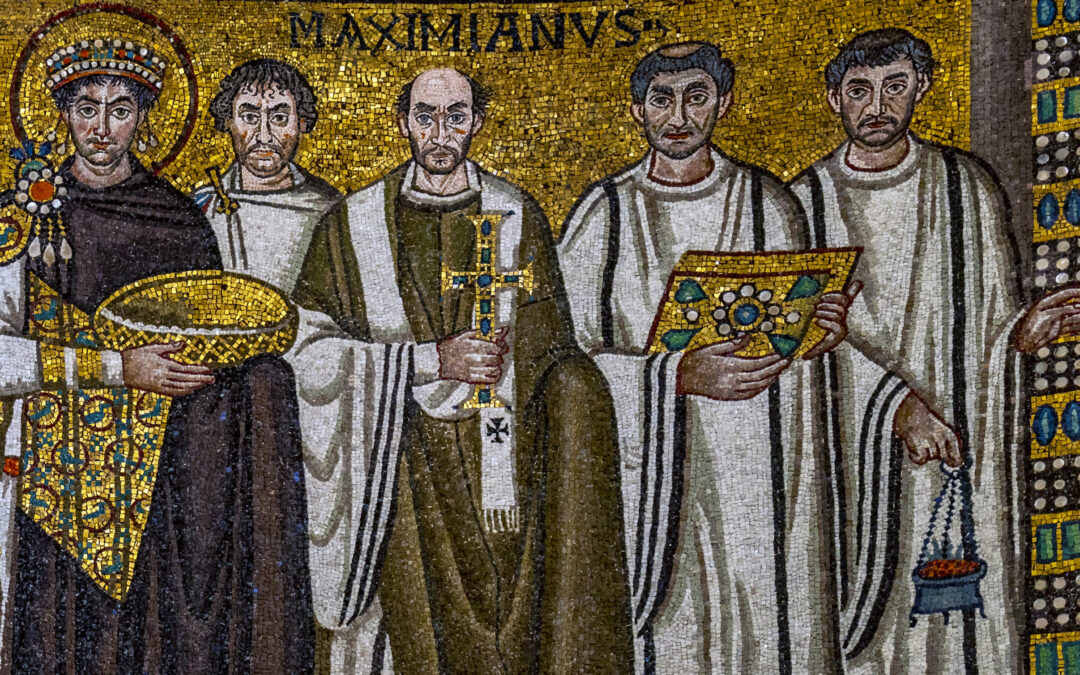
In previous posts I have talked about the various Holy Orders in the Church (twice about deacons, once about pastors as priests). Now, we come to the third order for the function of the Church. The Bishop.
Before we look at the historical development of this role, and contemporary usage, we need to look at what Scripture presents, and clear up some things that might seem cloudy. In the New Testament we get the word bishop from the Greek ἐπίσκοπος episkopos, which when translated is the word overseer (used in Acts 20, Philippians 1, 1 Timothy 3 & Titus 1). In it’s usage the word seems fairly interchangeable with πρεσβύτερος, presbuteros, from which we derive the title Elder or Priest. But, in the usage of the word episkopos there does often seem to be this extra discussion of overseer and authority that is used with it.
Then, moving from Scripture into the first two centuries of the Church we see how this began to play out. What is often seen in the development of the role of bishop is the idea of “elder of the elders”, where the various elders from a given city would select and make one of their own their overseer, providing consistent oversight and authority. This tradition has been carried on where bishops come from the ranks of elders first.
In cities like Alexandria, we see through their history a fairly consistent practice of the elders selecting their bishop from among the elders, which is actually the method that John Wesley referred back to when consecrating Coke & Asbury for mission in America.
The pattern is important because it shows that the bishop was not originally conceived as a detached administrator, but as a pastoral elder among elders, one who carried a coordinating responsibility for teaching, order, and unity within the local church. That matters, because it keeps episcopacy grounded in the life of the presbyterate rather than setting it over against it as though the bishop were a different kind of creature altogether.
This is also why the historical development of the office is so illuminating. The church did not invent the bishop out of nowhere; rather, as the Church grew, the need for settled oversight became more visible, and the role that had already existed in seed form began to take on clearer shape. In that sense, the bishop is best understood as an organic development of apostolic oversight, not a later replacement for it.
That same pattern helps explain why the early church so often assumed that bishops should come from the ranks of the elders. If the office is a higher mode of oversight, then it makes sense that the one who exercises it would first have been tested in the pastoral work of shepherding, teaching, and governing. The bishop is not merely a manager appointed from outside the life of the Church; he is an elder who has been recognized for broader charge and wider responsibility.
This is also the logic that many Anglicans and Methodists have found compelling in tracing their own heritage. John Wesley’s appeal to the ancient practice of episcopal selection was not an attempt to sever the Church from its past, but to recover a pattern of order that he believed belonged to the early Christian witness. In that way, Wesley’s action with Coke and Asbury stands as a reminder that episcopacy has often been defended not as a novelty, but as a faithful continuation of an older apostolic instinct.
If we say it plainly, the bishop exists for the sake of the Church’s unity, doctrine, and mission. They ares called to hold together what is otherwise liable to fragment, to guard what is otherwise liable to drift, and to oversee what is otherwise liable to become disordered. That is why the title itself is so fitting: a bishop is, at root, an overseer.
Of course, this does not erase the close connection between bishop and elder. Rather, it strengthens it. The bishop is not less than an elder, but more properly the elder who bears the wider burden of oversight on behalf of the whole community. And that is precisely why the biblical language matters so much before the historical development is ever discussed.
That line of thought naturally brings us to the bishop as the pastor of pastors. If the bishop is an overseer in the fullest sense, then their first task is not to manage an institution, but to care for the shepherds who care for the flock. They stand in a unique place in the life of the Church, not above the pastoral office in a worldly sense, but within it in a wider and more encompassing way.
This is where the modern age can easily distort the office. When a bishop begins to think of themself primarily as a chief executive, a strategist, or an administrator, they may become efficient but spiritually distant. They may know how to organize systems, but lose touch with the burdens, joys, wounds, and prayers of the people and clergy entrusted to them. The bishop’s calling is not to become less pastoral as their responsibility grows, but more deeply pastoral precisely because it does.
A bishop must therefore be near to their elders/priests, deacons, and local pastors in the way a shepherd is near to their under-shepherds. They listen to them, pray with them, correct them with charity, encourage them in discouragement, and strengthen them for the work they cannot do alone. In this sense, the bishop’s authority is never merely juridical; it is fatherly, spiritual, and relational.
This is also why episcopal leadership must be measured by more than visible results. A bishop may oversee programs, budgets, appointments, and structures, but if they are not tending souls, they have missed the heart of their office. The Church does need order, but order only serves the deeper work of salvation, holiness, preaching, sacrament, discipline, and care. The bishop exists to make that work more faithful, not merely more manageable.
So the bishop must remain a pastor even when they are governing. They must preach as one who believes, counsel as one who has suffered, correct as one who loves, and lead as one who knows that every act of oversight is accountable before Christ the Chief Shepherd. The higher the office, the more urgent the pastoral character of the one who holds it.
That is the real test for bishops in every age. Not whether they can run an organization well, but whether they can carry the heart of a shepherd into the wider field of oversight. A bishop who remains a pastor of pastors strengthens the whole Church; a bishop who becomes only an administrator slowly empties the office of its soul.
The Free Methodist Church, like many Methodist denominations rooted in the historic orders of the Church, has the offices of Deacon, Elder (Pastor/Priest) & Bishop. These roles of servant leadership are seen instituted by and through the Apostles in the book of Acts, and through the epistles of the New Testament to see Christ’s Church function.
The role of Elder (presbyter from the Greek presbyteros) is the role we see most spoken of by St. Paul is his pastoral epistles as he is often writing to churches in need of issues resolved. Through his writings we see the outline of the role, and the qualifications needed for such a role (1 Timothy 3). We also see elders working in conjunction with the Apostles in Acts 11:30.
The next role that is often closely associated with elders is that of the overseer, from the Greek word episkopos, which is where we derive the term episcopal, and the title Bishop from. In the New Testament this term seems to be used interchangeably. What we do see early in Church history is this role being that of the chief elder selected to oversee a given church of a city, and would have been selected from among the elders of that city. This has been carried on through Church history to this day where the Bishop oversees a collection of churches, often in a geographical area providing oversight to the elders, deacons and parishioners within, sometimes called the chief pastor.
The final role is that of a deacon. Which arises very quickly in the narrative of Acts 6:1-4, “In those days when the number of disciples was increasing, the Hellenistic Jews among them complained against the Hebraic Jews because their widows were being overlooked in the daily distribution of food. So the Twelve gathered all the disciples together and said, “It would not be right for us to neglect the ministry of the word of God in order to wait on tables. Brothers and sisters, choose seven men from among you who are known to be full of the Spirit and wisdom. We will turn this responsibility over to them and will give our attention to prayer and the ministry of the word.”
This role of deacon, created from the need for service in the Church, like the others has been carried on through the Church in a variety of ways to serve the body. Historically the diaconate is a role that seems to be a stepping stone for those pursuing elders orders, but otherwise is a position that is dedicated to the long-term care of the congregation, especially in polity situations where there is frequent rotation of clergy. (see my previous post on deacons).
This then brings us to the question of deacons in the Free Methodist Church.
You might be surprised to find out that they do actually exist!
Found in our Book of Discipline, ¶6600: Consecrated Deacons are members in good standing in the Free Methodist Church. They are persons of good reputation, full of wisdom and the Spirit, whose spiritual gifts from God have been confirmed by their societies. In response to God’s call on their lives, Consecrated Deacons offer servant leadership in particular areas of congregational life, according to the gifts and graces God has given and they have developed. Complementing the work of elders, Consecrated Deacons serve the Society by assisting and leading the membership to carry out its ministries to one another and the world.
There is more the BOD says about the role, particularly this: Consecrated Deacons remain members of the local Free Methodist church with no official standing in the annual conference. Consecrated Deacons may therefore serve as lay delegates to annual conference and General Conference.
Historically the role of Deacon has been a Holy Order along with being an Elder and Bishop. Ordained as such for ministry, a foot in both the world (congregation), and as clergy in their own way. In keeping with the Scriptural work deacons were created to fulfill, this is very often kept up in traditional expressions of the Chrisitan faith.
All that being said. I have never met a Free Methodist Deacon. (If you are one, I’d love to meet you!!)
What’s unfortunate is that as a denomination, we are missing a core Scriptural role and position that Christ, in His wisdom through the Apostles has blessed us with so that those who serve as Elders can focus on their distinct roles to serve the Body of Christ.
We in the Free Methodist Church need a revitalization of the diaconate. Why? Not only because it is found in Scripture and in the long tradition of the Church, but I believe it is one of the solutions to the clergy burnout crisis. Pastors are often saddled with so many tasks which may include visits and other elements of ministry of mercy and presence. And that’s not to say those of us with Elders Orders shouldn’t do that, we need to. But in some cases, there are pastors who are saddled with a large load of the work that Christ intended for Deacons to take.
Another aspect we might not be considering is in regards to the involvement of our laity. How many people do we have in our churches who feel a call to some kind of ministry, but all we really have to present them is to “become an ordained pastor”. But what if that’s not what they are called to, but rather feel the pull into the diaconate, but we are unaware and are not making use of this so important but unused role?
A final note I will make is I feel we have done a disservice in removing the diaconate from its historic placement in the ordination process of clergy. Historically, as it is also done in traditional expressions of the faith today, those pursuing Elder’s orders, as a part of the process, actually become deacons. It is during this time they serve in that role in serving the flock as they continue the process towards becoming an Elder.
In our current Free Methodist situation, the role of deacon has been seemingly separated from this historic track unless someone feels otherwise called or can’t carry on pursuing Elder ordination for some reason (see the rest of ¶6600 in the BOD). I’m not sure when or why this change was made in our polity, but I have a feeling it had subtle but noticeable detrimental effects. One possible suggestion would be to simply keep the process we have for ordination (LMC to CMC to Elder), but simply rename the CMC title to Deacon, to bring us back into historical alignment with the role, and modify the track to allow those to stay at that level if they feel it is their calling to ministry. And if someone then feels the call to remain in the diaconate, their membership can remain at the local level.
While some of this discussion may seem life insignificant squawking, we don’t often realize how changes from how things have been, even if they don’t seem important, can actually have major impacts down the road. And while the question of the diaconate seems like a small problem in a world gone mad, maybe the role Christ has given the Church to help serve the flock would help bring back some of our sanity to keep us going until He one day comes again.
Recently I did a post about the need to refocus the role of pastors (derived from presbyter in the NT and also called priest in some traditions) back to its historic and Scriptural role of being a priest, rather than a business leader. Since then I have been thinking again about the roles of leadership in the Church, and that of deacon came to mind. From this I have taken a bit more of a look at this position, what it has looked like, what it often looks like (or doesn’t look like particularly in an evangelical context), and what the benefits would be for the Church to regain part of the historic nature that this role provided in serving Christ’s Body.
One of the cornerstones of the episcopal structure of Church governance is the three-fold group of Holy Orders of the bishop, elder (in some traditions called priest or pastor) and deacon. In many Christian traditions, the usage of these historic roles has fallen out of use, while maintaining some connection to the Scriptural basis of the roles found in Scripture (something we will touch on in a bit). But while evangelicalism has often sought to simplify church structure in the name of pragmatism, we have perhaps unintentionally surrendered a gift Christ gave to His Church—the ministry of deacons—and substituted something less theologically rich, less biblically rooted, and less spiritually fruitful.
We see the origination of the role of Deacon in Acts 6, where the quickly growing Church faced a problem, the Apostles, who were to teach the good news of the Gospel had much of their time taken with the practical side of alms and good words (nothing wrong with that of course, but focus is important when doing a job). “So the Twelve gathered all the disciples together and said, “It would not be right for us to neglect the ministry of the word of God in order to wait on tables. Brothers and sisters, choose seven men from among you who are known to be full of the Spirit and wisdom. We will turn this responsibility over to them and will give our attention to prayer and the ministry of the word.” Acts 6:2-4 NIV. This newly created role was not just to be a waiter like at a restaurant, but an extension of the Church as the hands and feet of Christ, serving with love and dedication.
Paul’s words in 1 Timothy 3 reinforce the seriousness of the office: deacons are to be tested, spiritually mature, and faithful. They are not simply board members, door greeters, or finance committee volunteers. They are ordained servants, carrying sacramental responsibility and pastoral care in the name of Christ. We also see the role of deacons in the function of the Early Church in the first few centuries. The early Church knew this role well. Deacons were entrusted with:
Administering alms and mercy ministries
Assisting at the Eucharist and preparing the table
Serving bishops and priests in pastoral care
Preaching, catechizing, and evangelizing
Carrying communion to the sick
Guarding the unity and order of worship
St. Ignatius of Antioch, in the early second century, wrote: “Let all respect the deacons as Jesus Christ, just as they respect the bishop as a type of the Father and the presbyters as the council of God.”In other words, the diaconate was not an afterthought—it was woven into the very structure of the Church’s life. For centuries, to remove or diminish the diaconate would have been unthinkable.
And this is what I think we in the Western Evangelical Church have lost sight of in the function and operation of the Church. While in some contexts there is an understanding of this role, much of the focus in running the church is focused on the programmatic operation like a business, rather than the people centric focus of sacramental presence and ministry to hungry people in a broken world. This is not a criticism, but simply an observation, just as I spoke of in the role of pastors and priests, that we as the church must reclaim the historic role of deacons as not just managers, but as ministers who assist in the shepherding of God’s flock.
But more than just returning to the proper function of deacons, many have completely abandoned the role. And in abandoning it, many evangelical churches have unintentionally forced pastors to carry both the apostolic proclamation role and the diaconal mercy-care role, resulting in pastoral exhaustion and congregational under-formation.
The Church needs priests who can pray, preach, shepherd, and administer the sacraments. And the Church needs deacons who can embody the compassionate hands of Christ, serving at the altar and among the poor, binding the church’s worship to its service in the world.
Here in the Free Methodist Church, we reclaimed the office of deacon after a long period without it. Yet we have not fully embraced its depth. At present, deacons are recognized locally, often as pastoral helpers or ministry assistants. This is good, but it can also stop short of the rich and historic calling Scripture and tradition give us.
Recovering the diaconate more fully does not mean abandoning our Wesleyan heritage—it means living into it. Wesley himself sent deacons, commissioned lay preachers, empowered class leaders, and believed the Spirit called people to particular vocations within the Body. Holiness, for Wesley, was not abstract—it was enacted love. And the diaconate is enacted love.
Pastors change from time to time. While the FMC practices longer appointments than other Wesleyan-Holiness denominations, there still can be pastoral turnover. Deacons historically have been a grounding force of ordained ministerial presence that comes up from within the congregation, and is planted in the church, staying consistent even through multiple pastoral changes.
Today, many of our congregations feel the pressure of multiplying needs: pastoral fatigue, growing community crises, loneliness among young adults, hunger for depth, and a longing for embodied faith. This is not a time to narrow the ministry of the Church; it is a time to strengthen it. Not by adding programs, but by recognizing callings.
To restore a robust diaconate—in prayerful, thoughtful, historically rooted ways—is to affirm that God still calls servants, and that the Church still needs them.
So what might it look like for the Free Methodist Church to lean into this calling anew?
It begins with prayerful discernment. By asking who among us God may be calling not simply to “help out,” but to embody the servant-hearted ministry of Christ in a particular and visible way. It looks like pastors and congregations encouraging those with a heart for mercy, intercession, visitation, table service, and Gospel witness in everyday places. It looks like laying hands on them, blessing them, and releasing them to a ministry that is grounded in worship and poured out in love.
We do not restore things because they are ancient; we restore them because they are alive. The diaconate is not nostalgia—it is discipleship. It is not hierarchy—it is humility. It is not about creating distance between clergy and laity—it is about strengthening the Body so that all may flourish.
In a restless age, a Church rooted in Scripture, nourished by sacrament, and enlivened by servant-hearted ministers will shine like a city on a hill. And in a weary world longing for tangible grace, deacons may once again become a signpost of Christ’s presence.
May we have the courage to listen, to bless, and to send those whom the Spirit calls. And may our Church, strengthened by the ministry of servants shaped by the cross, become ever more like the One who came not to be served, but to serve.
Over my lifetime I have seen many different types of Church leadership styles come and go, in and out of vogue. Most of them have been focused on the leadership qualities and abilities that one possesses, and how do we develop them further for use in the church setting. This from the get go makes sense. We need competent people who can lead teams and congregations for the growth of the Kingdom. This has been especially true since the explosion of Church programs in churches since the 70’s and 80’s. At the same time, we have also started to see cracks along the edges. The turnover rate in the pastoral ministry is higher than ever, with only 1 in 10 pastors who actually retire while still in the job, and 42% of pastors in the US considering leaving the ministry annually. That is staggering!. What has happened? I don’t think it’s an issue with the overall calling that people have to the ministry. That’s never been the issue.
What I have been increasingly convinced of is that we have unduly repackaged the role of a pastor. The pattern of Scripture shows that the pastor fulfills a role that is more akin to a priest, where in our Westernized context have transformed this priestly calling into that of a CEO type leader of an organization. Think of the difference between cattle driving and sheep herding. Recovering this priestly identity is not nostalgia or an attempt to be “traditional.” It’s essential for the health, witness, and formation of the Church.
I understand the general trepidation in talking about the pastor being a priest. It is usually grounded in a skepticism of, and desire to not have appearances of things that could be considered “Roman Catholic”. Yet, in that desire, those of us in the Evangelical world have unduly separated ourselves from the riches of what the historic Church has understood to be true and in line with Scripture. With that in mind,
Shepherding – Jesus said to Peter: “Feed my sheep… Tend my sheep… Feed my sheep.” – John 21:15–17
Shepherding is relational, incarnational, and sacrificial. It’s not about delegating tasks, but entering deeply into the life of the flock. Often in our contemporary era the idea of successfully leading a church is by gauging the number of programs that are offered, and how many people are attending those programs. This, as a measure of success, is able to chart the growth or decline of a ministry solely on the number of people participating in it. Often, “discipleship” is focused on making a pathway where someone comes to church, believes, starts getting more involved, starts giving financially, and then volunteers their time. While these are all good things, the focus is on the programmatic nature of their involvement, and the success of their discipleship is gauged off involvement in said programs.
Rather, pastors as priests are called to shepherding. Instead of driving people to programs, the role is all about being with the flock as they go about their lives. Just as a shepherd would live with the sheep in the field, the pastor is called to be in and about the flock in the normal rhythms of life, not shut-up in an office planning the next worship extravaganza or coordinating the next program.
Teaching – Pastors guard truth and call people to holiness: “Preach the word; be ready in season and out of season; reprove, rebuke, and exhort, with complete patience and teaching.” – 2 Timothy 4:2
Of all the tasks and roles that a pastor is to fulfill, teaching and preaching are the ones that go without question. We can never remove the teaching importance of the pastor from a priestly understanding. In the Old and New Testaments, it was incumbent upon those in leadership in the Temple or Early Church to teach God’s Words and ways to His people. The role of preaching and teaching must of course never be removed, but it should be put in its proper place alongside the other roles that the pastor as priest fulfills. What has generally happened in the last half century, particularly in Western Christianity is the simplification of preaching into something that is no more than inspiration and platitudes. That must be rectified to return the permanence of solid preaching that correctly conveys the purpose and will of God to His people through His Word.
Intercession – The pastor stands between God and the people—not as a barrier, but as a bridge. Paul urges Timothy, “I urge that supplications, prayers, intercessions, and thanksgivings be made for all people” (1 Timothy 2:1). This is not mere sentiment; it is a priestly calling. The pastor’s intercession is an act of love, lifting the names and needs of the flock before the throne of grace. Prayer is one of the last vestiges of the priestly ministry that has remained intact in much of the Evangelical world. Yet even here, something has been lost. The modern trend toward purely extemporaneous prayer has, at times, replaced the deep rhythm and form of a life steeped in prayer. Historically, the priestly pattern of prayer was not spontaneous alone but structured—rooted in the “Daily Office,” where morning and evening prayers wove together Scripture, intercession, and thanksgiving for all people. This rhythm trained the heart to carry the congregation into the presence of God continually, not just reactively. The pastor’s intercession is not a task to check off but a vocation to inhabit—an ongoing participation in Christ’s own ministry of prayer for His Church.
Sacramental Ministry – In a sacramental vision of ministry, the pastor becomes a steward of the mysteries of God. Baptism, the Lord’s Supper, and absolution are not symbolic niceties but tangible means through which Christ gives Himself to His people. As Paul writes, “The cup of blessing that we bless, is it not a participation in the blood of Christ?” (1 Corinthians 10:16). The sacraments are where heaven touches earth, where the grace of God is not only declared but embodied. The pastor’s role in administering them is not about power or prestige but service—serving as Christ’s hands extended, offering grace that is not their own to give but His alone. In Free Methodist and broader evangelical contexts, we must recover this sacramental imagination: to see baptism not as a public statement of faith alone but as a moment of new creation; to see communion not merely as a memorial but as a mysterious participation in Christ’s body and blood; to see confession and absolution as the embrace of the Father to the prodigal. The sacramental ministry is where the Word becomes flesh again and again in the life of the Church.
Living Sacrifice – If the pastor’s ministry is priestly, then their life must also be sacrificial. Paul writes, “Present your bodies as a living sacrifice, holy and acceptable to God, which is your spiritual worship” (Romans 12:1). The pastor’s calling is not simply to lead worship but to become worship—to live a life that mirrors Christ’s own self-giving love. Ministry, at its heart, is poured-out living. Paul describes his own life this way: “I am poured out as a drink offering” (Philippians 2:17). This is not a romantic image; it is the gritty reality of discipleship. The priestly pastor embodies a life of surrender, of holiness offered to God for the sake of others. Every sermon prepared, every bedside prayer whispered, every unseen act of service becomes part of that offering. In a world that prizes comfort, efficiency, and personal fulfillment, the pastor is called to a different pattern—the pattern of the cross. To be a living sacrifice is to allow one’s own life to become the altar where the love of Christ is made visible.
True pastoral authority is not rooted in charisma, charm, or organizational success—it is grounded in ordination under Christ and expressed through faithfulness in ministry. Peter exhorts pastors to “shepherd the flock of God… not domineering over those in your charge, but being examples to the flock” (1 Peter 5:2–3). The authority of the pastor is not managerial but sacramental; it is not seized but received. It comes through the laying on of hands, through a calling that is both divine and communal, confirmed by the Church and commissioned by Christ Himself. In a culture that often measures leadership by visibility, influence, or metrics, the pastor’s authority is quiet, cruciform, and deeply relational. It is the authority of the towel and basin, not the throne and scepter. The pastor’s task is not to control but to care, not to command but to cultivate holiness in the people of God. When the Church recovers this vision of authority as humble participation in Christ’s own shepherding, pastoral leadership ceases to be a performance and becomes once again a vocation of love—faithful, steady, and shaped by the cross.
Authority is cruciform, sacrificial, and relational—not transactional.
Dimension
Pastor as CEO / Org‑Leader
Pastor as Priest under Christ
Identity
Manager, strategist
Mediator, shepherd, steward of grace
Primary Task
Growth, outreach
Spiritual nourishment, holiness, sacramental life
Metrics of Success
Attendance, budget
Faithfulness, spiritual fruit
Preaching
Relevant, motivational
Proclaiming Word, truth, repentance
Worship & Sacrament
Optional
Central, formative
Care
Programmatic
Personal, incarnational
Authority
Skill-based
Call & ordination under Christ
Goal
Performance
Holiness & participation in Christ
Recovering the pastoral priesthood reshapes churches, leaders, and congregations:
Formation over Platform: Investment in pastoral holiness, not only skill.
Intercession & Spiritual Care: Deeply entering into the spiritual life of the congregation.
Authority as Servanthood: Leadership is given, not grasped.
Holiness over Popularity: Sometimes speaking truth is unpopular—but faithful.
Church as Temple, Not Corporation: Visible sanctity and grace, not just programs.
When the Church recovers the language and practice of the priesthood… we begin to see people not as consumers of religion but as participants in the mystery of Christ. Pastors, the call is urgent. Will we embrace a role as priests of God’s household, stewards of the mysteries of Christ, bearers of the flock to God? Or will we settle for being managers of institutions, administrators of programs, or performers for applause?
Christ said to Peter:
“Feed my sheep.” – John 21:17
It’s not about building organizations. It’s about bearing God to His people, and His people to God. That is priestly ministry. That is true pastoral leadership.