
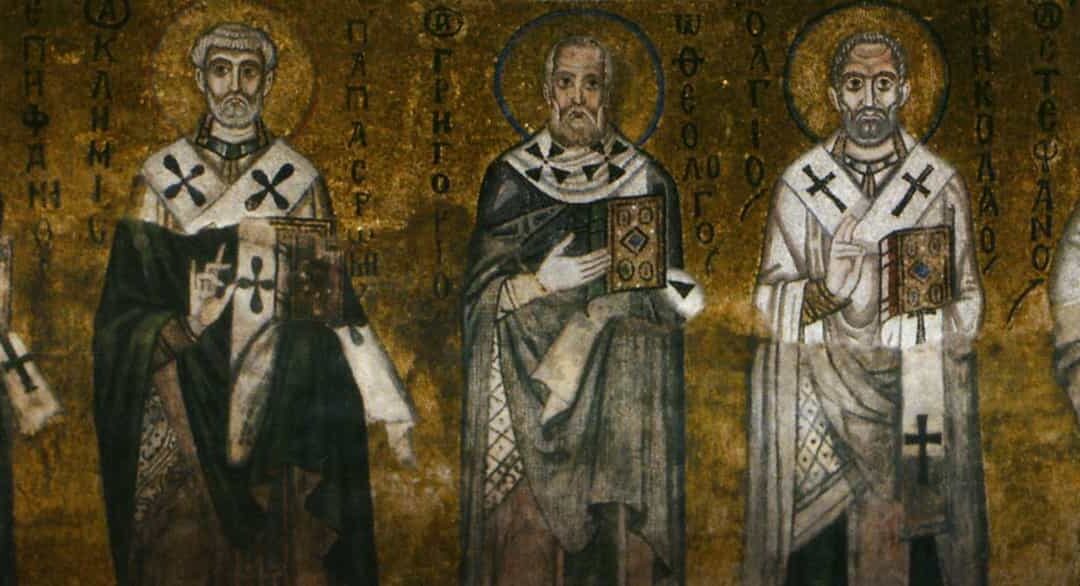
In previous posts I have talked about the various Holy Orders in the Church (twice about deacons, once about pastors as priests). Now, we come to the third order for the function of the Church. The Bishop.
Before we look at the historical development of this role, and contemporary usage, we need to look at what Scripture presents, and clear up some things that might seem cloudy. In the New Testament we get the word bishop from the Greek ἐπίσκοπος episkopos, which when translated is the word overseer (used in Acts 20, Philippians 1, 1 Timothy 3 & Titus 1). In it’s usage the word seems fairly interchangeable with πρεσβύτερος, presbuteros, from which we derive the title Elder or Priest. But, in the usage of the word episkopos there does often seem to be this extra discussion of overseer and authority that is used with it.
Then, moving from Scripture into the first two centuries of the Church we see how this began to play out. What is often seen in the development of the role of bishop is the idea of “elder of the elders”, where the various elders from a given city would select and make one of their own their overseer, providing consistent oversight and authority. This tradition has been carried on where bishops come from the ranks of elders first.
In cities like Alexandria, we see through their history a fairly consistent practice of the elders selecting their bishop from among the elders, which is actually the method that John Wesley referred back to when consecrating Coke & Asbury for mission in America.
The pattern is important because it shows that the bishop was not originally conceived as a detached administrator, but as a pastoral elder among elders, one who carried a coordinating responsibility for teaching, order, and unity within the local church. That matters, because it keeps episcopacy grounded in the life of the presbyterate rather than setting it over against it as though the bishop were a different kind of creature altogether.
This is also why the historical development of the office is so illuminating. The church did not invent the bishop out of nowhere; rather, as the Church grew, the need for settled oversight became more visible, and the role that had already existed in seed form began to take on clearer shape. In that sense, the bishop is best understood as an organic development of apostolic oversight, not a later replacement for it.
That same pattern helps explain why the early church so often assumed that bishops should come from the ranks of the elders. If the office is a higher mode of oversight, then it makes sense that the one who exercises it would first have been tested in the pastoral work of shepherding, teaching, and governing. The bishop is not merely a manager appointed from outside the life of the Church; he is an elder who has been recognized for broader charge and wider responsibility.
This is also the logic that many Anglicans and Methodists have found compelling in tracing their own heritage. John Wesley’s appeal to the ancient practice of episcopal selection was not an attempt to sever the Church from its past, but to recover a pattern of order that he believed belonged to the early Christian witness. In that way, Wesley’s action with Coke and Asbury stands as a reminder that episcopacy has often been defended not as a novelty, but as a faithful continuation of an older apostolic instinct.
If we say it plainly, the bishop exists for the sake of the Church’s unity, doctrine, and mission. They ares called to hold together what is otherwise liable to fragment, to guard what is otherwise liable to drift, and to oversee what is otherwise liable to become disordered. That is why the title itself is so fitting: a bishop is, at root, an overseer.
Of course, this does not erase the close connection between bishop and elder. Rather, it strengthens it. The bishop is not less than an elder, but more properly the elder who bears the wider burden of oversight on behalf of the whole community. And that is precisely why the biblical language matters so much before the historical development is ever discussed.
That line of thought naturally brings us to the bishop as the pastor of pastors. If the bishop is an overseer in the fullest sense, then their first task is not to manage an institution, but to care for the shepherds who care for the flock. They stand in a unique place in the life of the Church, not above the pastoral office in a worldly sense, but within it in a wider and more encompassing way.
This is where the modern age can easily distort the office. When a bishop begins to think of themself primarily as a chief executive, a strategist, or an administrator, they may become efficient but spiritually distant. They may know how to organize systems, but lose touch with the burdens, joys, wounds, and prayers of the people and clergy entrusted to them. The bishop’s calling is not to become less pastoral as their responsibility grows, but more deeply pastoral precisely because it does.
A bishop must therefore be near to their elders/priests, deacons, and local pastors in the way a shepherd is near to their under-shepherds. They listen to them, pray with them, correct them with charity, encourage them in discouragement, and strengthen them for the work they cannot do alone. In this sense, the bishop’s authority is never merely juridical; it is fatherly, spiritual, and relational.
This is also why episcopal leadership must be measured by more than visible results. A bishop may oversee programs, budgets, appointments, and structures, but if they are not tending souls, they have missed the heart of their office. The Church does need order, but order only serves the deeper work of salvation, holiness, preaching, sacrament, discipline, and care. The bishop exists to make that work more faithful, not merely more manageable.
So the bishop must remain a pastor even when they are governing. They must preach as one who believes, counsel as one who has suffered, correct as one who loves, and lead as one who knows that every act of oversight is accountable before Christ the Chief Shepherd. The higher the office, the more urgent the pastoral character of the one who holds it.
That is the real test for bishops in every age. Not whether they can run an organization well, but whether they can carry the heart of a shepherd into the wider field of oversight. A bishop who remains a pastor of pastors strengthens the whole Church; a bishop who becomes only an administrator slowly empties the office of its soul.