by Joel V Webb | Dec 10, 2025 | Orthodoxy Matters, Theology & Practice, Uncategorized
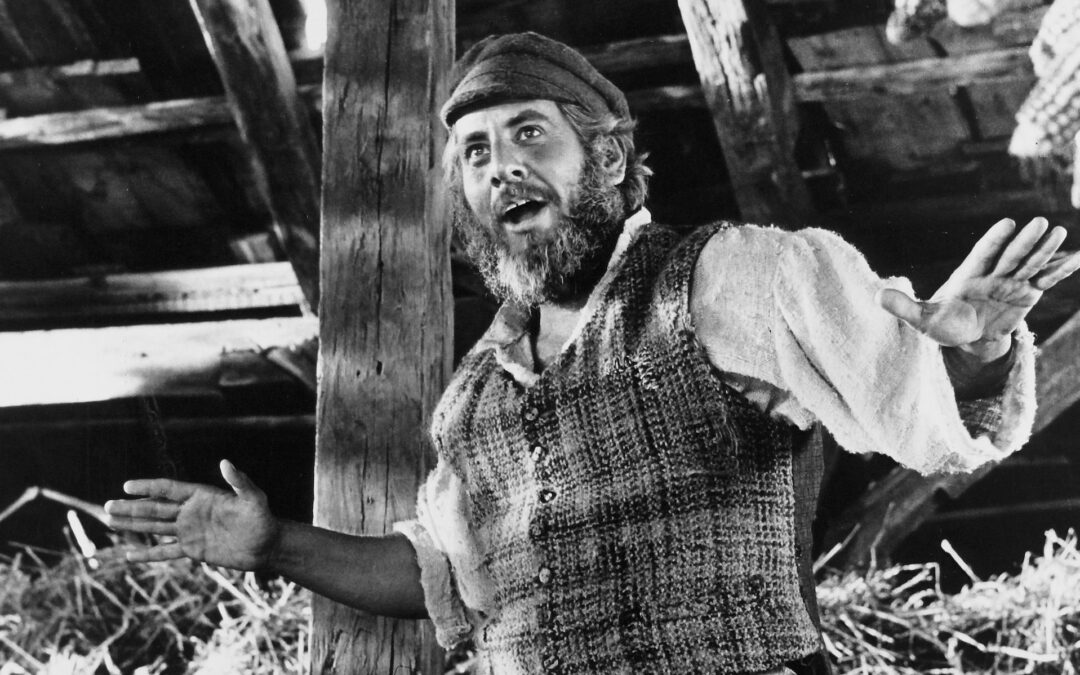
Modern Christians love to sing about “tradition” when Tevye belts it out in Fiddler on the Roof, but many of us grow uneasy when the same word comes up in church. We instinctively feel the pull of Tevye’s point: tradition gives shape, identity, and continuity to a people; take it away, and everything wobbles. Yet when it comes to the Christian faith, we often imagine we can live on “Bible alone” in a way that somehow bypasses tradition altogether. The irony is that, just like the villagers of Anatevka, we already live by powerful inherited patterns—ways of worshipping, reading Scripture, praying, and organizing church life—that were handed down to us, even if no one ever called them “tradition.”
One of the cornerstones of the Protestant Reformation was the reclamation of Scripture as the central infallible rule of faith. Meaning that no matter what, Scripture is the ultimate authority in all things of faith and practice. As someone in a tradition downstream from Anglicanism, we see this in Article 6 of the 39 Articles (which are the confessional and theological foundation of Anglicanism, and were as well for early Methodism), “Holy Scripture containeth all things necessary to salvation: so that whatsoever is not read therein, nor may be proved thereby, is not to be required of any man, that it should be believed as an article of the Faith, or be thought requisite or necessary to salvation.”
And I agree with this. Scripture is essential and of all importance because it is to us a direct revelation of God. Yet, from this also stems a primary frustration. For some Protestants there is always that ‘dirty word’ hiding in the corner…tradition. Like many, I grew up believing that tradition is bad, if not evil, and that tradition is what keeps people away from God. Whenever tradition came up, it always had something to do with those Catholics, Orthodox, Lutherans, Anglicans, or other Christians who dressed funny, and certainly didn’t worship “in the Spirit”, because they were all bound up by their traditions.
Well, for anyone who has known me the last several years, you know I now have a very different answer. Tradition is not bad. Ironically, WE ALL HAVE TRADITION! The question we often fail to ask is, “do I acknowledge my own traditions”. Because, if we don’t, we are actually more controlled by those traditions than we realize, because they are hidden. And this is the fatal deceit we Protestants often fall prey to. We think tradition is bad, and that tradition is not an authority.
But again, we can’t get away from the truth that tradition is always going to be there. And here’s the other thing we must realize. Interpretation of Scripture outside of tradition is just as likely to lead us into heretical teachings that it is into orthodox ones. Just ask Joseph Smith, Charles Taze Russell, Ellen G. White, and the list goes on. As Protestants we must have tradition, otherwise we will continue into an endlessly featuring web of church splits and every more specified denominations over small matters of interpretation.
Now, this is not to say there are no reasons for separation. There certainly are. But when we fail to understand that tradition is authoritative, sometimes we look to as a rule of interpretation, it can help us in maintaining true Christian unity.
Over the last few years, I’ve come to see that tradition, properly understood, is not a rival to Scripture but a servant of it. The great creeds and confessions of the Church were not written to replace the Bible, they were written to safeguard its message, to offer faithful summaries of what the Church across time and place has understood Scripture to teach. When we recite the Apostles’ Creed or the Nicene Creed, we are not adding to the Bible; we are joining our voices to a two‑thousand‑year chorus of believers who have wrestled with the same questions, doubts, and heresies we face today.
At its simplest, tradition functions like a set of guardrails on a mountain road. It does not confine us; it keeps us from tumbling into error while still allowing for movement, discovery, and growth. It gives us perspective—reminding us that the Church did not begin with our generation, nor with the Reformers, nor even with the apostles, but with the eternal purpose of God carried out through time. When we cut ourselves off from that inheritance, we risk spiritual amnesia.
The irony, of course, is that the Reformers themselves were deeply traditional. Luther and Calvin constantly appealed to the early Fathers—Augustine, Chrysostom, Athanasius—not because they thought those writers were infallible, but because they knew that faithful interpretation does not happen in a vacuum. “Sola Scriptura” never meant “Solo Scriptura.” The former places Scripture at the center of authority; the latter isolates it from the Church that bears witness to it.
Many modern Christians assume they have escaped “tradition” simply because they don’t follow a written liturgy or historic creed, but that does not mean they are tradition‑free; it just means their traditions are invisible to them. The way a church structures its services, chooses its music, teaches about salvation, organizes leadership, and even dresses on Sunday are all patterns that have been received, repeated, and defended over time, that is, they are traditions. When these homegrown traditions go unacknowledged, they are rarely tested against Scripture or the wider wisdom of the Church, and so they can quietly harden into non‑negotiable identity markers. The more Protestants distance themselves from historic Christian tradition; creeds, catechisms, classical liturgy, and a common sacramental life, the more each community is forced to invent itself from scratch, which only accelerates fragmentation, doctrinal confusion, and church splits. If this trajectory continues, the body of Christ will become increasingly divided into isolated tribes, each mistaking its own unexamined habits for pure, tradition‑less Christianity, rather than humbly receiving and discerning the tested traditions that once held believers together.
Healthy Christian tradition is not just anything that has been done for a long time; it is the Church’s tested, communal wisdom about how to believe and live the gospel under Scripture. Good tradition gathers up biblical teaching in stable forms—creeds, catechisms, liturgies, patterns of discipleship—that help ordinary believers confess the faith clearly and avoid well‑worn errors. At the same time, because Scripture remains the final norm, even long‑standing practices and assumptions must stay open to correction and reform. Naming this explicitly helps people see that the choice is not between “Bible or tradition,” but between unexamined, private traditions and accountable, Scripture‑shaped ones.
If tradition is to be received and discerned wisely, it has to be held by more than isolated individuals; it belongs to the Church as a concrete, visible community across time and space. Councils, confessions, agreed forms of worship, and recognized teachers are ways the Church has historically said, “This is what we together hear in Scripture,” rather than leaving every question to personal improvisation. When the gathered Church, under the Word and in dependence on the Spirit, tests and hands on tradition, it offers a shared framework that can restrain fragmentation and correct local excesses. Recovering this sense of the Church as a real, tradition‑bearing body helps modern Protestants move from “me and my Bible” toward “we, the Church, listening together to the Scriptures,” which is where genuine unity and faithful reform become possible.
Ultimately, the goal is not to exalt tradition for its own sake, but to love and know Christ more faithfully. Scripture is God’s Word written; tradition is the Church’s memory of how that Word has been lived and confessed. We need both if we are to remain rooted and flourishing in a fragmented world. Perhaps the way forward for Protestantism is not to abandon its Reformation principles, but to deepen them—to see in the Reformers not just critics of the past, but faithful heirs of a much older and larger communion of saints.
by Joel V Webb | Dec 8, 2025 | Uncategorized
This article was originally written for and posted on HolyJoys.org
s as having deep spiritual symbolism. What we see in historic sanctuaries, such as those in older Anglican, Methodist, and Presbyterian churches, represents a blend of practical development and profound spiritual significance. This blend contributes to the richness of Christian worship and continually points us toward the central work of Christ through the gospel.
The Two-Fold Testimony of Scripture
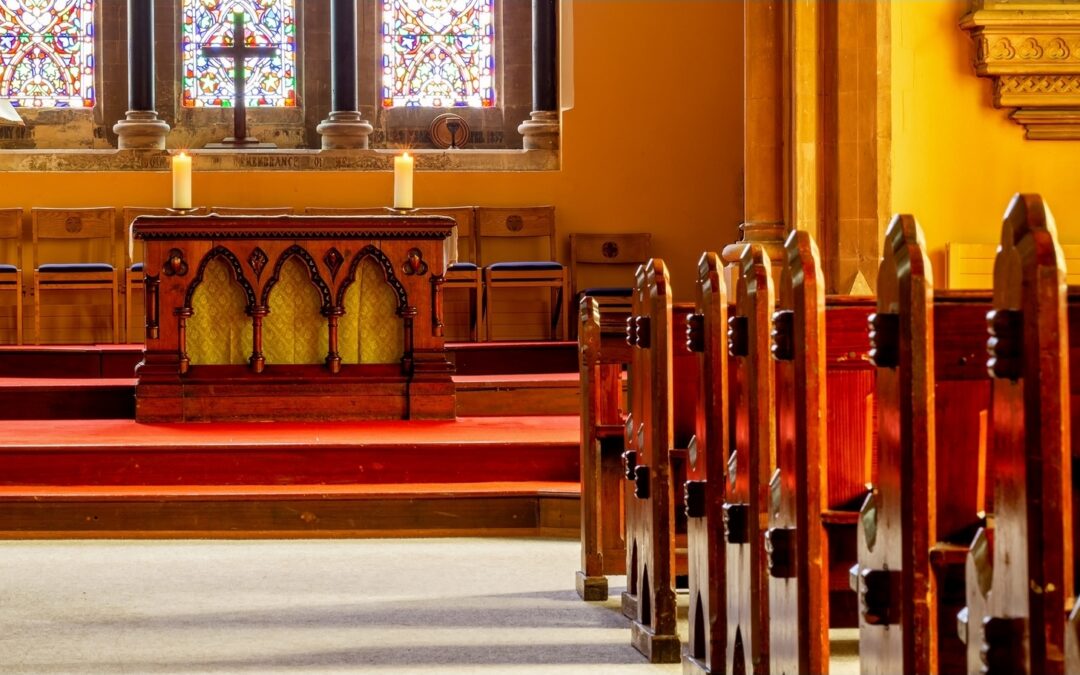
Step into most churches shaped by the church’s historic liturgy and you are likely to see two candles, one placed on each side of or on top of the altar or communion table. Over time, the two candles came to be associated with the proclamation of Scripture. When facing the altar, the candle on the right became known as the Epistle Candle, and the one on the left became the Gospel Candle. This grew out of the historic practice of reading the Epistle from one side of the chancel (the front portion of the church) and the Gospel from the other, an arrangement still visible in some older churches and described in medieval ceremonial guides (e.g., Ordo Romanus I).
This practice also reflects the shape of older lectionaries such as the one found in the 1662 Book of Common Prayer which assigned only two readings for the Eucharistic liturgy: an Epistle and a Gospel. The modern four-reading pattern (OT, Psalm, Epistle, Gospel), familiar in most churches today, only became standard after the liturgical reforms of the 20th century, especially following The Second Vatican Council. So here we see the close weaving together of tradition and practicality: candles originally needed for light eventually became markers of the very structure of the liturgy.
The Two Natures of Christ
Beyond their connection to Scripture readings, the two altar candles also came to symbolize the two natures of Christ, His full divinity and His full humanity, as defined by the Council of Chalcedon in A.D. 451. The church has long sought to confess visually what she proclaims verbally: Jesus Christ is one Lord, “acknowledged in two natures, without confusion, without change, without division, without separation” (Chalcedonian Definition). Thus, the dual candles become a small but meaningful reminder that the One whose presence we invoke at the altar is both God and Man, fully divine Light and fully human flesh, united for our salvation.
The church has long sought to confess visually what she proclaims verbally.
The Light that Gathers and Sends Us
Even the way the candles are lit and extinguished carries meaning. Many traditional services begin with a processional, as clergy, deacons, and acolytes (those assisting in the service) enter the sanctuary in reverence. Often, an acolyte will carry the light itself—sometimes taken from a sanctuary lamp or another ever-burning flame within the church—and use it to ignite the altar candles. This represents Christ, the Light of the World (John 8:12), entering into the midst of His people as worship begins.
Likewise, when the service concludes with the recessional, the light is carried out again. This action reminds us that Christ does not remain “on the altar” when worship ends; rather, He goes out with His people, sending them into the world as bearers of His light. In this way, the extinguishing or carrying out of the candles becomes a liturgical sign of the Great Commission—Christ’s light shining in the world through His Church.
Beauty in Worship
Finally, candles add beauty to Christian worship. While beauty is a profoundly underasked question in our age, there is a reason why the United States has a four billion dollar candle industry! We love candles not just because of the aroma, but because they are beautiful. We certainly don’t need their light, but we are captivated by the mood that’s created by a flickering light. Using candles in the church is a way to beautify the place where we worship our supremely beautiful God.
Using candles in the church is a way to beautify the place where we worship our supremely beautiful God.
Living Catechesis
For some, the use of candles and related practices may appear quaint or overly ceremonial. But far from being empty rituals, they serve as a living catechesis. They teach us—silently, consistently, and beautifully—truths about Christ, the Scriptures, and the mission of the Church. They connect us to the unfathomably long story of Christian worship, where objects once needed for simple visibility have become symbols that illuminate the gospel. Technology may change, and with it many of our daily habits. But within the worship of the Church, candles remain steady witnesses: to the enduring unity of practicality and spirituality; to the two-fold testimony of Scripture; to the two natures of Christ; to the Light that both gathers us and sends us out; and to the beauty of our God. They help us to reconnect not only with our past, but with the One who is the same yesterday, today, and forever.
Candle Options and Where to Buy Them
If your church doesn’t currently use altar candles but you’d like to begin, the internet offers a wide range of options. You can choose traditional wax candles or oil-based ones. Wax candles often come in paraffin (cheaper) or beeswax (more expensive but longer-burning, cleaner, and more “traditional”). Oil-based candles—either refillable or with disposable cartridges—are convenient if you want low-maintenance, reusable lighting. Which type you choose will depend on your church’s budget, how often you use candles, and the aesthetic or symbolic tone that you want for worship.
Once you pick a fuel source, you’ll need candlesticks or candle holders appropriate to your altar space. Even a simple brass or wooden pair can be a good starting point, with the option to upgrade later. The goal isn’t luxury, but to add reverence, symbolic meaning, and beauty to worship.
While there are numerous church suppliers you could utilize (and of course you could always go to Amazon!), there are several well-established online vendors where you can order altar candles (wax or oil) and related church supplies. For the best quality, customer service, and a history of supplying the Church, these are wonderful companies to support:

by Joel V Webb | Nov 26, 2025 | Resources, Theology & Practice
A while ago I wrote about utilizing the Lectionary for preaching. This ancient tool provides Scriptures for every Sunday of the Church year, each passage carefully selected to guide the Church through the rhythms of Christ’s life and the great mysteries of the gospel. At its best, the lectionary is not just a schedule—it’s a theological lens. It draws us into a way of reading Scripture that aligns our hearts with the seasons of the Church, shaping how we pray, how we worship, and even how we understand the story of redemption as it unfolds across the pages of Scripture.
During Lent, for instance, we hear readings that focus on Christ’s ministry as He moves steadily toward His Passion. The texts remind us of His temptation, His preaching on repentance, and His resolute journey to the Cross. These aren’t random selections—they’re intentionally chosen to form us in penitence, humility, and renewed devotion. And now, in Advent, the readings point us toward watchfulness and hope. They remind us of God’s promises, the prophets’ longing, and the call to prepare our lives for Christ’s coming—both His first coming in Bethlehem and His return in glory. When used well, the lectionary doesn’t just tell the story of salvation history; it invites us into it.
Most churches today that follow a lectionary use a three-year cycle—Years A, B, and C. This pattern is a relatively modern innovation, developed after Vatican II and adopted by many Protestant denominations as well. The idea was simple: expand the range of Scripture heard on Sundays so that congregations would receive a broader diet of biblical passages. With concerns about growing secularism, biblical illiteracy, and the increasingly thin scriptural foundation in Western culture, this seemed like a noble and necessary move.
Historically, however, the Church used a one-year cycle that repeated annually. Each new Church year started with Advent, and the readings cycled through the same appointed lessons every year. The repetition was intentional. The Church believed that spiritual formation happens through immersion, not novelty—through hearing the same words again and again, in the same seasons, until they become part of the Christian imagination.
So why did many churches move to a three-year cycle? Part of the answer has to do with changes in everyday life. For centuries, the primary place believers heard large amounts of Scripture wasn’t Sunday morning—it was the daily prayer offices, especially Morning and Evening Prayer. Through these, the entire Bible was read in the course of a year. But as the pace of life accelerated and the daily offices fell out of regular use for many, Sunday morning became the main (and for some, the only) time people regularly encountered Scripture. The three-year lectionary was an attempt to compensate for that loss.
But good intentions do not always yield the outcomes we expect. While the breadth of Scripture increased, something subtle but significant was lost: depth.
Three years is simply too long for the average congregation to hold a unified scriptural rhythm in memory. The seasonal themes become stretched thin. The passages don’t repeat often enough to become familiar, let alone formational. A reading heard only once every three years might be interesting or enlightening in the moment, but it rarely has the opportunity to sink in, to reappear in prayer, or to become a recurring voice shaping our lives.
The older one-year lectionary, by contrast, offered a formative repetition that acted like liturgical catechesis. Every Advent, you encountered Isaiah’s promises. Every Lent, you heard the same calls to repentance and the same foreshadowing of the Passion. Every Easter, the same readings shouted the resurrection hope of the gospel. Over years of worship, these passages became companions—scriptures that lived in the heart, surfaced in difficulty, and formed the backbone of a believer’s biblical memory.
This is why many people who grew up with the one-year cycle can recall certain readings with remarkable clarity. They don’t remember them because they studied them in a classroom; they remember them because they prayed them, sang them, and heard them proclaimed every year. The repetition shaped not only what they believed, but how they believed it.
In the end, this is what the lectionary is meant to do. It is not merely a reading plan. It is a tool for communal formation. It shapes the imagination of the Church, builds a shared scriptural vocabulary, and roots our worship in the story of Christ from Advent through Pentecost and beyond. And perhaps the most important thing we can rediscover—whether using a one-year or three-year cycle—is that Scripture forms us most powerfully when it returns to us again and again.
The goal of the lectionary is not simply that we “get through” more of the Bible, but that the Bible gets deeper into us. And in a restless, distracted age, that depth may be more valuable than ever.
So starting this Sunday (November 30, 2025), the church I pastor is switching to the traditional 1-year lectionary that is found in the 1662 Book of Common Prayer. This is for the most part the same lectionary that John Wesley himself used his entire life. The only major change is the addition of an Old Testament and Psalm reading that has been added by the Canadian Prayer Book Society, as the original 1662 Lectionary only contained an Epistle and Gospel reading.
My hope and prayer is not that this will reap an immediate reward or change, but that in 3 or 4 years, parishioners and myself alike will see how God has been working in us His likeness and character as we encounter the same Scriptures a different way. Our human nature needs repetition for something to sink in. and while the Scriptures might be the same every year, the Holy Spirit has been working each of us into the image of Christ just a bit more, and so we are by His grace that much more like Him.
by Joel V Webb | Nov 21, 2025 | Orthodoxy Matters, Theology & Practice
One of the perennial issues of discussion, disagreement, and consternation in modern Christianity is how to solve a “problem” like the book of Revelation (cue The Sound of Music). It is one of the most talked-about and also one of the most misunderstood books of the Bible, precisely because of what makes it so beautiful. It is mysterious, symbolic, imaginative, and at first glance feels opaque enough that Christians often fall back on whatever interpretive framework they inherited. And for many in the Western church, that inherited lens is some version of the dispensational, end-times schema popularized by the Left Behind series.
Recently, a parishioner asked me how to understand Revelation, and I realized quickly that a simple five-minute conversation wouldn’t be enough. The questions behind Revelation are not only about interpretation but about imagination. We need to untangle what the text actually says from the assumptions we bring to it. And this is difficult, because for many Christians even those who do not personally identify as dispensational, our cultural imagination has been shaped by that system. The idea of a seven-year tribulation, an individual Antichrist, a secret rapture, and a sequence of future political events culminating in Armageddon often feels like it “must” be biblical because we’ve heard the system so often and so confidently.
But when we slow down, open the Scriptures, read Revelation in its own historical and literary context, and listen to the witness of the early Church, we discover something surprisingly simple: Revelation is not about decoding a timeline. It is about unveiling the triumph of Jesus Christ and the call for His people to remain faithful in a world that often opposes the Lamb.
It is striking that the book opens not with a puzzle but with a blessing: “Blessed is the one who reads aloud the words of this prophecy” (Revelation 1:3). The early Church never treated Revelation as a secret codebook but as a proclamation, prophetic imagery meant to comfort persecuted Christians, strengthen their worship, and remind them that the Lamb reigns even when Rome seems unshakable.
This is precisely how the earliest Christian writers approached the book. Irenaeus, writing in the second century, did take Revelation seriously as prophecy, but he always tied its hope to the victory already won by Christ. He wrote, “The name of our Lord… is the faith which brings salvation” (Against Heresies 3.18.7). The point is not prediction. The point is fidelity. Origen, commenting on Revelation’s imagery, said that the visions “are to be understood spiritually” and that the book “reveals what Christ has done and is doing” (Commentary on John 2.2). Even Augustine, often accused unfairly of over-allegorizing, was simply following the pastoral instinct of the Church before him when he said that Revelation displays the reality that “the Church is always under trial… yet is always victorious through Christ” (City of God 20.9).
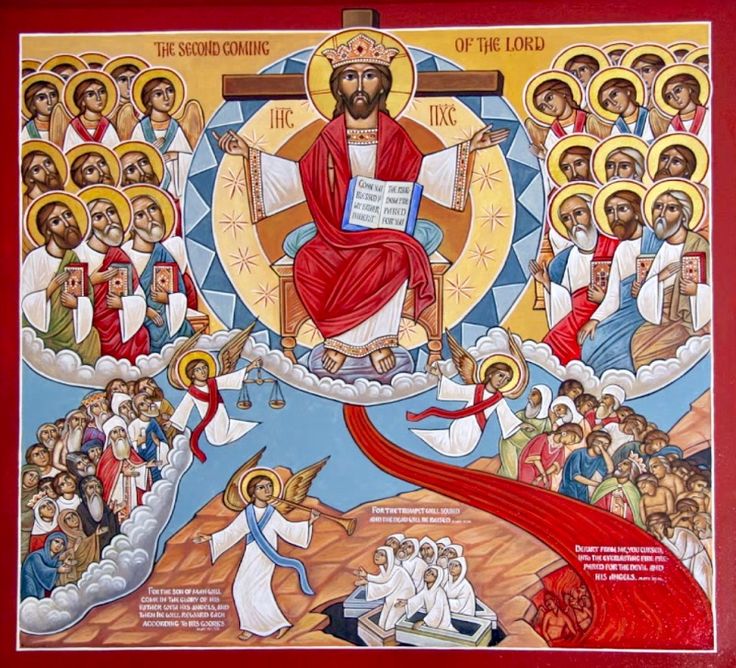
For the early Church, the primary message of Revelation was not fear of what might come, but confidence in what has already come: the Lamb who was slain now stands (Revelation 5:6). Christ’s victory is not future, it is the very lens through which the future must be seen.
This is also why the historic Church never taught a seven-year tribulation. That idea simply does not appear anywhere in Revelation. It emerged from a very particular reading of Daniel 9, developed in the 1800s, in which dispensational writers “paused” Daniel’s 70th week and moved it thousands of years into the future. No Christian writer, east or west, taught this before the modern period. For the early Christians, the “tribulation” was the reality of discipleship in a world that crucified Jesus and still resists His reign (cf. John 16:33). As Tertullian wrote, “The blood of the martyrs is the seed of the Church”—not because the Church awaits a future seven years of horror, but because tribulation is the normal environment of faithful witness.
Likewise, the idea of a single end-times Antichrist figure does not come from Revelation either. The only place in Scripture that uses the word “antichrist” is the Johannine epistles, and there John says plainly: “Many antichrists have come” (1 John 2:18). It is a category, people and powers opposed to Christ—not a cinematic villain. Revelation’s beast imagery is not about a future political leader waiting in the wings; it is prophetic imagery about oppressive empire, idolatrous power, and systems that stand against the Lamb. Early Christians knew this. Victorinus, the earliest commentator on Revelation (3rd century), wrote, “The beast signifies worldly kingdoms… opposed to the Church” (Commentary on Revelation 13). Not an individual. Not a future dictator. A system. A pattern. A recurring reality in history.
In other words, Revelation is not predicting a future empire in exact detail, it is revealing the spiritual nature of all empires that wage war against the Lamb (Revelation 17:14). And the Lamb wins.
Even the Reformers and later theologians continued this historic reading. Luther was initially suspicious of Revelation, but even he insisted its purpose was to “reveal Christ and testify to Him.” Calvin did not write a commentary on Revelation, but he preached from it confidently, saying, “The sum of all prophecy is that God in Christ reconciles the world to Himself.” John Wesley, in his Explanatory Notes Upon the New Testament, reads Revelation as a symbolic depiction of Christ’s ongoing victory and the Church’s call to endurance. Wesley wrote, “The sum of this book is that God governs all things by His providence, for the good of His people.” He never once suggested an end-times timeline, a seven-year tribulation, or a single Antichrist figure.
It is important to say this gently and pastorally: the dispensational approach is very new. It arose in the 1830s through John Nelson Darby, was popularized through the Scofield Reference Bible, and became mainstream in America only in the 20th century. That does not make dispensationalists bad Christians, many of them love Jesus deeply. But it does mean their interpretive framework is not the standard Christian reading and should not be assumed as normative.
This brings us back to Revelation itself, the text, the imagery, the hope. When we set aside the pressure to decode it, Revelation becomes astonishingly clear: the crucified and risen Jesus is the center of all history. The visions unveil not chaos but order; not fear but faithfulness; not despair but triumph. Revelation tells us that the powers of this world may roar, but they are doomed to collapse. The martyrs may seem forgotten, but they stand before the throne in glory (Revelation 7:9–14). The Church may feel besieged, but she is protected by the Lamb who walks among the lampstands (Revelation 1:12–13). The dragon may rage, but it has already been cast down (Revelation 12:7–10). Babylon may boast, but she is fallen before the word is even spoken (Revelation 18:2). Heaven’s cry is not “fear what is coming,” but “Worthy is the Lamb who was slain” (Revelation 5:12).
Revelation is not announcing that Christ will win someday. It is announcing that Christ has won already.
And because He has won, the Church can be faithful even when the world looks like Rome, even when suffering feels heavy, even when the powers rage. Faithfulness is the call; worship is the weapon; perseverance is the witness. As the author of Hebrews reminds us, “we are receiving a kingdom that cannot be shaken” (Hebrews 12:28).
When we read Revelation in continuity with the early Church, with the Reformers, with Wesley, and with the whole sweep of Christian interpretation before the 19th century, we discover that its message is not a coded warning but a cosmic proclamation: Jesus reigns. The Lamb has conquered. The nations will be healed. And God will dwell with His people.
Revelation is not a puzzle to solve but a vision to behold. And when we behold it, without the unnecessary weight of modern timelines—we find precisely what John intended his hearers to find: courage, clarity, and the unshakeable hope that “the kingdom of the world has become the kingdom of our Lord and of His Christ” (Revelation 11:15).
If you wish to further explore this topic, here are some amazing resources to take a look at:

by Joel V Webb | Nov 17, 2025 | Theology & Practice
One of the most unsettling episodes in Scripture comes right after the healing of Naaman in 2 Kings 5. Elisha, the prophet of God, refuses the lavish gifts that Naaman brings in gratitude for his healing. But Elisha’s servant Gehazi cannot resist. He runs after Naaman, takes some of the gifts for himself, and returns as if nothing happened. Elisha, as a prophet of the Lord, knows immediately what Gehazi has done. He confronts him, and Gehazi receives the leprosy of Naaman as a consequence for his actions. It is a sobering story of human desire gone astray and a reminder that God’s grace cannot be manipulated.
Gehazi’s sin was not just greed—though that certainly played a role. It was something more subtle and spiritually dangerous: he tried to turn God’s freely given grace into a personal mechanism, something he could manage, control, or profit from. Naaman’s healing was an act of divine mercy, an unmistakable sign that God moves according to His will and not human schemes. But Gehazi could not accept that reality. He wanted to take God’s miracle and make it serve his own ends. In that, he mirrors a very modern temptation: the idea that we can somehow manifest our desires into reality, that our focused intention, visualization, or spiritual “technique” can make God—or the universe—bend to our will.
Manifesting, in its modern sense, promises control. It suggests that if we align our thoughts, speak our desires boldly, or create the right mental or spiritual conditions, we can bring our hopes to life. It is spiritualized method: a way of trying to manage outcomes outside of God’s sovereignty. Like Gehazi, manifesting assumes that blessing can be directed, ordered, and earned, rather than received as a gift. And this is precisely what Scripture warns against. God does not respond to formulas or mental exercises; He responds to hearts that trust Him, submit to Him, and delight in His will.
One of the challenges for Christians today is that manifesting can be deceptively attractive. In a world of uncertainty, it offers an illusion of control. In a culture that prizes individual desire above all else, it presents a way to “claim” outcomes without surrendering to God. It is appealing because it promises immediate results, gives a sense of spiritual power, and allows people to feel like the architects of their own destiny. But this allure is precisely what makes it dangerous: it positions our desires as the authority, rather than God’s sovereignty.
The difference between manifesting and prayer could not be more stark. Prayer begins with God; manifesting begins with self. Prayer assumes that our desires must be shaped and purified by God; manifesting assumes they are inherently right. Prayer acknowledges God as the one who shapes reality; manifesting suggests we can. Prayer is relational and dependent; manifesting is transactional and self-reliant. Gehazi’s story exposes this danger beautifully: human desire left unchecked, whether in ancient Israel or modern culture, becomes the source of deception, greed, and ultimately judgment.
Scripture gives us a far healthier way to navigate our desires. Our hearts are deceitful (Jeremiah 17:9), and God calls us to submit them to Him. He reshapes our longings so that they align with His will, fulfilling them in ways that are far greater than we could ever imagine. Psalm 37:4 is not a promise that God will give us whatever we want; it is a promise that when we delight in Him, He will create desires in us that match His kingdom purposes. True blessing comes not from our control, but from communion with the God who holds all things in His hands.
Practically, this means that as followers of Christ we must resist the temptation to manipulate outcomes, stop treating our faith like a spiritual technique, and instead cultivate trust, patience, and obedience. Prayer, Scripture, worship, confession, and disciplined spiritual practices form the heart to recognize God’s work in our lives. Gehazi’s downfall is a cautionary tale: when we try to control God’s grace, we corrupt it. But when we trust Him, we receive His mercy and find freedom, peace, and joy that no amount of “manifesting” could ever produce.
The gospel invites us to live in this posture: to receive, not manufacture; to trust, not manipulate; to delight in God’s will, not in our own ability to bend reality. Gehazi’s story and the modern temptation of manifesting remind us that life with God is not about controlling His power, but about participating faithfully in His work. We do not manifest our future. We receive it. We do not create our destiny. We trust the One who holds it. And in that trust, we discover a peace and joy that is impossible to manufacture—but entirely real for those who follow Him.