by Joel V Webb | Jan 9, 2026 | Uncategorized
One of the most fascinating sociological phenomenons is the food offerings at Chinese-American restaurants. While there may be some local variations, these usually independently owned establishments share so much commonality in their menus that I can expect to get just about the same order of sesame chicken just about anywhere. There’s been no grand conspiracy of these restaurants coming together and pick their menus. But organically, over the last several generations, American Chinese food has found some sort of equilibrium where the menus are all about the same.
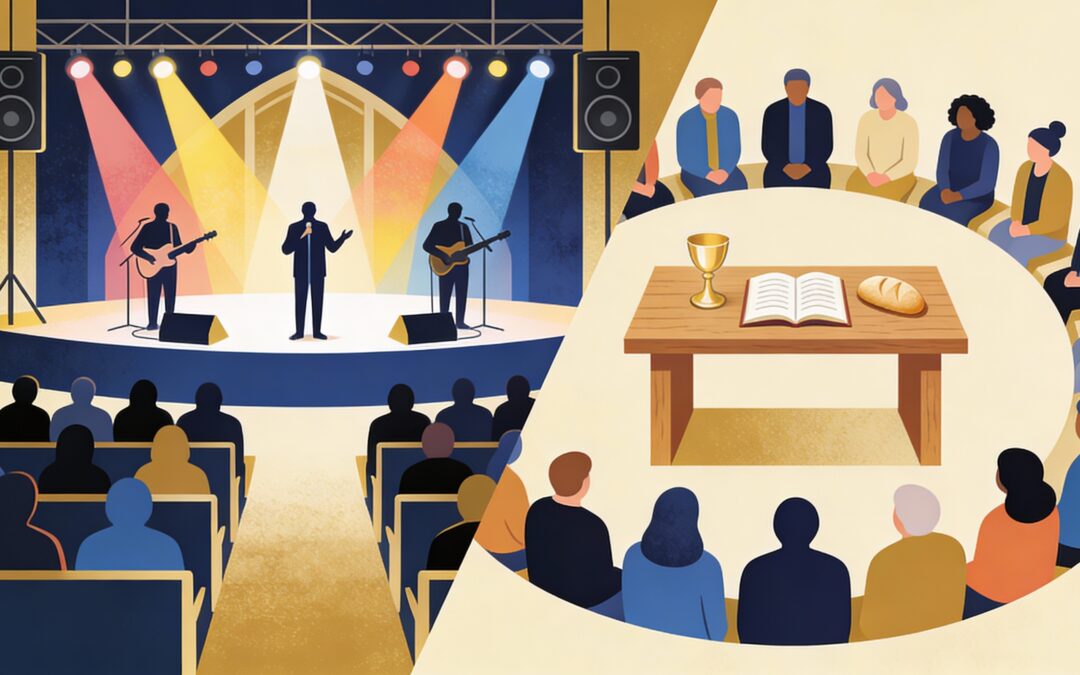
In American church culture there is something very similar going on here. Despite denomination or theological differences, many of the worship services across the West look the same: an energetic welcome, opening song, announcements, more worship songs, prayer, sermon, and then a closing song, sometimes paired with an altar call. I have seen online and have been in these services. Sometimes the church is Baptist, Methodist, Reformed, or non-denominational, yet they share a common “house style” that has quietly become the default American evangelical liturgy, no matter what the denomination’s actual theology or history might say.
There wasn’t a giant gathering of pastors who all agreed, “This is now how church must look.” Just like the takeout menu, this pattern emerged over time. Revivalism taught churches to center everything on visible “decisions” and emotional urgency. Modern sound systems and lighting made it easy to turn the front of the sanctuary into a small concert stage. Church growth experts told leaders to strip out anything that might feel unfamiliar or “churchy” to seekers. And so, slowly, a template took shape: a block of music, a block of speaking, maybe a response song at the end, and very little else.
In the Free Methodist heritage, one of our original distinctives is, “free to worship in the Holy Spirit.” This distinctive comes from our origin story in the mid-1800s, when B. T. Roberts and others broke from the Methodist Episcopal Church over things like slavery, pew rentals, and a kind of buttoned-up formalism that seemed more interested in pleasing wealthy pew-holders than in pleasing God. “Free” meant, among other things, that the poor didn’t have to rent a pew to have a place in the sanctuary, that laypeople and especially women could use their gifts in the assembly, and that worship wouldn’t be suffocated by cold performance or social respectability.
What “free to worship in the Holy Spirit” did not originally mean was “free from the church’s historic practices of Word and sacrament.” The early Free Methodists saw themselves as continuing “original Methodism,” not inventing an entirely new kind of Christianity. And original Methodism, in John Wesley’s own practice, was both revivalist and sacramental. Wesley preached in fields and on street corners, organized small groups, and also remained an Anglican priest who used set forms of prayer and insisted on regular Communion as one of the chief “means of grace.”
Wesley even wrote a famous sermon called “The Duty of Constant Communion,” where he argues that Christians ought to receive the Lord’s Supper as often as they possibly can. He doesn’t treat Communion as a rare symbol but as a regular, God-given channel of grace—a habit that actually shapes the Christian life. For him, to neglect the Table when it is offered is either to ignore Christ’s command or to ignore one of the main ways Christ cares for his people. That is the sacramental DNA that sits underneath our broader Wesleyan tradition.
Fast-forward to the present, and a lot of our Free Methodist services look far more like the generic American evangelical template than like anything recognizably Wesleyan. Instead of a gathered people formed week by week through Scripture, confession, creed, intercession, and frequent Communion, we often have a band set, a sermon, and an altar moment, with Communion tacked on occasionally when the calendar or local habit demands it. The shape of the service quietly catechizes us. It answers the question, “What is church for?” long before the preacher says a word.
If the whole service is built around the sermon and a decision moment, then church starts to feel like an event where individuals come to receive a religious talk and then make a personal choice. If the biggest energy is in the music set, church starts to feel like a spiritual concert with a TED Talk in the middle. But in a Wesleyan and wider historic Christian frame, the church is not just a weekly event. It is the baptized people who are gathered, forgiven, instructed, and fed with Christ’s own life in Word and sacrament, and then sent into the world.
That is where the “Chinese menu” analogy bites a little. No one confuses General Tso’s chicken with the full depth and variety of regional Chinese cooking. It’s a simplified, American-shaped version that settled into place because it works in a particular context. In the same way, the default evangelical order of service “works” in a narrow sense: it is reproducible, marketable, easy to explain, and familiar. But it is not the fullness of the Free Methodist or Wesleyan inheritance, and it may not be the best pattern for forming people in deep holiness over a lifetime.
The tragedy is that our own founding distinctives actually call us to more, not less. Freeing worship from the control of the wealthy and from stiff, performative formalism was meant to open the doors wide—to the poor, to lay gifts, to the Spirit’s prompting—not to cut us off from the very practices that rooted Wesley and the early Methodists in the wider Church. Free seats and full participation make the most sense when you remember that baptism and Communion are the great “levelers”: moments when every person, regardless of status, stands on the same ground of grace.
So the question becomes: do we want our services to be shaped mainly by what “works” in the American religious marketplace, or by what actually tells the truth about what the church is? A Free Methodist congregation that takes its heritage seriously does not have to become a museum of antique Anglicanism. But it does have to wrestle with the fact that Wesley’s own vision was one where the Spirit moves powerfully through very ordinary, very repeatable means—Scripture, prayer, baptism, and the Supper—woven into a recognizable pattern week after week.
If American Chinese food found its equilibrium menu by accident, perhaps we have done something similar in our worship. The good news is that menus can change. No one restaurant has to fix the whole system. A local church can begin, quietly and patiently, to recover a different center: to bring the Table back to the heart of Sunday, to pray not only in our own words but with the words of the wider Church, to order the service so that people are drawn into God’s story rather than just into a string of religious moments.
Over time, that kind of “menu” will form a different kind of people. Not consumers chasing the next moving worship set, but men and women, teenagers and children, learning to live out of their baptism, to expect Christ to meet them at his Table, and to see their whole lives as an extension of what happens when the church gathers. That, it seems, is much closer to what our own distinctive tries to say: not just free to do whatever we want on a Sunday morning, but truly free to worship in the Holy Spirit.
by Joel V Webb | Jan 2, 2026 | Uncategorized
This article was writte nfor, and originally posted on HolyJoys.org
Names are important because they carry meaning and history with them. When the name for something changes, more than just the name can be lost. Part of its identity can be lost, even if the thing remains. I grew up talking about “the cigarette lighter” in cars (something that I burned my fingers on a number of times as an overly curious child). Today, it’s now just called a “12 volt power outlet” or “charger port.” As a non-smoker, I welcome the development. But the point is this: With the change of name, its original purpose is no longer evident.
When it comes to the church, changes in names are more serious and worthy of reflection. For hundreds of years, there were established terms for the parts of the church’s architecture. In recent years, many of these terms have fallen out of use in some contexts. Other terms have been brought in to replace them. This article explores a few of these largely forgotten terms and considers what might have been lost along with the change in name.
From “Chancel” to “Stage”
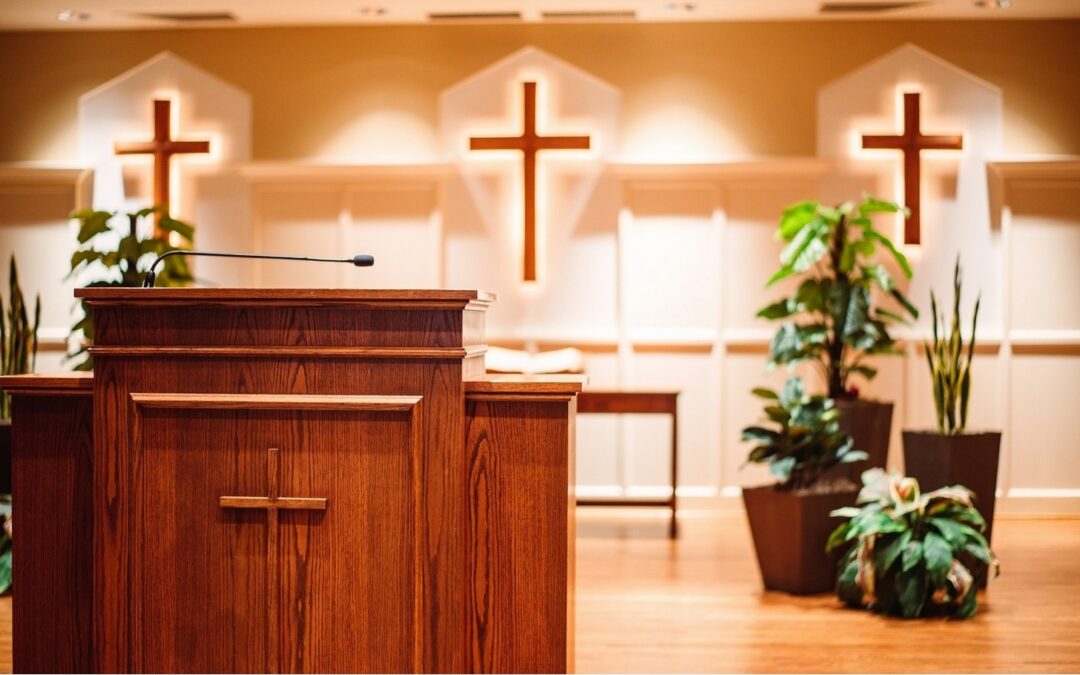
One of the most striking examples of this is the name for the place in the church where the primary activity of the service takes place. Today, it is most commonly called “the stage” or “the platform.” Traditionally, this area of the church has been called the chancel. The chancel is the area where the pulpit, lectern, and altar or communion table are placed, and where the choir, musicians, and clergy conduct most of the service. The term chancel originates from French usage of late Latin meaning lattice, since in many medieval and traditional churches, the chancel area is sectioned off by a lattice-type wall that you can see through, but that defines a distinction of space. Whether or not a church has a lattice-type wall, the point is that for much of history, churches had a special name for this sacred part of the church.
When we abandon traditional language and begin to refer to the front part of the church as a “stage,” something subtle shifts in our imagination. A stage is for performers. A stage is where you watch people do something for you. A stage implies an audience, spotlights, and a certain transactional relationship: you come, they do, you leave. And while no one means any harm by the language, the word itself quietly undercuts the very thing worship is meant to express.
The word “stage” quietly undercuts the very thing worship is meant to express.
The chancel, on the other hand, does not carry the implication of a performance. It carries the weight of a story. The word reminds us that this space is not just where things happen but where holy things happen. It is the place where prayers are offered, Scripture is proclaimed, the sacraments are administered, and the people of God gather near the mysteries that sustain them. A chancel is not a platform; it is a place set apart.
Reintroducing a word such as “chancel”—even softly, and at first within our own imaginations—can deepen our conviction that the church is not a theater. It is a sanctuary—another word that has suffered its own slow fade into generic meaning. A sanctuary is a place of safety, a place marked for the presence of God, a place where heaven and earth meet. When we reduce the sanctuary to an “auditorium,” we risk losing that sense of sacred encounter. An auditorium is where you attend. A sanctuary is where you are received.
From “Nave” to “Seating Area”
Another example is the nave—the central seating area where the congregation gathers. The word comes from the Latin navis, meaning “ship.” Many have never heard the term, but for centuries Christians understood the nave to symbolize the “ship” or “ark” of the Church, carrying the faithful through the storms of the world, as the ark was used by God to save Noah and his family. Some traditional churches are even designed as a long rectangle or as a half-circle to reinforce this theology.
While it may seem like a small thing to say “nave” instead of “seating area,” the older term reminds us that the church is for our salvation (see David Fry’s article “What is the Church’s Role in Our Salvation?”). In the church, we encounter the Savior who can keep us from drowning (queue walking on the water!). The word “nave” also reminds us that our Christian life is not static. We are going somewhere. Together. We are being carried by a grace not our own through the storms of life by the grace and mercy of God that is given to His people.
From “Narthex” to “Lobby”
Finally, consider the narthex, which is now commonly called the “entryway, “vestibule, “or “lobby” of the church. The narthex once symbolized the place of preparation, the threshold between the ordinary world and the holy drama of worship. It was the space where catechumens waited, where penitents stood, where newcomers took their first breath of the church’s life. When we call it the lobby, we lose the sense that worship begins before we ever sit down. We forget that crossing that threshold is itself an act of intention.
More Than Just Tradition
None of this is about being archaic for the sake of being archaic. It’s about remembering that the church is not just a building with functional parts but a space sanctified to God for sacred purposes with meaning-laden sections. The old words don’t just describe; they invite. They teach. They remind us that our faith has depth, that our worship has a lineage, and that we stand in a long procession of believers who use these spaces not simply as rooms but as signs.
The church is not just a building with functional parts but a space sanctified to God for sacred purposes with meaning-laden sections.
When language changes, the identity of a thing sometimes changes with it. And so part of our task in a distracted, rootless age is to recover not only the practices of the church but the vocabulary that helps shape our imagination of what the church is. Of course, we can just use vocabulary without intention and knowledge of the depths that it represents, and that certainly is a danger. But isn’t that true of any word or phrase that we use? That shouldn’t stop us from appreciating the rich meanings that our brothers and sisters in the faith have found through the ordinary means of architecture and construction—things that point us to Christ and the gospel.
Once you see the chancel as the chancel, the nave as the nave, or the narthex as the narthex, it’s hard to ever see them again as just a stage, seating area, or lobby. And even if you don’t use the traditional names, finding other meaningful words can help to sanctify the church’s space and carry meaning forward for a new generation. A small shift could be the beginning of recovering something we didn’t realize we lost.
by Joel V Webb | Dec 29, 2025 | Uncategorized
One of the things that has increasingly bothered me in recent years is that basic ice‑breaker question people ask when religion comes up: “So, are you Christian or Catholic?”
Most of the time I know what they mean. They’re trying to ask, “Are you Protestant or Roman Catholic?” But the way it actually gets phrased reveals something deeper. It sets “Christian” and “Catholic” over against one another as if they were two different species. “Christian” becomes the default, and “Catholic” becomes the oddity that has to be explained.
That way of talking grates on me now, because if words mean anything at all, Roman Catholics are just as much my brothers and sisters in Christ as any other person who truly belongs to Jesus. They are baptized into the same Triune Name. They confess the same Lord’s Prayer. Many of them read the same Scriptures with deep reverence and cling to the same crucified and risen Christ. So when someone asks, “Do you think Catholics are really Christians?”, I’ve come to answer, “I know as many saved Catholics as I know unsaved Protestants.”
That line isn’t meant to be provocative. It’s simply honest. Over the years I’ve met Catholics whose repentance, charity, and love for Christ would put a lot of our supposedly ‘gospel‑centered’ circles to shame. And I’ve met plenty of Protestants who can rattle off all the slogans about grace and faith and justification and yet show no sign that they have actually bowed the knee to Christ. Denominational labels don’t magically sort wheat from tares.
And yet, in large parts of the evangelical, fundamentalist, and hard‑line Reformed world I grew up around, the default assumption was that Rome is not just wrong but essentially beyond the pale. The largest and oldest Western body of Christians is quietly, or not so quietly, filed under “not really part of Christ’s body.” Rome isn’t just in error; Rome is apostate.
I understand how people get there, because that was my default for a long time. I had been catechized into a very particular picture of Catholicism. The list went something like this:
- Catholics worship Mary, who is basically a pagan goddess in a blue robe.
- They pray to a whole pantheon of saints like a set of lesser gods and goddesses.
- The Mass is a piece of ritual magic—transubstantiation—where a priest “conjures” Jesus into the bread.
- They don’t really trust God for forgiveness, so they have to crawl into a confessional and tell a man their sins.
- Their statues, icons, relics, scapulars, holy water, and medals are just Christianized idols and talismans.
When you rehearse that catalogue often enough, it becomes very hard to imagine Catholics as Christians at all. They look like polite pagans who have stapled the name “Jesus” over top of a pre‑Christian religion. You can tolerate them as neighbours, maybe, but you don’t instinctively think of them as family.
What I did not realise at the time was how much that entire way of imagining Catholicism has been shaped by a particular story about “pagan roots” and “pagan survivals” that we’ve absorbed from the culture around us. We think we’re just being biblical and Reformation‑faithful, but our mental furniture has been arranged by someone else.
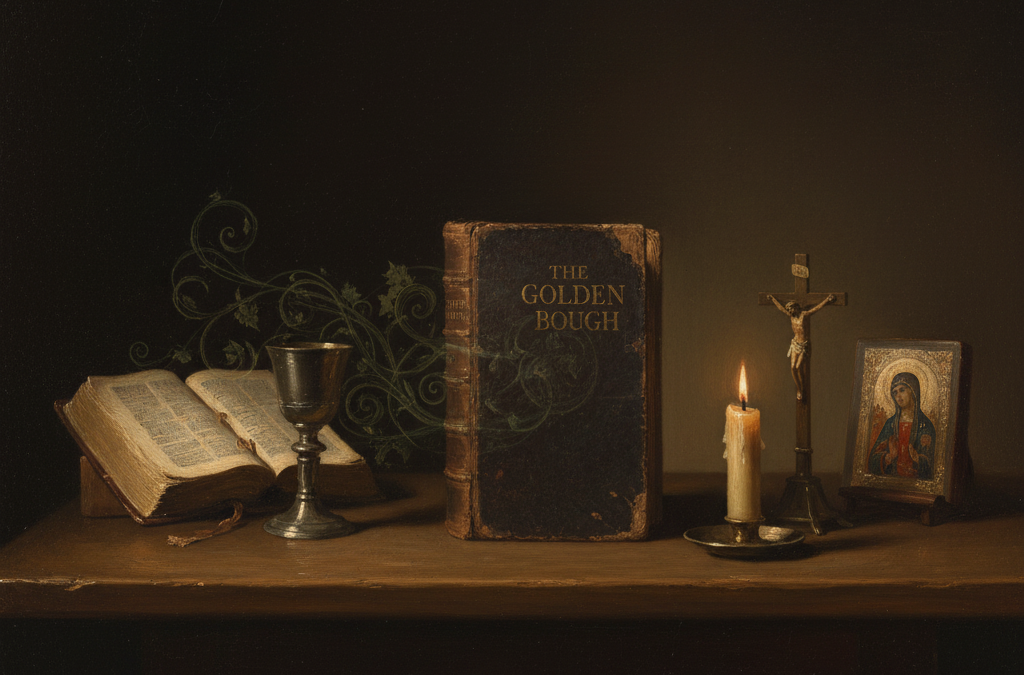
One of the main furniture‑arrangers was Sir James George Frazer, the author of The Golden Bough. Frazer grew up in strict Scottish Presbyterianism and later rejected Christianity altogether. He wanted to show that religion, Christian and pagan alike was an early, mistaken stage in humanity’s development, something that would eventually be swept away by science. To do that, he spun a powerful narrative: at the heart of many religions, he said, is a “dying and rising god” or sacred king, whose death and rebirth guarantees the fertility of the earth and the survival of the tribe.
Into that narrative he threw pagan gods like Osiris, Adonis, and Tammuz. And then, very deliberately, he threw Jesus. The crucifixion and resurrection became, in his telling, another iteration of the same old myth. Easter became a spring fertility festival with a Christian gloss. Christmas became a baptised solstice feast. The whole Christian year became a patchwork of older pagan festivals that the church had simply painted over.
Once that framework is in place, Catholic‑looking Christianity is the easiest target. If you’re hunting for “pagan survivals,” you go where there are feasts, processions, saints’ days, Marian statues, relics in altars, candles and bells and incense. You re‑read all of those things as evidence that the church never really left the old fertility cults behind. “Mary is just the mother goddess in a new dress. The saints are the old local gods with new names. The Mass is a cleaned‑up version of temple sacrifice. Relics are magic bones. Feast days are old seasonal festivals with Christian labels.”
Now, specialists have spent the last hundred years poking holes in Frazer’s grand theory. His “dying and rising gods” turn out to be far less uniform than he imagined. His historical connections between specific ancient rites and specific Christian practices often vanish when you actually trace the sources. His neat story about Christmas and Easter simply being taken wholesale from pagan festivals is, at best, oversimplified. And his underlying assumption that religion is just bad science in fancy dress reads more like late‑Victorian self‑confidence than like a sober description of how human beings actually worship.
But even though the academic world has moved on, Frazer’s way of thinking has stuck in the cultural imagination. It’s there when neo‑pagans talk about “taking back” Easter and Christmas. It’s there when atheists insist that Christianity is nothing but “recycled paganism.” It’s there in the way internet skeptics gleefully circulate charts “proving” that Mary is Isis and the saints are the old gods under new titles. And it’s there, more quietly but just as really, in the way many evangelicals and fundamentalists talk about Catholicism as essentially a pagan religion with a Christian coat of paint.
Here’s the uncomfortable part: a lot of us Protestants have borrowed Frazer’s conclusions without knowing it, and then baptised them as “discernment.” We look at Catholic practices and assume that any resemblance to something we once read about in a documentary or a meme must mean direct borrowing. We assume that if you can find an ancient mother‑and‑child statue somewhere, then Mary must be a goddess. If you can find a pre‑Christian spring festival, then Easter must be stolen. If you can find any pagan use of bread and wine, then the Eucharist must be a sun‑god ritual.
We rarely stop to ask the harder questions:
- What do Catholics themselves say they are doing when they celebrate the Mass or honour Mary or ask a saint to pray for them?
- How did these practices actually arise in Christian history, out of what texts, arguments, pastoral concerns, and controversies?
- Where do they align with, or diverge from, Scripture as read in the early Church, not just as filtered through modern polemic?
From an Anglo-Methodist, Reformation‑shaped perspective, Scripture still has to be the final measure of doctrine and practice. That means there will be places where we say, “No, we cannot follow Rome there.” We may be convinced that certain Marian dogmas go beyond the Word, that particular formulations about sacrifice at the Mass obscure the sufficiency of Christ’s cross, or that some ways of using relics and sacramentals invite superstition. Those aren’t small matters, and we shouldn’t pretend they are.
But if Scripture is our final standard, then truthfulness is not optional either. We are not free to put words in our neighbour’s mouth or to invent origin‑stories that flatter our side. “You shall not bear false witness against your neighbour” doesn’t come with a footnote that says, “unless your neighbour is Roman Catholic.”
So here is where I’ve landed.
First, some may suspect I am on the road to “swim the Tiber”, a coloquial phrase for someone who converts to Catholicism. That’s not where I’m at. I am firmly convinved of why I am a Protestant. Even as my own understanding of the Christian faith has been more deeply enriched by a balanced and Biblical understanding of the authority of tradition, it has only resolved me more to be a Protestant as the expression of the classical Christian consensus, or the “faith once delivered to all the saints” (Jude).
With that, I can, and do, remain committed to the Reformation’s call to weigh every teaching by the written Word of God. I can be frank about my disagreements with Rome where I believe Rome has erred. But I am no longer willing to prop up those disagreements with sloppy talk about “pagan roots” that I haven’t actually investigated, or with caricatures of Catholic belief that crumple the moment I ask a thoughtful Catholic to explain what they really confess.
I still hear the question, “Are you Christian or Catholic?”, and it still bothers me. Not because I’ve become indifferent about doctrine, but because I have become more jealous for the truth. I know as many saved Catholics as I know unsaved Protestants. That simple observation forces me to slow down. It reminds me that Christ’s grace does not honour our party lines as much as we might hope, and that my first allegiance is to Him, the truth, before it is to any half‑remembered stories about who stole what from which pagan festival.

by Joel V Webb | Dec 23, 2025 | Uncategorized
Introduction: When Mission Becomes Functionally Godless
Most of us leading evangelical churches would never dream of calling ourselves atheists. We preach Christ, we pray, we plan missions because we genuinely want people to meet Jesus. But if you sit in enough strategy and church growth weekends, you start to notice something subtly unsettling. While there certainly is the language of the church being used, a time of worship and prayer, much of everything else is not too different from what you might find at a business conference. At the very end someone offers a quick prayer “Lord, bless our plans” and everyone goes home feeling like they’ve been faithful. Yet a nagging question remains: if everything we just mapped out “worked,” would we be able to say God actually did anything, or would the whole thing be explainable in terms of technique, psychology, and branding? That’s the question this piece wants to poke at. Not to sneer at planning or to baptize laziness, but to name a quiet reality: it is possible to ask God to bring in the results and still run our ministries in a way that would basically work if God were not real. Call it “practical atheism.”
One of the most obvious and influential sources of this is in the person of Charles Finney. Finney did not invent that problem, but his “new measures” gave it a powerful shape and memory in American revivalism, and a lot of our current strategies are still drinking from that stream. This is not a grumbling complaint against Finney specifically, or what many call the church growth or exponential movements. What it is, is a prayerful question as to whether our means to the mission of the Church have replaced the true source of it all.
Symptoms: How Practical Atheism Shows Up in Mission
One of the first places this shows up is in how we ask, “Does it work?” That’s not a bad question; it’s just a terrible first question. In a lot of ministry literature and conference chatter, “what works” becomes the unquestioned dogma, with faithfulness quietly assumed but rarely examined. We borrow language from the business world best practices, scalable models, proven pipelines and then sprinkle some Bible verses and spiritual platitudes about the great commission over the top. The underlying assumption sounds a lot like Finney’s: if you use the right means in the right way, you should expect the right spiritual results. Revival is “the predictable outcome of proper measures.” That logic now lives on in our church messaging, our pathways to programs and our haunted‑house‑level control over the Sunday “experience.” When our cues, lighting, and language are designed so precisely that almost any outcome can be produced on schedule, we should at least pause and ask: which of these core strategies could a secular nonprofit copy with almost no changes?
Another subtle sign is the way God becomes a kind of brand asset. We’ve all heard and said lines like “God gave us this vision,” sometimes as a genuine testimony, sometimes as a way of putting our plans beyond question. Finney defended his new measures with real conviction, he was sure they were necessary tools for reaching people, and many after him have done the same with whatever their version of the anxious bench is. Today it might be a particular worship style, a pipeline, or a growth strategy. We tell story after story about people who “went through our process” and came out changed. The danger isn’t in the stories; it’s in where they point. Do they draw attention to the sheer, free work of God, or to the cleverness of our funnel? If we stripped out our logos and trademark language, would anyone listening still be able to tell that God, not our brand, was the main actor?
Finally, practical atheism shows up in how we respond when the graph stops sloping up and to the right. This is something that I fall prey to at times. When attendance flattens, giving dips, or the energy in the room feels off, most of us feel a familiar panic rise in our chests. The instinct is to find a new model, see “what sticks”, or copy what’s working down the road. In Finney’s framework, if revival isn’t happening, it’s because someone is not using the right measures or using them with enough passion. Many of us, without thinking, have absorbed that same instinct: if the system is lagging, we must need a better system. What rarely comes naturally is calling the church to fasting, repentance, or rigorous self‑examination. It is far easier to fix the optics than to face the possibility that God might be withholding visible “success” for our sanctification. When growth slows, do we first reach for a different playbook, or do we fall on our faces and ask whether the Lord might be trying to get our attention?
Roots: The Theological Imagination Behind Practical Atheism
Underneath all of this is a particular way of imagining God and the Church. One root is a kind of functional deism. On paper, we believe in a God who is all powerful, can work miracle and knows all things; in practice, we lean on a God who set up certain “laws” of ministry and now expects us to work them. Finney captures this mindset bluntly when he insists that revival is “not a miracle,” but a natural outcome when the right means are used. That doesn’t mean he denied God’s existence or sovereignty, but it does mean he thought in fairly mechanical terms: do the right things, in the right way, and you should expect the right results. A lot of modern leadership material assumes something similar. Once the strategy is set, the right people are in place, and the systems are running as they should, we expect the ministry engine to behave itself. Divine interruption becomes the exception, not the norm.
There’s also a thin doctrine of the Church at work. When the local church is primarily imagined as an organization with a mission statement instead of as the Body of Christ gathered at font and table, it makes sense to treat it like any other organization. Finney’s focus fell often on “the meeting” rather than on a particular congregation’s ongoing life. The big event whether in a town square or a church was the center of communal life. That emphasis has filtered down to us in the form of the endlessly optimized Sunday “experience” and the traveling conference. Meanwhile, the slow, sacramental life of a concrete community; washing people in baptism, feeding them at the Lord’s Table, visiting the sick, bearing one another’s burdens, sits in the background. When the “real action” is happening on the stage, and the sacraments are add‑ons, we’ve already adopted a self-produced revivalist imagination, even if we’ve never read Finney.
The way we talk about the Holy Spirit reveals another root. In a lot of evangelical spaces, the Spirit is language for energy: “God really moved” often means “the room was buzzing, and I felt like it went good.” Finney’s lectures on revival tend to describe the Spirit’s work in moral and psychological categories. Divine persuasion meeting human decision. There is, in his scheme, less room for the Spirit to say “no,” to withdraw, to discipline the church, or to confound a carefully planned campaign. When that imagination trickles down, we begin to think of the Spirit as the power that makes our methods effective, rather than the Lord who might blow them up. We plan, the Spirit fuels, and the only thing that would cause us to change course is a drop in visible results, not a word from God.
Towards Needing God Again: Constructive Practices
So what might it look like, practically, to run ministries that make no sense without God? One starting point is rediscovering practices that look gloriously “unproductive” on a spreadsheet. Churches can decide, as an act of faith, that major decisions will be wrapped in fasting and prayer, not as a last‑minute add‑on but as the main work. That may mean delaying a building project, a campus launch, or a new program because the people of God have not yet had time to wait on the Lord together. It may mean building silence into elder meetings and staff retreats, not just brainstorming and whiteboarding. None of that will make a great conference talk. It will, however, force us to confront whether we actually believe God speaks, leads, and intervenes.
Another move is to re‑center Word and sacrament as the Church’s first “strategy.” Instead of treating preaching as content that supports the program, we could recover it as the moment when the risen Christ addresses His people through Scripture. Instead of letting baptism be tagged onto the end of a service, we could let it shape how we talk about conversion: as a passage into a new community and a new identity, not just a personal decision. Instead of treating the Lord’s Table as a quarterly speed bump, we could make it the weekly heart of our gathering, where mission begins and ends. Revivalistic patterns, from Finney onward, tend to decenter the Table in favor of the meeting. A sacramental imagination does the opposite: the meeting is in service to font and table, not the other way around.
We can also choose to embrace holy inefficiency. That might mean slowing leadership processes, inviting more people into discernment, or telling the truth when we don’t know what to do next. It might mean walking away from techniques that “work” emotional manipulation, fear‑based preaching, relentless hype, because they damage the Body, even if they produce decisions. In a world shaped by Finney’s confidence in new measures and our own addiction to the latest model, saying “no” to an effective tactic for the sake of the Church’s health is a profoundly theological act. It is us saying, “We would rather appear unsuccessful than wound Christ’s Body.”
Finally, we can put metrics back in their place. Numbers matter; they tell part of the story. But they are not the judge of the Church. Instead of using them as a silent verdict—“we’re winning” or “we’re failing”—we can use them as prompts for prayer: “Lord, what are you saying to us here?” Alongside attendance and giving, we can start to name other signs of grace: reconciled relationships, long‑term faithfulness, growth in generosity, courage in suffering. In a culture trained by revival reports and conference highlight reels to only notice the spectacular, this is training our eyes to see the quiet work of God.
Pastoral Examination: Questions for Leaders and Teams
None of this lands unless it becomes personal. For those of us who lead, there are some uncomfortable but necessary questions: Where do I feel most panicked in ministry, and what does that reveal about where I’m trusting strategies more than the Spirit? Which of my habits; sermon prep routines, counseling practices, leadership decisions, would look utterly foolish if God were not alive and active? For leadership teams: Can we name one area of church life we currently run on autopilot? What would repentance there actually look like? When we look back over the last year of big decisions, which ones were clearly shaped by prayer, waiting, and a readiness to be wrong, not just by urgency and imitation? And for whole congregations: If an outsider watched our life together for a month, where would they see that we actually *need* God, not just believe in Him?
If some of these questions sting, that’s not necessarily bad news. Finney was right about at least one thing: God really does work through means, and there are ways of arranging our common life that welcome or resist His work. The invitation is not to throw away planning, preaching, or passion, but to let the Spirit of God re‑baptize them.
Conclusion: From Strategy‑Driven to Presence‑Dependent Mission
The problem is not that we care about mission, or that we want to plan wisely. The problem is how easy it has become to build churches and ministries that run beautifully on principles any practical atheist could affirm. Finney stands in this story as both a caution and a mirror: a man aflame with evangelistic zeal who helped normalize the idea that spiritual outcomes are the predictable result of the right tools in the right hands. Many of us have inherited that confidence without realizing it. The way forward is not to romanticize the past or demonize every modern method, but to become communities whose most treasured practices; preaching, prayer, baptism, the Supper, confession, healing, patient love, only make sense if Jesus Christ is risen and reigning. That might start very simply: a season of fasting and prayer before the next big initiative, a fresh look at how your church treats Word and sacrament, an honest conversation among leaders about where you’ve trusted systems more than the Spirit. The question underneath all of it is disarmingly simple: in our mission as a church, do we actually need God?
by Joel V Webb | Dec 10, 2025 | Orthodoxy Matters, Theology & Practice, Uncategorized
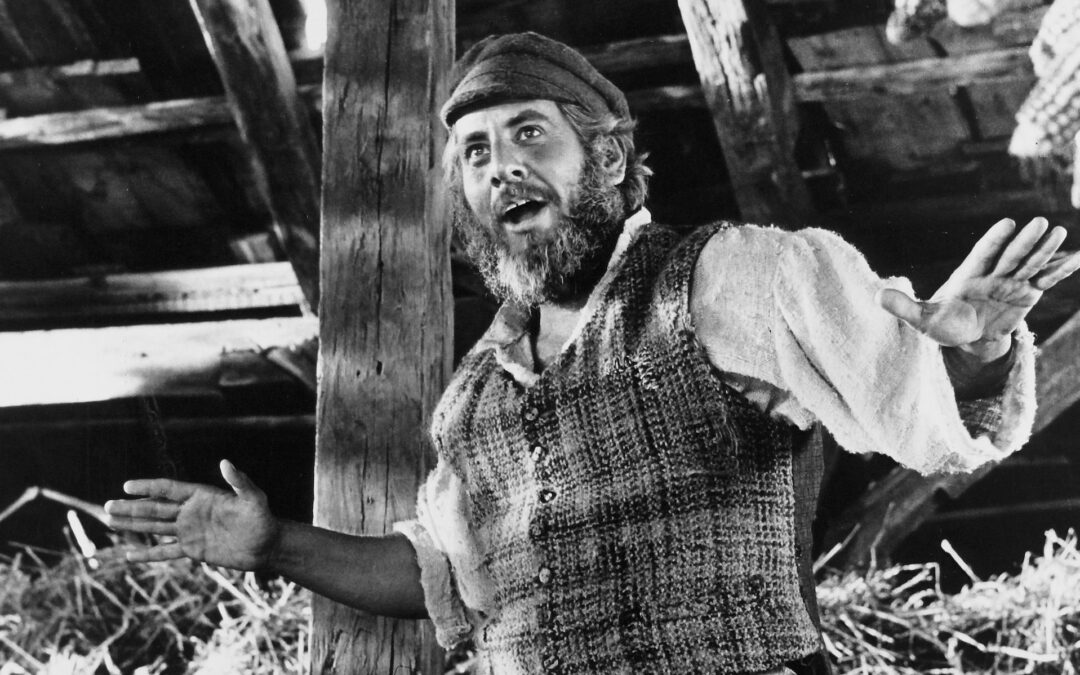
Modern Christians love to sing about “tradition” when Tevye belts it out in Fiddler on the Roof, but many of us grow uneasy when the same word comes up in church. We instinctively feel the pull of Tevye’s point: tradition gives shape, identity, and continuity to a people; take it away, and everything wobbles. Yet when it comes to the Christian faith, we often imagine we can live on “Bible alone” in a way that somehow bypasses tradition altogether. The irony is that, just like the villagers of Anatevka, we already live by powerful inherited patterns—ways of worshipping, reading Scripture, praying, and organizing church life—that were handed down to us, even if no one ever called them “tradition.”
One of the cornerstones of the Protestant Reformation was the reclamation of Scripture as the central infallible rule of faith. Meaning that no matter what, Scripture is the ultimate authority in all things of faith and practice. As someone in a tradition downstream from Anglicanism, we see this in Article 6 of the 39 Articles (which are the confessional and theological foundation of Anglicanism, and were as well for early Methodism), “Holy Scripture containeth all things necessary to salvation: so that whatsoever is not read therein, nor may be proved thereby, is not to be required of any man, that it should be believed as an article of the Faith, or be thought requisite or necessary to salvation.”
And I agree with this. Scripture is essential and of all importance because it is to us a direct revelation of God. Yet, from this also stems a primary frustration. For some Protestants there is always that ‘dirty word’ hiding in the corner…tradition. Like many, I grew up believing that tradition is bad, if not evil, and that tradition is what keeps people away from God. Whenever tradition came up, it always had something to do with those Catholics, Orthodox, Lutherans, Anglicans, or other Christians who dressed funny, and certainly didn’t worship “in the Spirit”, because they were all bound up by their traditions.
Well, for anyone who has known me the last several years, you know I now have a very different answer. Tradition is not bad. Ironically, WE ALL HAVE TRADITION! The question we often fail to ask is, “do I acknowledge my own traditions”. Because, if we don’t, we are actually more controlled by those traditions than we realize, because they are hidden. And this is the fatal deceit we Protestants often fall prey to. We think tradition is bad, and that tradition is not an authority.
But again, we can’t get away from the truth that tradition is always going to be there. And here’s the other thing we must realize. Interpretation of Scripture outside of tradition is just as likely to lead us into heretical teachings that it is into orthodox ones. Just ask Joseph Smith, Charles Taze Russell, Ellen G. White, and the list goes on. As Protestants we must have tradition, otherwise we will continue into an endlessly featuring web of church splits and every more specified denominations over small matters of interpretation.
Now, this is not to say there are no reasons for separation. There certainly are. But when we fail to understand that tradition is authoritative, sometimes we look to as a rule of interpretation, it can help us in maintaining true Christian unity.
Over the last few years, I’ve come to see that tradition, properly understood, is not a rival to Scripture but a servant of it. The great creeds and confessions of the Church were not written to replace the Bible, they were written to safeguard its message, to offer faithful summaries of what the Church across time and place has understood Scripture to teach. When we recite the Apostles’ Creed or the Nicene Creed, we are not adding to the Bible; we are joining our voices to a two‑thousand‑year chorus of believers who have wrestled with the same questions, doubts, and heresies we face today.
At its simplest, tradition functions like a set of guardrails on a mountain road. It does not confine us; it keeps us from tumbling into error while still allowing for movement, discovery, and growth. It gives us perspective—reminding us that the Church did not begin with our generation, nor with the Reformers, nor even with the apostles, but with the eternal purpose of God carried out through time. When we cut ourselves off from that inheritance, we risk spiritual amnesia.
The irony, of course, is that the Reformers themselves were deeply traditional. Luther and Calvin constantly appealed to the early Fathers—Augustine, Chrysostom, Athanasius—not because they thought those writers were infallible, but because they knew that faithful interpretation does not happen in a vacuum. “Sola Scriptura” never meant “Solo Scriptura.” The former places Scripture at the center of authority; the latter isolates it from the Church that bears witness to it.
Many modern Christians assume they have escaped “tradition” simply because they don’t follow a written liturgy or historic creed, but that does not mean they are tradition‑free; it just means their traditions are invisible to them. The way a church structures its services, chooses its music, teaches about salvation, organizes leadership, and even dresses on Sunday are all patterns that have been received, repeated, and defended over time, that is, they are traditions. When these homegrown traditions go unacknowledged, they are rarely tested against Scripture or the wider wisdom of the Church, and so they can quietly harden into non‑negotiable identity markers. The more Protestants distance themselves from historic Christian tradition; creeds, catechisms, classical liturgy, and a common sacramental life, the more each community is forced to invent itself from scratch, which only accelerates fragmentation, doctrinal confusion, and church splits. If this trajectory continues, the body of Christ will become increasingly divided into isolated tribes, each mistaking its own unexamined habits for pure, tradition‑less Christianity, rather than humbly receiving and discerning the tested traditions that once held believers together.
Healthy Christian tradition is not just anything that has been done for a long time; it is the Church’s tested, communal wisdom about how to believe and live the gospel under Scripture. Good tradition gathers up biblical teaching in stable forms—creeds, catechisms, liturgies, patterns of discipleship—that help ordinary believers confess the faith clearly and avoid well‑worn errors. At the same time, because Scripture remains the final norm, even long‑standing practices and assumptions must stay open to correction and reform. Naming this explicitly helps people see that the choice is not between “Bible or tradition,” but between unexamined, private traditions and accountable, Scripture‑shaped ones.
If tradition is to be received and discerned wisely, it has to be held by more than isolated individuals; it belongs to the Church as a concrete, visible community across time and space. Councils, confessions, agreed forms of worship, and recognized teachers are ways the Church has historically said, “This is what we together hear in Scripture,” rather than leaving every question to personal improvisation. When the gathered Church, under the Word and in dependence on the Spirit, tests and hands on tradition, it offers a shared framework that can restrain fragmentation and correct local excesses. Recovering this sense of the Church as a real, tradition‑bearing body helps modern Protestants move from “me and my Bible” toward “we, the Church, listening together to the Scriptures,” which is where genuine unity and faithful reform become possible.
Ultimately, the goal is not to exalt tradition for its own sake, but to love and know Christ more faithfully. Scripture is God’s Word written; tradition is the Church’s memory of how that Word has been lived and confessed. We need both if we are to remain rooted and flourishing in a fragmented world. Perhaps the way forward for Protestantism is not to abandon its Reformation principles, but to deepen them—to see in the Reformers not just critics of the past, but faithful heirs of a much older and larger communion of saints.