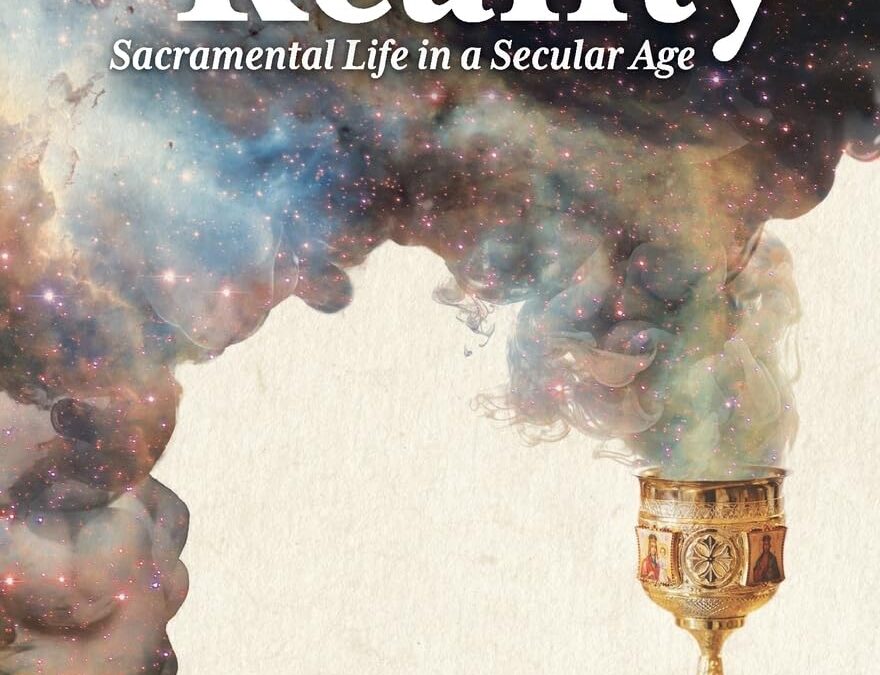
What is reality? And if we have lost the picture of it in the Christian context, how do we return?
This question and more are handled by Zachary Porcu in this very easy to read and understand, yet deeply profound book. While coming from an Eastern Orthodox perspective, the nature of the topic is still immensely applicable to any believer in any context.
Out of the gate, Porcu sets the stage of where we are currently at. For the most part, many in Western Christianity while truly believing in Christ as Lord and Savior, are in every other respect, functioning secular materialists in their worldview and theology. One thing I have appreciated as I have studied the Eastern Orthodox world more is their intention in ensuring that the way we understand and experience reality is in line with the ancient worldview of the early Church rather than the development that culminates from 19th Century German philosophy. This way of seeing the world does not delineate between the spiritual and the physical as we are so use to. Instead, these two realities are intertwined in an inseparable way that was commonly understood in the ancient world, and by the first followers of Christ.
This way of looking at things has led to many unintended consequences. Rather than seeing how Christ may work in a comprehensive way in all things, we either find ourselves in a tug of war between Christ working individually through salvation, or through society to being about the perfect recreation as He intended. This tension between what can be boiled down to the political left and right, are ultimately incorrect in their ultimate assessment, because again, they are looking at the world, and her problems through the lens as a modern secular materialist.
So what is the answer?
Sacramental Christianity. This word might scare some who come from low-liturgy backgrounds, or have fundamentalist tendencies. Porcu makes the excellent point that the way God now, following the ascension of Christ and the coming of the Holy Spirit does not just interact with us in a spirit-to-spirit way, as many in the modern west act. Because of the incarnation, God coming in the flesh, that means that He also interacts through what we would call the physical, and this is through sacrament.
Rather than just looking for that “feel good moment”, sacramental Christianity is about knowing that God works through the means of Grace He has instituted in the Church. The primary focus of this is of course Eucharist (Communion, or the Lord’s Supper). As we journey to understanding the Christian faith is more than just a set of beliefs, but a participation in an ongoing story, we then see how we are empowered to follow Christ as we engage in the life of the Church.
Now, I will note, Porcu does list the seven primary sacraments of the Orthodox faith. As a Protestant, I affirm the two sacraments of Baptism & Eucharist. Yet, I do believe that the others on the list may provide similar sacramental benefit, as they are all involved in engaging us in receiving from Christ.
Through the book he uses a simple analogy. Being a electrical unit that needs plugged in to work. At baptism, the believer is plugged into the wall. And then as we participate in sacrament through the life of the Church (primarily Eucharist) it is the electricity that flows to power us. This can help us see the ongoing work of Christ in our lives, rather than always focusing on the one time salvation experience that we are trained to look for.
The focus of Sacramental Christianity is to retrain our minds and worldview, to see existence as the early followers of Jesus would have. Rather than being dulled by materialism and secularism, we are awakened again to a world charged with the presence of God, where heaven and earth are not competing realms but interpenetrating realities. This shift is not merely intellectual—it is deeply formative. It calls us not just to think differently, but to live differently, to recover practices that reorient our desires, our worship, and our understanding of what it means to be human. In many ways, this is a call to repentance at the level of imagination—a turning away from a flattened, disenchanted view of the world toward one that is alive with meaning, mystery, and divine presence.
Porcu’s strength is in his ability to take what could be an abstract philosophical and theological discussion and ground it in the lived experience of the Church. He is not simply arguing for a different framework; he is inviting the reader into a different way of inhabiting reality. That invitation is both challenging and hopeful. Challenging, because it requires us to unlearn deeply ingrained assumptions shaped by modernity—assumptions that have quietly catechized us into seeing faith as private, inward, and largely disconnected from the material world. Hopeful, because it offers a more coherent and holistic vision of the Christian life—one that refuses to reduce salvation to a moment or faith to mere cognition, but instead presents it as an ongoing participation in the life of God.
One of the most helpful contributions of the book is how it exposes the inadequacy of the categories we often use to talk about Christian life and mission. The common dichotomy between “personal salvation” and “social transformation” begins to break down when viewed through a sacramental lens. In a sacramental worldview, Christ is not working in competition between individual hearts and societal structures, but is redeeming and restoring all things in and through His Body, the Church. This reframing helps dissolve some of the ideological tensions that have come to define much of modern Christianity, particularly in the West. What we often interpret as theological disagreement may, at a deeper level, be the result of a shared but unexamined commitment to a secularized understanding of reality.
For those in pastoral ministry, especially within low-church or revivalist traditions, this book serves as a helpful corrective without being unnecessarily polemical. It does not caricature Protestantism, nor does it demand an abandonment of evangelical convictions. Instead, it gently but persistently presses us to consider whether those convictions have been unintentionally narrowed by a secular framework. It asks whether our emphasis on conversion, for example, has been detached from incorporation into a sacramental community, or whether our understanding of grace has been reduced to an internal experience rather than a lived, embodied reality mediated through the Church.
Why this book matters for Protestants
For Protestant readers in particular, Journey to Reality is valuable not because it argues for Eastern Orthodoxy, but because it exposes a blind spot many of us have inherited. Much of Protestant theology, especially in its modern expressions, has been filtered through post-Enlightenment assumptions that subtly reshape how we read Scripture, understand salvation, and practice the Christian life. The result is often a sincere but truncated faith—rich in conviction, yet thin in sacramental depth and cosmic vision.
Porcu’s work helps Protestants recover categories that are not foreign to our tradition, but foundational to it. The Reformers themselves held a robust view of the means of grace, even where they disagreed with Rome or the East on their number and nature. John Wesley, in particular, spoke of the sacraments as “ordinary channels” through which God conveys grace—language that resonates strongly with the vision Porcu presents. In this sense, the book can serve as a retrieval tool, helping Protestants reconnect with aspects of their own theological heritage that have been neglected or overshadowed.
Additionally, this book provides a needed corrective to the tendency toward individualism that pervades much of Protestant practice. By emphasizing participation in the life of the Church, it calls believers out of a purely personal or privatized faith and into a communal, embodied reality. This is not a denial of personal conversion, but a deepening of it—situating it within the ongoing life of worship, sacrament, and discipleship.
It also challenges the reduction of faith to intellectual assent or emotional experience. In many Protestant contexts, the Christian life is often measured by what one knows or feels. Porcu redirects attention to what God is objectively doing through the Church, inviting believers to trust in and submit to those means of grace even when subjective experience fluctuates. This can be especially grounding in seasons of doubt, dryness, or spiritual fatigue.
Perhaps most importantly, Journey to Reality helps Protestants see that recovering a sacramental worldview does not require abandoning core commitments to Scripture, justification by faith, or the authority of the gospel. Rather, it invites a fuller integration of those commitments into a way of life that takes seriously the Incarnation—that God works not only through words and ideas, but through matter, bodies, and created realities.
In that sense, the book is not a threat to Protestant identity, but an invitation to deepen it.
In that sense, Journey to Reality can function as a bridge text—helping Protestants recover a richer sacramental imagination without requiring full agreement with every aspect of Eastern Orthodox theology. As someone who affirms two sacraments rather than seven, I still found Porcu’s broader point compelling: that God’s grace is not limited to internal or invisible means, but is communicated through tangible, embodied practices that shape us over time. Even where there is theological disagreement, there is still much to be gained by wrestling with the vision he presents.
Another notable strength is the accessibility of the book. Porcu avoids overly technical language without sacrificing depth. His use of analogy—particularly the image of being “plugged in” at baptism and continually energized through participation in the sacramental life of the Church—is simple but effective. It provides a helpful way of understanding the continuity of the Christian life, pushing back against the tendency to overemphasize a one-time decision while neglecting the ongoing means by which God sustains and transforms His people.
This also has significant pastoral implications. In many of our contexts, believers struggle with assurance, spiritual dryness, or a sense that their faith is stagnant. A sacramental framework offers a different approach. Rather than constantly looking inward for evidence of spiritual vitality or chasing emotional experiences, it directs us outward—to the concrete means of grace given to the Church. It roots the Christian life not in fluctuating feelings, but in the steady, objective work of God through Word and sacrament.
At a broader level, Porcu’s work invites us to reconsider what we mean by “reality” itself. If reality is fundamentally sacramental—if it is created and sustained by God, and continually bearing His presence—then the Christian life is not about escaping the world, nor merely managing it better. It is about rightly perceiving it and rightly participating in it. This has implications not only for worship, but for ethics, vocation, and daily life. Work, relationships, creation care, and even suffering can be reinterpreted within a framework where God is actively present and at work.
Of course, readers from different traditions will engage the book in different ways. Some may find certain claims overstated or wish for more nuance in areas of theological disagreement. Others may feel a tension between Porcu’s presentation and their own ecclesial commitments. Yet even where one does not fully agree, the central thrust of the book remains valuable. It raises questions that many of us have not been trained to ask, and it challenges assumptions that have long gone unquestioned.
Ultimately, Porcu reminds us that Christianity is not simply about escaping the world or fixing it through purely human means. It is about participation in the life of God, made available to us through Christ, and continually mediated by the Spirit through the life of the Church. To return to reality, then, is to return to this participatory vision—to see, receive, and live in a world where God is truly present and at work, not just in extraordinary moments, but in the ordinary rhythms of sacramental life.
This is a short book, but it carries weight far beyond its length. It is accessible enough for the average church member, yet substantive enough to provoke deeper theological reflection and meaningful pastoral application. I would especially recommend it to pastors, teachers, and thoughtful laypeople who sense that something is missing in the way faith is often practiced in the modern West. For those willing to engage it seriously, Journey to Reality offers not just a critique, but a path forward—a way of recovering a fuller, richer, and more faithful vision of the Christian life.