Since becoming a pastor people have asked me what my favorite part of the role is. Initially I would say sermon preparation. And I do love it. The prayer, study, condensing of the message and delivery are things I enjoy very much. But as time has progressed and I am getting close towards one year as a lead pastor, I have started to notice that there is something else that is my favorite part of the role.
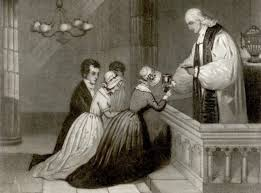
Recently I have spent some time doing home visits for a parishioner who has been facing some medical issues. Because of these issues he isn’t always able to make it to church, which means that he misses on coming to the table for communion. So there we are, sitting together in his room, talking and spending some time together, and then I open my portable communion kit, and we share in some prayers, and then eating and drinking together. And it was in that moment that I realized, “this is what I love to do.”
To be sacramental is to understand that what makes the world what it is, is not the scientific understanding of the molecular and atomic as the building blocks of reality. But to know that it is through those means that God utilizes as the delivery method of His grace. We are not disembodied spiritual beings. We are people who are spiritual, that have physical bodies, and at this current moment, during our lives, they are inseparable.
It is gnostic in tendency to believe that the primary experience of the Christian life is cathartically non-material. That it is based on our feelings, or an inward experience that does not have an outward or physical expression. Yes, there is a moment of regeneration that takes place, when the Spirit of God enters a person and they are now a Christian, a member of Christ’s body on the earth, not dedicated to be an ambassador of the Kingdom. But that moment is recognized and understood historically in Christian theology, to be at baptism, when through an act of God, a person is circumcised not by human hands, and is brought into a new life in Christ. The physical act, not in and of itself, is the act by which God operates His grace and works in us and to us.
Here we now come back to Communion. What are the means that we are strengthened and enabled for Christian life and service? This has always been understood in classical Christianity, and through the magisterial reforms to be through coming to the table. John Wesley says in his sermon The Duty of Constant Communion:
The grace of God given herein confirms to us the pardon of our sins, by enabling us to leave them. As our bodies are strengthened by bread and wine, so are our souls by these tokens of the body and blood of Christ. This is the food of our souls: This gives strength to perform our duty, and leads us on to perfection. If, therefore, we have any regard for the plain command of Christ, if we desire the pardon of our sins, if we wish for strength to believe, to love and obey God, then we should neglect no opportunity of receiving the Lord’s Supper.
It is in this primary sacrament that God gives us His grace, and here we see the importance for us to never neglect participating in it. As I have said before, it is unfortunate that this most essential and important act has taken “second fiddle” so to speak in much of the American Protestant experience. Whether through practical consternation, or theological downplaying, we have taken what seems to be an obvious command of Christ, and neglected it.
Part of John’s strength of words on the position was largely due to the practice of receiving the Sacrament during his lifetime. At that time in England, it was law for all a part of the Church of England to receive at minimum the Eucharist three times a year. And, as often happens with minimums, many people took that as the rule, and only received those three times to maintain their participation and status within society. This lax recognition, seeing the reception of the means of grace as the bare minimum of societal participation would of course as we can guess lead to a low view of the Sacraments. As the Rev. Dr. James Wood of the Nazarene Theological College of Australia would say that the Methodist revival was not just evangelical in nature (centered around the Word of God), but also a sacramental revival, as churches where John would administer the Sacrament would have hundreds in attendance (https://podcasts.apple.com/us/podcast/did-wesley-intend-to-start-a-church-with-joseph-wood/id1569988895?i=1000735543639)
This should lead us to have a slightly modified perspective then, as those in the Wesleyan-Methodist movement in the 21st century, that the heritage we hold is not just the centrality of Scripture and holiness, but as well a recentering of the sacraments as the means by which God’s grace is administered and flow through to His Church. Sadly, the result over the last century in particular in those movements such as my own who have influence from the holiness movements have seen that low church drift towards a secondary importance of things like the Lord’s Supper, seeing them an ancillary to the life of the People of God, rather than primary and central that have co-equal necessity in ministry to the life of followers of Christ.
From the Eucharistic Manual of John & Charles Wesley: This Holy Sacrament is not only a Commemorative Sacrifice, but a Feast conveying blessings to man, nurturing and sustaining his soul ; it is the divinely appointed means of access to God, the channel through which His graces are given. To this Feast all Christians are invited to meet their Saviour, and to feed upon His precious Body and Blood, which once having given for the life of the world , He there offers to be the sustenance of every faithful soul.’ It is a sure instrument of present grace, and the only safe pledge of our everlasting inheritance.’
Do we now see what we have so often missed? John himself it is seen from his diaries and other accounts that he took communion at least 4 times a week. And, a central contention in the early Methodist movement, particularly in America was the necessity of clergy who could administer the Sacraments to a quickly expanding United States, with Methodist as a whole growing right alongside it. Wesley’s Sunday Service of the Methodists was a revised Book of Common Prayer edited for the American Methodists to have worship centered around this administration.
This is often the false dichotomy that we create around the Methodist revival. It was not a rejection of the sacramental or liturgical nature of the Anglican tradition, that was moved aside for a more evangelical or in some cases it would be argued charismatic expression of the Christian faith. Rather, it it through the evangelical and charismatic in which the sacramental and liturgical were brought to life, restored to their full benefit and purpose in being the bulwark of living the faith day to day, mediating the grace of God through the Church as had been described and demonstrated from Acts, the Church Fathers, through to the Reformation and then to the Wesley’s.
So here is where we are called. To a re-centering of the Eucharistic heart of the Church. To see that coming to the table is not just a necessity, or something we do from time to time. But instead is, when done in faith and out of love for God, as the “grand channel” of God’s grace (Sermon 11, “Give Us This Day Our Daily Bread.”). And I think, the longer we think about it, the more we realize that in a tired and disenchanted age, we need the mystery, beauty and strength that God gives to us in His body and blood.
When one studies Church history as a Protestant there are one of two avenues to approach it. The first is that of the magisterial reformers such as Luther, Calvin, Cranmer and others who saw the ongoing move of the Church as good, with the need to reform and adapt to the issues being presented to maintain the fidelity and effectiveness of Christ’s Kingdom on earth. The second approach likewise stems from the reformation from characters like Zwingli, and others of the radical reformation that saw the medieval church as wholly apostate and unfaithful, having been that way some few generations after the close of the book of Acts, and it is their job to bring the Church back to the true apostolic practice of the Christian faith.
I used to be a part of that latter group. I was unequivocally taught that while there is always a faithful remnant, the Church really got back on track with Martin Luther in the 16th Century, and while things have not always been done correctly, we have the true and best version of the faith. These tendencies are particularly found in low-church Reformed circles, anabaptist, baptist and non-denomination evangelicalism. Anything traditional is viewed with suspicion as being “too Catholic” (Roman Catholic), and generally there is a HUGE knowledge gap between the book of Acts and Martin Luther, because frankly there’s not much worth knowing until the church was saved by Luther. The problem with this mentality is that in its desire to be faithful, it ends up throwing out the baby with the bathwater, and ultimately rejects what the reformers sought to do.
To actually be Protestant—and not restorationist—means recovering what the Reformers themselves knew in their bones: that the faith of the apostles was never lost, but preserved, guarded, and handed down through the centuries by the Church under the guidance of the Holy Spirit. The Protestant Reformation was never meant to erase history, but to redeem it—to scrape off the corrosion of error and neglect so that the gold of the Gospel could shine once again.
Modern Protestants often forget this. We imagine that the Reformation was about starting over, about “getting back to the Bible” as though no one in fifteen hundred years had ever read it rightly. But that’s not how Luther, Calvin, Cranmer, or any of the magisterial Reformers saw their work. They saw themselves as continuing the one, holy, catholic, and apostolic Church—reforming her where she had strayed, but never abandoning her. They were heirs of the Fathers, not orphans. Their vision of reformation was renewal within the story of God’s people, not rebellion against it.
When you actually read the Reformers, you see how deeply they drew from the well of patristic theology. Luther was steeped in Augustine; Calvin filled his Institutes with quotations from Chrysostom, Basil, and the early councils. Cranmer built the Book of Common Prayer on the bones of ancient liturgies, purified and translated for the English people. These men saw no contradiction between Scripture and the Church’s historical witness; they believed that the same Spirit who inspired the Word also preserved its faithful interpretation through the ages.
That conviction stands in sharp contrast to the restorationist impulse that dominates much of modern evangelicalism. Restorationism assumes that the Church fell off the rails almost immediately after the apostles died—that by the second or third century, Christianity was already hopelessly compromised. It views history not as a story of God’s faithfulness, but as a long night of corruption and error until “we” finally rediscovered the truth. Its posture toward the past is suspicion, not gratitude.
But such thinking is historically false and spiritually dangerous. It cuts the believer off from the communion of saints, leaving each generation to reconstruct Christianity on its own terms. It treats the Holy Spirit as though He took a sabbatical for 1,400 years, only to return in the 16th century or, worse, in a 19th-century revival meeting. That’s not faithfulness to Scripture—it’s arrogance cloaked in piety.
Thomas Oden, one of the most important theologians of the 20th century, saw this clearly. After decades as a progressive theologian chasing modern trends, he underwent what he called a “paleo-orthodox” conversion—a return to the consensual tradition of the early Church. Oden realized that genuine renewal comes not from innovation but from remembrance. He argued that the Church’s future depends on recovering her ancient consensus, what he called “the great cloud of witnesses” of the first five centuries.
Oden’s rediscovery of the Fathers was not mere academic nostalgia; it was a spiritual awakening. He came to see that the early Church’s theology was not speculative philosophy but lived wisdom—the fruit of prayer, persecution, and pastoral care. These were men and women who wrestled with heresy, hammered out the creeds, and preserved the integrity of the Gospel under immense pressure. They gave us the vocabulary of Christian faith: Trinity, Incarnation, grace, and salvation. To ignore them is to amputate ourselves from our own theological bloodstream.
The Reformers understood this instinctively. Calvin wrote, “If we wish to provide in the best way for the consciences of men, we must go back to the ancient Church.” Luther affirmed that he taught nothing new but “the same faith that Augustine and the Fathers held.” Cranmer’s Anglican liturgy drew directly from patristic sources such as the Didache, Chrysostom, and the Gelasian Sacramentary. They didn’t imagine a sharp divide between the apostolic and the catholic; they saw themselves as faithful heirs of both.
By contrast, restorationism tries to make every believer an apostle and every church a new Jerusalem. It erases history, treating the Church as a failed experiment that must be rebooted from scratch. The result is a dizzying array of “New Testament” churches, each claiming to have recaptured the primitive faith, yet all differing on baptism, the Lord’s Supper, authority, and even the Gospel itself. What was once meant to restore unity ends up multiplying division.
True Protestantism offers a different way. It stands with Scripture as the final authority, but never apart from the Church’s living memory. It reforms what has been corrupted but keeps what is good, refusing both blind traditionalism and reckless innovation. It honors the Fathers as witnesses to how the early Church lived, prayed, and understood the Word of God. It confesses that the Spirit who inspired Scripture is the same Spirit who preserved its meaning through the generations.
Thomas Oden put it simply: “The next reformation will be a recovery of memory.” That is the call of genuine Protestantism—to remember who we are, to recover the faith that formed us, to recognize that the Church is not a modern invention but an ancient household. If the Reformers could say with confidence that they stood in continuity with the Fathers, can we?
To be Protestant, rightly understood, is to be reformed and rooted—to be biblical and historical—to be evangelical and catholic. It means confessing the faith of the Nicene Creed without embarrassment, praying words shaped by centuries of saints, and reading Scripture through the same lenses worn by those who first received it. It means recognizing that tradition, when purified by the Word, is not our enemy but our inheritance.
Our age does not need another “new” version of Christianity. It needs a remembering Church—a Protestantism that knows its Fathers, honors its Reformers, and lives its faith as part of the one Body that stretches across time and space. That kind of Protestantism is not a protest of rebellion, but a protest of witness: a bearing forth of the ancient Gospel in every generation, until the Lord returns.
I grew up in Canada, so I didn’t get the experience of saying the pledge of allegiance every day. But as in the US we did sing the national anthem every morning, facing the national flag in the room as part of our daily routine. Every morning we sang the words, “God keep our land, glorious and free!”. While Canada certainly could learn a thing or two from that line right now, I’m not here to comment on that. Nevertheless, we all have these common things that bind us together in a certain identity. We know that they know, and because of that there is a shared understanding of who we are.
Then we get to the world of Christian worship, and the plethora of styles that exist in the world today. This isn’t wholly a bad thing. Before becoming a lead pastor, I led worship in a contemporary context, and there were certain things I loved about it. But one thing that nagged at the back of my head was, “what is the connection with what we are doing with the rest of the Church?”.
For most in the modern American evangelical world, more traditional styles of worship can often be looked at with suspicion (often being suspected of “being too Catholic”), or maybe kind of laughed at as antiquated. But there are many things that we in evangelicalism can learn from the faithful worship of our brothers & sisters in ages past.
One of these key elements of worship is the reciting of an ecumenical creed. Even since the earliest days of the Church, a variety of concise statements of belief have been used as a part of preparation for baptism, and in worship. The two main creeds that are often used are the Apostle’s Creed, or the Nicene Creed. Both of these creeds accepted by all orthodox Christian throughout history, contain the core truths of the Christian faith.
Why is reciting a creed even important?
First, historically the creeds have been placed in the order of worship for churches as a check on the clergy. In Anglican liturgy, the creed follows the sermon. This is placed there as a statement and question, “does what was just preached line up with what we just said?” In many churches there can be problematic theology that is presented from the pulpit, and having the core creed of Christian doctrine help work as a ruler that the sermon can be compared too. Though sadly this is not a sure fire way, because there are many more traditional denominations and traditions that are wholly caved the liberal and woke ideology, despite saying the creeds weekly.
Secondly, creeds provide a foundation of right belief, and an inoculation against bad ideas. A good friend of mine was raised Roman Catholic. He learned the creeds from a young age, and even during his teen years when he wasn’t really following Christ, he encountered a preacher who was sharing aberrant theology. Despite not actively living the Christian life, my friend was still inoculated from these ideas, because he instantly recognized that what was being said did not line up with the creed in certain areas. Now again, as stated above, this is not a 100% sure thing. You can know the creed, and choose to ignore what it is actually saying. But, I would argue that for most Christians, knowing the creeds would be a beneficial thing.
We live in an age with a million messages hitting our brain every singly day. Facebook, Instagram, TikTok, Reddit, Youtube and the list goes on and on…not to mention traditional advertising on billboards and TV commercials. We are constantly being messaged to.For us as followers of Christ, the creeds provide to us messaging that we can get on board with. Something that we can remember and look to, as a sure thing as to the truth of the Christian faith.
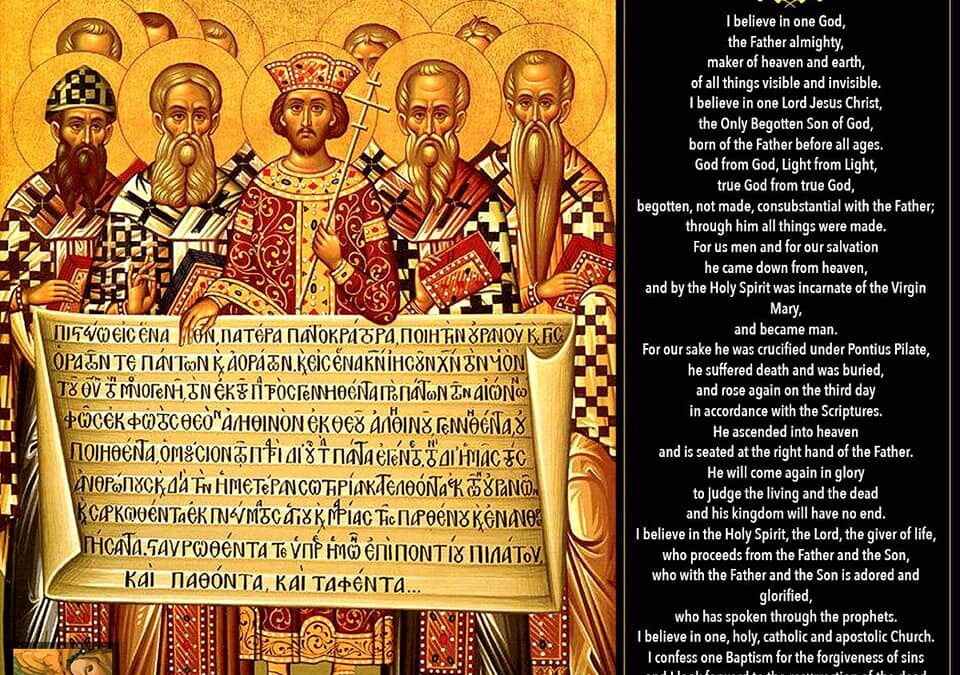
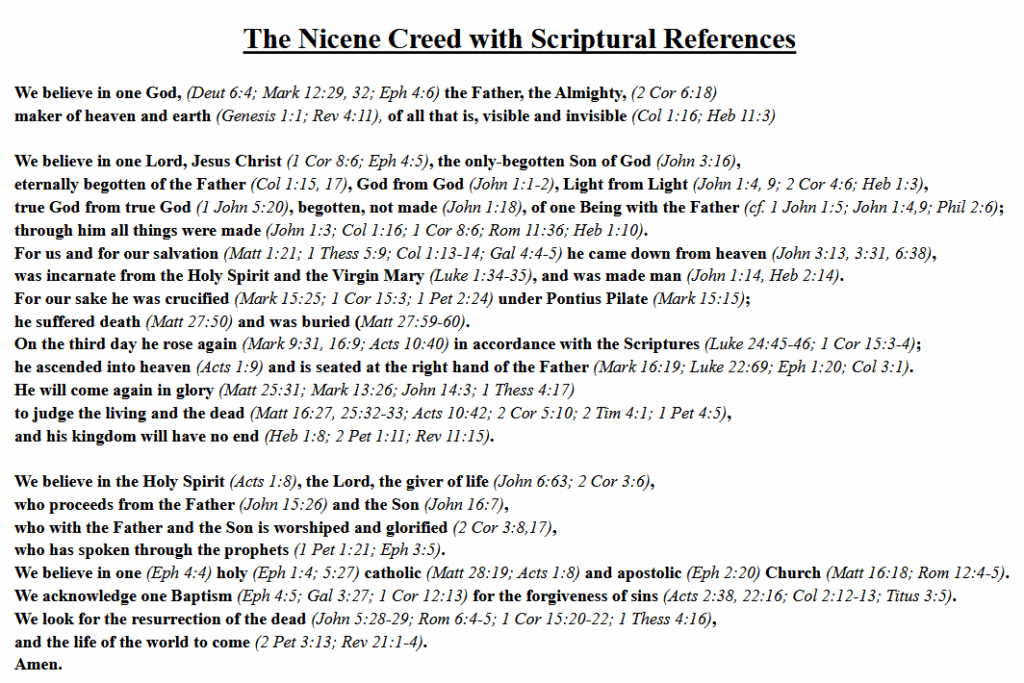
Below is a photo showing the Scriptural references that are found in the Nicene Creed. The creeds are not just “concocted words of men”, but are synthesized and condensed truths from Scripture, organically presented to systematically present the truths of, and the general flow of the Gospel message. The creeds help ground and center us in a crazy world.
The creeds help provide a guard rail against bad theology. You see, the tricky little secret that many don’t think about, is that heretical ideas use the same Scripture. Yes, ideas are over weighted in their importance, or incorrect translations or ideas are added to the text, but nevertheless the Bible is used as a proof-text for bad ideas. The creeds help us in telling us that as we read God’s holy and inspired Word, the correct interpretation and understanding of them will be found inside of the bounds of the creeds.
But how can all of this work in a contemporary setting? Good question!
As I had mentioned, I had been leading worship in a contemporary worship setting up until the beginning of 2025. For the entire last year I led worship, we recited the Apostle’s Creed every single week as part of our time of worship. And other than a little confusion about the word ‘catholic’, it integrated really well.
It can, and I would argue should be done. As Christians we have a beautiful and rich heritage in the creeds, but for many Christians there is complete ignorance that they even exist. But so much benefit is being missed out on. There are so many different ways for contemporary worship settings to use the creeds.
In recent years there have been a bunch of fantastic contemporary worship songs coming out based on or directly quoting the ecumenical creeds of the Church. I Believe by Phil Wickham, We Believe by the Newsboys, The God We Love (Nicene Creed) by CityAlight, This I Believeby Hillsong just to name a few. Use these songs, often! If a worship leader or pastor doesn’t feel that reciting a creed regularly can work for some reason, sing these songs.
But in the end, I believe firmly that EVERY church should in some way shape or form should recite a creed every single week. I always led it at the beginning, before going in to the worship set. But that is just one example, there are a multitude of ways that they can be added in, and practically it can take 30 seconds. The Apostle’s Creed is an easy one because it is shorter, but for most the Nicene Creed is the “gold standard” that the Church historic has used.
In our day and age having a good handle on the truths of the Christian faith is more important than ever, which means we need the creeds more than ever. Their usage will be enriching for all, because not only are we being taught and reminded of the Gospel, and the work of Christ, but we are being connected to Christians all around the world, and throughout history. There is continuity, there is connection, there is family.