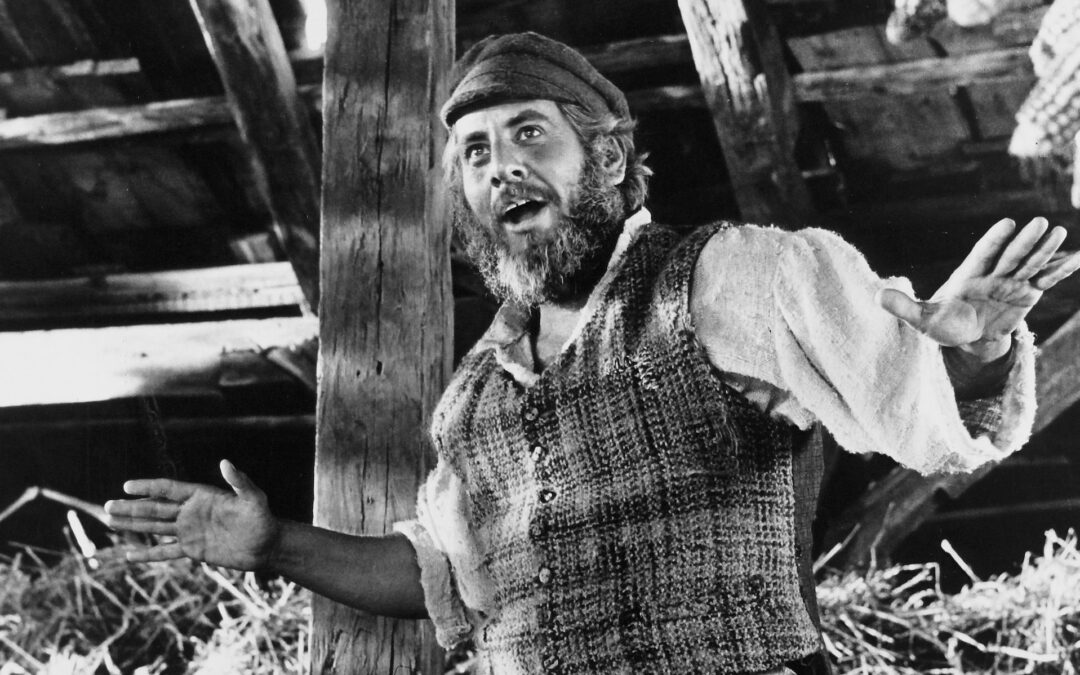
Modern Christians love to sing about “tradition” when Tevye belts it out in Fiddler on the Roof, but many of us grow uneasy when the same word comes up in church. We instinctively feel the pull of Tevye’s point: tradition gives shape, identity, and continuity to a people; take it away, and everything wobbles. Yet when it comes to the Christian faith, we often imagine we can live on “Bible alone” in a way that somehow bypasses tradition altogether. The irony is that, just like the villagers of Anatevka, we already live by powerful inherited patterns—ways of worshipping, reading Scripture, praying, and organizing church life—that were handed down to us, even if no one ever called them “tradition.”
One of the cornerstones of the Protestant Reformation was the reclamation of Scripture as the central infallible rule of faith. Meaning that no matter what, Scripture is the ultimate authority in all things of faith and practice. As someone in a tradition downstream from Anglicanism, we see this in Article 6 of the 39 Articles (which are the confessional and theological foundation of Anglicanism, and were as well for early Methodism), “Holy Scripture containeth all things necessary to salvation: so that whatsoever is not read therein, nor may be proved thereby, is not to be required of any man, that it should be believed as an article of the Faith, or be thought requisite or necessary to salvation.”
And I agree with this. Scripture is essential and of all importance because it is to us a direct revelation of God. Yet, from this also stems a primary frustration. For some Protestants there is always that ‘dirty word’ hiding in the corner…tradition. Like many, I grew up believing that tradition is bad, if not evil, and that tradition is what keeps people away from God. Whenever tradition came up, it always had something to do with those Catholics, Orthodox, Lutherans, Anglicans, or other Christians who dressed funny, and certainly didn’t worship “in the Spirit”, because they were all bound up by their traditions.
Well, for anyone who has known me the last several years, you know I now have a very different answer. Tradition is not bad. Ironically, WE ALL HAVE TRADITION! The question we often fail to ask is, “do I acknowledge my own traditions”. Because, if we don’t, we are actually more controlled by those traditions than we realize, because they are hidden. And this is the fatal deceit we Protestants often fall prey to. We think tradition is bad, and that tradition is not an authority.
But again, we can’t get away from the truth that tradition is always going to be there. And here’s the other thing we must realize. Interpretation of Scripture outside of tradition is just as likely to lead us into heretical teachings that it is into orthodox ones. Just ask Joseph Smith, Charles Taze Russell, Ellen G. White, and the list goes on. As Protestants we must have tradition, otherwise we will continue into an endlessly featuring web of church splits and every more specified denominations over small matters of interpretation.
Now, this is not to say there are no reasons for separation. There certainly are. But when we fail to understand that tradition is authoritative, sometimes we look to as a rule of interpretation, it can help us in maintaining true Christian unity.
Over the last few years, I’ve come to see that tradition, properly understood, is not a rival to Scripture but a servant of it. The great creeds and confessions of the Church were not written to replace the Bible, they were written to safeguard its message, to offer faithful summaries of what the Church across time and place has understood Scripture to teach. When we recite the Apostles’ Creed or the Nicene Creed, we are not adding to the Bible; we are joining our voices to a two‑thousand‑year chorus of believers who have wrestled with the same questions, doubts, and heresies we face today.
At its simplest, tradition functions like a set of guardrails on a mountain road. It does not confine us; it keeps us from tumbling into error while still allowing for movement, discovery, and growth. It gives us perspective—reminding us that the Church did not begin with our generation, nor with the Reformers, nor even with the apostles, but with the eternal purpose of God carried out through time. When we cut ourselves off from that inheritance, we risk spiritual amnesia.
The irony, of course, is that the Reformers themselves were deeply traditional. Luther and Calvin constantly appealed to the early Fathers—Augustine, Chrysostom, Athanasius—not because they thought those writers were infallible, but because they knew that faithful interpretation does not happen in a vacuum. “Sola Scriptura” never meant “Solo Scriptura.” The former places Scripture at the center of authority; the latter isolates it from the Church that bears witness to it.
Many modern Christians assume they have escaped “tradition” simply because they don’t follow a written liturgy or historic creed, but that does not mean they are tradition‑free; it just means their traditions are invisible to them. The way a church structures its services, chooses its music, teaches about salvation, organizes leadership, and even dresses on Sunday are all patterns that have been received, repeated, and defended over time, that is, they are traditions. When these homegrown traditions go unacknowledged, they are rarely tested against Scripture or the wider wisdom of the Church, and so they can quietly harden into non‑negotiable identity markers. The more Protestants distance themselves from historic Christian tradition; creeds, catechisms, classical liturgy, and a common sacramental life, the more each community is forced to invent itself from scratch, which only accelerates fragmentation, doctrinal confusion, and church splits. If this trajectory continues, the body of Christ will become increasingly divided into isolated tribes, each mistaking its own unexamined habits for pure, tradition‑less Christianity, rather than humbly receiving and discerning the tested traditions that once held believers together.
Healthy Christian tradition is not just anything that has been done for a long time; it is the Church’s tested, communal wisdom about how to believe and live the gospel under Scripture. Good tradition gathers up biblical teaching in stable forms—creeds, catechisms, liturgies, patterns of discipleship—that help ordinary believers confess the faith clearly and avoid well‑worn errors. At the same time, because Scripture remains the final norm, even long‑standing practices and assumptions must stay open to correction and reform. Naming this explicitly helps people see that the choice is not between “Bible or tradition,” but between unexamined, private traditions and accountable, Scripture‑shaped ones.
If tradition is to be received and discerned wisely, it has to be held by more than isolated individuals; it belongs to the Church as a concrete, visible community across time and space. Councils, confessions, agreed forms of worship, and recognized teachers are ways the Church has historically said, “This is what we together hear in Scripture,” rather than leaving every question to personal improvisation. When the gathered Church, under the Word and in dependence on the Spirit, tests and hands on tradition, it offers a shared framework that can restrain fragmentation and correct local excesses. Recovering this sense of the Church as a real, tradition‑bearing body helps modern Protestants move from “me and my Bible” toward “we, the Church, listening together to the Scriptures,” which is where genuine unity and faithful reform become possible.
Ultimately, the goal is not to exalt tradition for its own sake, but to love and know Christ more faithfully. Scripture is God’s Word written; tradition is the Church’s memory of how that Word has been lived and confessed. We need both if we are to remain rooted and flourishing in a fragmented world. Perhaps the way forward for Protestantism is not to abandon its Reformation principles, but to deepen them—to see in the Reformers not just critics of the past, but faithful heirs of a much older and larger communion of saints.