
by Joel V Webb | Jan 17, 2024 | Uncategorized
We look at the world around us and wonder what is going on!? We see so much polarization, conflict and no matter what issue it seems there is either one side or the other.
What do we do? What is our path forward?
The question among most faithful Christians is “do we have the right position?” This is an important question to ask. Is the position we have truly grounded in a faithful interpretation of Scripture. Are we in line with what Christians have believed for most of our history and is it in line with God’s story seen in Scripture.
I don’t think for most of us this is the issue. For many we seem to be inside the big tent of orthodoxy. Yes, we don’t all line up exactly on every single issue, but overall, we are in agreement about the big stuff.
So, then what is the problem? Why is it that in some towns there needs to be 2 pastor’s prayer groups. Not because of schedule, but because some feel they can’t be in the same room praying as others. Why are we so quick to circle the wagons when our issue of choice comes up?
This comes down to not being an issue of position, but of posture. We spend so much time making sure we are thinking the way Jesus wants me to think about this thing (which does have importance), and taking no time to think “how would Jesus have gone about this?”
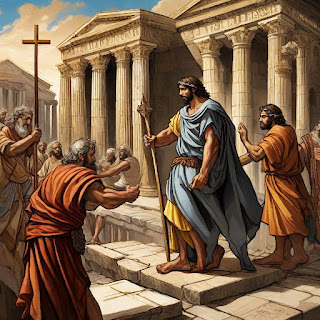
If we are honest, we realize that in most cases we would be with the group of people who were ready to stone the woman in adultery. How many of us would truly be the ones standing in the way of that. Yes, we are to follow Jesus faithfully in all things. Though we seem to get that confused with living our lives with rigid legalism, that if no one lines up then “TO HECK WITH EM”.
The last couple days I have spent a lot of time thinking about this. This side of new creation we are ALL going to image Christ imperfectly. No matter how hard we try, or how good we think out theology is, it’s going to be imperfect.
Maybe what needs to happen in a world that is rife with conflict, and people going to either side of the spectrum on any given issue to be the person standing in the middle. Yes, having a position that is consistent with a faithful Christian witness, that does not compromise the truth. And a posture that is loving and merciful, being a healing balm to a world that is hurting and in search of something more than the next talking point.
by Joel V Webb | Jan 10, 2024 | Uncategorized
What is Biblical Justice?
This is often a hot button issue of discussion. Many Christians completely ignore issues of justice and don’t involve themselves in transforming the world around them through the gospel. While others take concepts of justice with almost no discernment or differentiation from political ideologies that are antithetical to Scripture and hiw we are to see the world.
Here are some points I have found helpful in assessing how we enact justice.
If a view of justice blames all evil on external systems of oppression while ignoring Solomon’s pride-deflating insight that our own hearts are full of evil and moral insanity (Eccles. 9:3) then it is not true justice. A biblical worldview sees evil not only in systems (Ps. 94:20), where we ought to seek justice, but also within the twisted hearts of those who make those systems unjust. All the external activism in the world won’t bring about any lasting justice if we downplay our need for the regenerating, love-infusing work of God through the gospel.
If a view of justice deconstructs relationships in terms of “power differentials” and argues that all such hierarchies are oppressive and must be abolished in the name of “equality” then it is not true justice. A biblical worldview totally opposes the sinful abuse of power, but sees many hierarchies, like the parent-child, rabbi-disciple, elders-congregation, teacher-student relationships, as part of God’s good design for human flourishing.
If a view of justice interprets all truth, reason and logic as mere constructs of the oppressive class, if it encourages us to dismiss someone’s viewpoint on the basis of their skin tone or gender, then it is not true justice. The Greatest Commandment calls people from every ethnicity and gender to love God with our whole minds. A mind that loves the Father assesses ideas based on their biblical fidelity, truth-value and evidence, not the group identity of those articulating it.
If a view of justice encourages rage and resentment toward people groups as a motivator for social activism then it is not true justice. A biblical worldview calls us to overcome evil with good, love our enemies and pray for those who persecute us. Family and reconciliation among every tongue, tribe and nation, not intertribal warfare, is the Bible’s model for justice.
If a view of justice breaks people into group identities, generating a spirit of mutual suspicion, hostility, fear, labeling, offended-ness and preoccupation with one’s subjective feelings then it is not true justice. A biblical worldview champions a unifying kind of love that “is not easily offended,” and offers us the fruit of the Spirit like joy, peace, patience, kindness, goodness, gentleness and self-control.
If a view of justice treats individuals as exemplars or ciphers of their identity groups, attributing goodness or guilt on the basis of skin tone, gender or social status, then it is not true justice. A Christian worldview assesses everyone as guilty based on our group identity “in Adam.” This guilt can be erased only by finding our new and deepest group identity in Jesus, “the second Adam.” Rather than condemning people for ethnic or gender group identity, “there is now no condemnation for those who are in Christ Jesus” (Rom. 8:1).
If a view of justice seeks behavior modification, often through intimidation, speech codes and ideological re-education, then it is not true justice. A biblical worldview seeks character transformation not through political coercion but through the in-working power of the Holy Spirit, the discipleship of the family and the local church.
If a view of justice teaches that the human telos (i.e., our ultimate purpose and meaning) is defined by the creature, and that anyone who challenges our self-defined telos is an oppressor, then it is not true justice. A biblical worldview teaches that our telos is defined by the Creator and the sinful refusal to live within that God-defined telos brings oppression to ourselves and those around us. Real authenticity and freedom don’t come from defining yourself and “following your heart,” but from letting God define you and following his heart.
(taken from Thinking Biblically About Social Justice – Talbot Magazine – Biola University)

by Joel V Webb | Jan 3, 2024 | Uncategorized
The Context of Scripture
“The proper context for interpreting the Bible is the context of the biblical writers—the context that produced the Bible. Every other context is alien or at least secondary.”
― Michael S. Heiser, The Bible Unfiltered: Approaching Scripture on Its Own Terms
How are we supposed to read Scripture? This is often hotly debated because the implication of praxis (how we live it out) are profound. Church history, systematic theology, creeds and theologians are certainly helpful means for us to understand what Scripture is saying… but they are not the be all end all.
Ultimately, if we are not looking at and understanding the historical context of the Biblical writers (for both Old and New Testaments), we are doing a disservice when we attempt to exegete what the author intended. It can at times lead to eisegesis, where we read out own meaning or cultural understanding onto what Scripture says.
I love Church history and the writings of the patristics, reformers and others who have shaped the Christian faith through the generation. But they are not the context in which Scripture was produced. Yes, they are helpful and important to the development of understanding Scripture, but they are not the context of Scripture itself.
Why is this hard…because it is not easy. It is much easier to take the “plain reading” of the version we are reading in our native tongue. IT is much harder to look into not just the language being used (Hebrew & Greek), but also the meanings, understandings and nuances that were prevalent in that day.
Don’t misunderstand me. There are many parts of Scripture that are clear. There are also other parts that may seem unclear or muddy in how it is understood across the tent of orthodox Christianity, where then the context becomes essential in understanding what was intended by what was written.
Thankfully we live in an amazing age of information and technology that can give anyone access to scholarly information that we can use to not just enrich but also to at times realign our interpretation to reflect the context in which it was written.

by Joel V Webb | Dec 18, 2023 | Uncategorized
Women in Ministry
In 1 Corinthians 14, Paul is specifically addressing issues of orderly worship, not establishing who can and cannot be elders in the Church.
1 Cor 14:34–35 – Women should be silent during the church meetings. It is not proper for them to speak. They should be submissive, just as the law says. 35 If they have any questions, they should ask their husbands at home, for it is improper for women to speak in church meetings.
Some would argue this is Paul making a blanket command for all time. But when you look at the context of the day (because Scripture was not written in a vacuum) we know that in that day women were most likely not educated, and likely would have had many questions about what they were hearing in church services.
So, in order to ensure church continued orderly, Paul is specifically addressing the issue of a bunch of side conversations that would have been very distracting. In other parts of this very letter, Paul lays out orderly worship that does not specify men and women prophesying, speaking in tongues or speaking in other contexts.
How we exegete Scripture is important. And part of that process is understanding the cultural context in which it was written. Even outside of that, within context of the surrounding verses there is no argument here not allowing women to participate in church services.
You can read PART 2 and PART 3 of this article series