I grew up in Canada, so I didn’t get the experience of saying the pledge of allegiance every day. But as in the US we did sing the national anthem every morning, facing the national flag in the room as part of our daily routine. Every morning we sang the words, “God keep our land, glorious and free!”. While Canada certainly could learn a thing or two from that line right now, I’m not here to comment on that. Nevertheless, we all have these common things that bind us together in a certain identity. We know that they know, and because of that there is a shared understanding of who we are.
Then we get to the world of Christian worship, and the plethora of styles that exist in the world today. This isn’t wholly a bad thing. Before becoming a lead pastor, I led worship in a contemporary context, and there were certain things I loved about it. But one thing that nagged at the back of my head was, “what is the connection with what we are doing with the rest of the Church?”.
For most in the modern American evangelical world, more traditional styles of worship can often be looked at with suspicion (often being suspected of “being too Catholic”), or maybe kind of laughed at as antiquated. But there are many things that we in evangelicalism can learn from the faithful worship of our brothers & sisters in ages past.
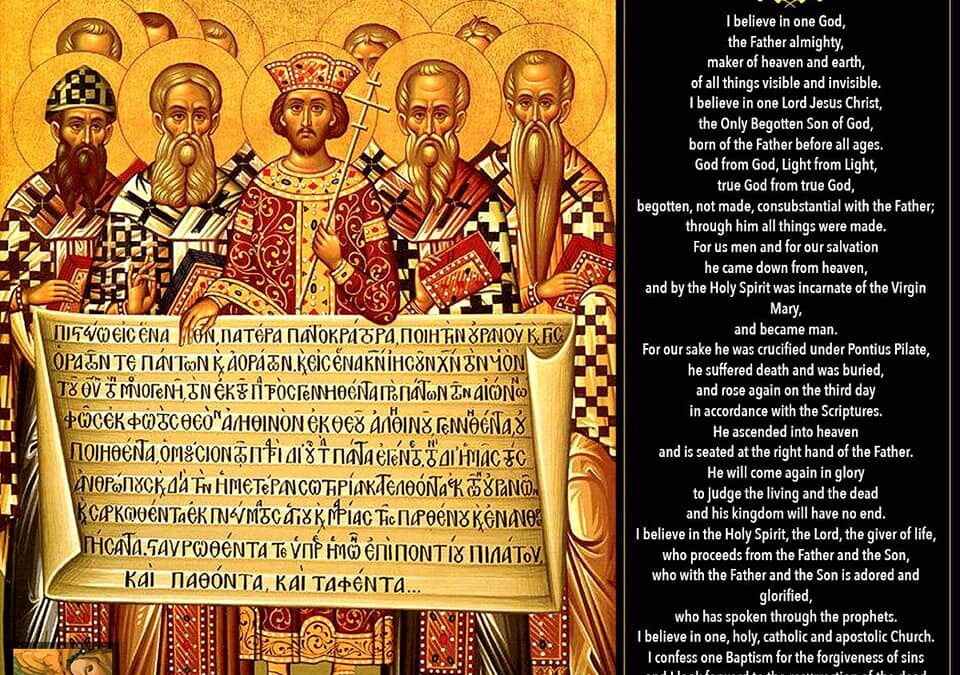
One of these key elements of worship is the reciting of an ecumenical creed. Even since the earliest days of the Church, a variety of concise statements of belief have been used as a part of preparation for baptism, and in worship. The two main creeds that are often used are the Apostle’s Creed, or the Nicene Creed. Both of these creeds accepted by all orthodox Christian throughout history, contain the core truths of the Christian faith.
Why is reciting a creed even important?
First, historically the creeds have been placed in the order of worship for churches as a check on the clergy. In Anglican liturgy, the creed follows the sermon. This is placed there as a statement and question, “does what was just preached line up with what we just said?” In many churches there can be problematic theology that is presented from the pulpit, and having the core creed of Christian doctrine help work as a ruler that the sermon can be compared too. Though sadly this is not a sure fire way, because there are many more traditional denominations and traditions that are wholly caved the liberal and woke ideology, despite saying the creeds weekly.
Secondly, creeds provide a foundation of right belief, and an inoculation against bad ideas. A good friend of mine was raised Roman Catholic. He learned the creeds from a young age, and even during his teen years when he wasn’t really following Christ, he encountered a preacher who was sharing aberrant theology. Despite not actively living the Christian life, my friend was still inoculated from these ideas, because he instantly recognized that what was being said did not line up with the creed in certain areas. Now again, as stated above, this is not a 100% sure thing. You can know the creed, and choose to ignore what it is actually saying. But, I would argue that for most Christians, knowing the creeds would be a beneficial thing.
We live in an age with a million messages hitting our brain every singly day. Facebook, Instagram, TikTok, Reddit, Youtube and the list goes on and on…not to mention traditional advertising on billboards and TV commercials. We are constantly being messaged to.For us as followers of Christ, the creeds provide to us messaging that we can get on board with. Something that we can remember and look to, as a sure thing as to the truth of the Christian faith.
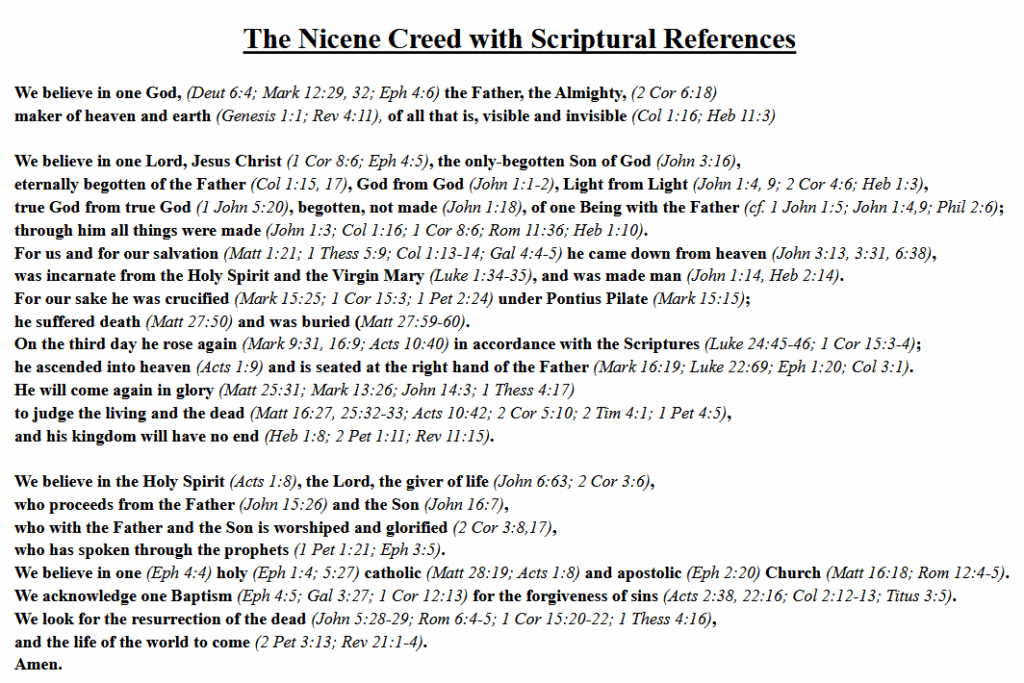
Below is a photo showing the Scriptural references that are found in the Nicene Creed. The creeds are not just “concocted words of men”, but are synthesized and condensed truths from Scripture, organically presented to systematically present the truths of, and the general flow of the Gospel message. The creeds help ground and center us in a crazy world.
The creeds help provide a guard rail against bad theology. You see, the tricky little secret that many don’t think about, is that heretical ideas use the same Scripture. Yes, ideas are over weighted in their importance, or incorrect translations or ideas are added to the text, but nevertheless the Bible is used as a proof-text for bad ideas. The creeds help us in telling us that as we read God’s holy and inspired Word, the correct interpretation and understanding of them will be found inside of the bounds of the creeds.
But how can all of this work in a contemporary setting? Good question!
As I had mentioned, I had been leading worship in a contemporary worship setting up until the beginning of 2025. For the entire last year I led worship, we recited the Apostle’s Creed every single week as part of our time of worship. And other than a little confusion about the word ‘catholic’, it integrated really well.
It can, and I would argue should be done. As Christians we have a beautiful and rich heritage in the creeds, but for many Christians there is complete ignorance that they even exist. But so much benefit is being missed out on. There are so many different ways for contemporary worship settings to use the creeds.
In recent years there have been a bunch of fantastic contemporary worship songs coming out based on or directly quoting the ecumenical creeds of the Church. I Believe by Phil Wickham, We Believe by the Newsboys, The God We Love (Nicene Creed) by CityAlight, This I Believeby Hillsong just to name a few. Use these songs, often! If a worship leader or pastor doesn’t feel that reciting a creed regularly can work for some reason, sing these songs.
But in the end, I believe firmly that EVERY church should in some way shape or form should recite a creed every single week. I always led it at the beginning, before going in to the worship set. But that is just one example, there are a multitude of ways that they can be added in, and practically it can take 30 seconds. The Apostle’s Creed is an easy one because it is shorter, but for most the Nicene Creed is the “gold standard” that the Church historic has used.
In our day and age having a good handle on the truths of the Christian faith is more important than ever, which means we need the creeds more than ever. Their usage will be enriching for all, because not only are we being taught and reminded of the Gospel, and the work of Christ, but we are being connected to Christians all around the world, and throughout history. There is continuity, there is connection, there is family.
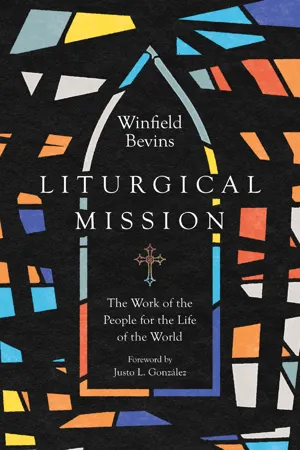
The last 3 years as I have made my journey into a historic approach to Christian worship, Winfield Bevins has been one of the most influential writers, especially as I started the journey. His book Liturgical Mission: the Word of the People for the Life of the World does more than just look at the benefits a liturgical approach to faithful Christian worship has, but expounds on the holistic and all-encompassing nature that it has when looking at the role of the Church in the world.
The first major aspect Bevins looks at is how liturgical worship helps the Church recover the big story of Scripture, and applies it to the life of the Christian. Through the rhytms and movements of the liturgical calendar, we are constantly reminded and participating in the story of Jesus as we move from nativity to resurrection. In our bustling world of a million stories and sub-plots we as people are disenchanted and disenfranchised. Whereas the Christian story can give us something better to be apart of, helping us be on task for what Christ has called the Church to be.
Through the movements of gathering, word, table and sending, liturgy provides to Christians an all encompassing time of worship that ensures all part of our being are worshipping God, and that we are being equipped to be sent out to mission in the world.
The next major section is the idea of sacramentality. In a world where many in the west presume a form of scientific naturalism that has invanded the imaginations of many in the church, sacramentality restores the relationship between physical and spiritual, acknowledging that God works through more than just the immaterial, but that He can be and is amongst us. The Eucharist is of course one of the first things you think of when talking about this. But more than that, if we look at the world more of how God is working actively in even physical actions, we can see how we are called to be His actors in the world.
Finally, Bevins calls the Christian not just into orthodoxy, (right belief), but also into orthopraxy (right actions). What liturgy provides is not just a historic and faithful was of worship, but an integration to urging the Christian to not just take, but to also do. We are called to be the hands and feet of Jesus, to go spread the Kingdom, and be an ambassador of Biblical justice in a broken world.
For most of my life I have been a non-fiction reader. I have read lots of fiction, but my primary diet is a healthy mix of history, theology, politics & theology. Recently I have been making more of a concerted effort to add more fiction into my reading diet that doesn’t have the name Lewis or Tolkien attached to it. When I was asked to review this soon to come out novel, I was excited. I hadn’t read a thriller/mystery novel in a long time, so it was long overdue, and boy was this a great reintroduction into the genre. As I opened and began reading my advance copy, I was immediately engaged.
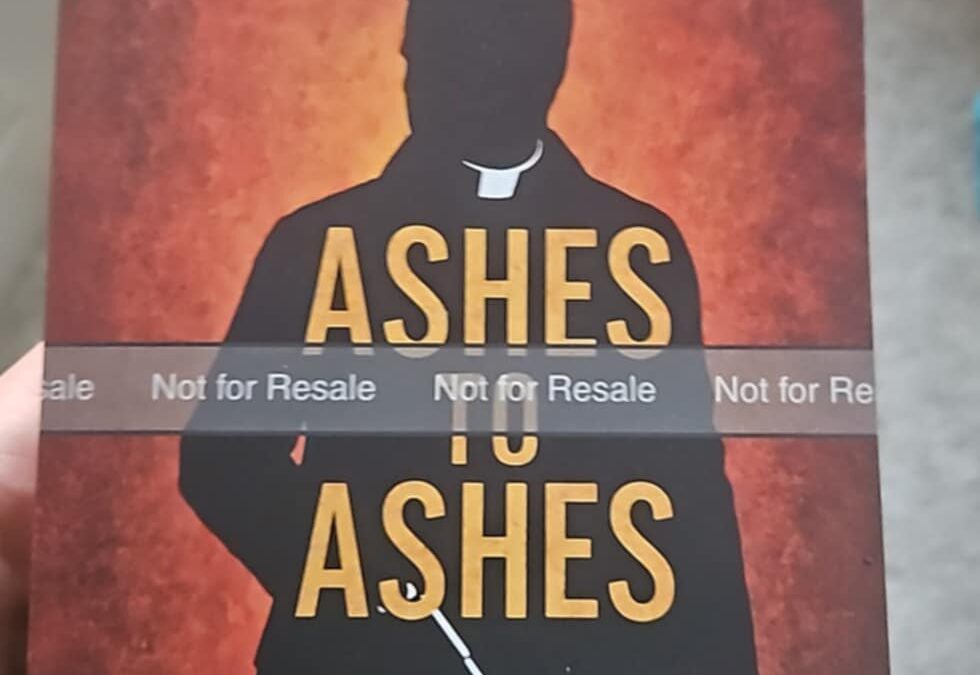
Ashes to Ashes is the first thriller foray for Christopher Thoma. While I haven’t read any of his other writings, they are now on my list to eventually pick up. As an author, Thoma paints a picture that is exquisitely vivid. I could easily picture every scene of his book with 4K quality as he not just described the scene, but also helped you feel every tense moment as if you were a fly on the wall. While more can be said about this, Thoma is an excellent writer.
I will try to not go beyond what you read on the back of the cover, and save something for you to read yourself. The only fitting way I can encapsulate the book is by imagining Father Brown meeting Crime & Punishment.
This story is challengingly prophetic. On one hand we are called and spurred into action. As God’s people there is a lot of evil that happens in the world, and more often than not we sit passively by while it happens. Like Father Brown, the protagonist pursues justice,even asking for the confession of those who participated in evil deeds. And like Crime & Punishment, the protagonist has to continually contend with the strain and struggle of the violent path that he has gone down.
Yet, Thoma’s narrative is likewise prophetically challenging as it calls each of us to self-assessment even of our own motives, and what we are willing to do in the name of justice. Our protagonist takes justice into his own hands, pursuing evildoers, crossing names off a list, but at what cost? The most striking and chilling scene of the book was towards it’s conclusion where the protagonist has a dream, or a vision. In it, Claire, the death that kicked off Michael’s (the protagonist) crusade of justice speaks to him, busting through the layers of his ego and righteousness to show him that what he was doing wasn’t the way to do things. As I read this, I could feel the cold challenge in my own soul, to ask the Holy Spirit to check my own motives and actions. Do I take things into my own hands? Even mundane normal things in life that don’t seem that significant? That’s a question we all need to ask ourselves from time to time.
At its core, Ashes to Ashes is a Christian and theological work. At numerous occasions in the narrative, the reader is introduced and engagingly immersed into a Lutheran liturgical worship context, that even for the uninitiated will be easy to follow and grasp. While Thoma is not as brash as C.S Lewis’ lion that is obviously Jesus, he is not as subtle as Tolkien in his commentary on questions of theology, tradition & worship style. His bad guys are both well written and humanly flawed as characters, but there were a few moments in some dialogue that was a bit cartoonish in its commentary on contemporary vs traditional worship styles, creating a black & white dichotomy between traditional being grounded and sincere, and contemporary being manipulative and completely contrived. I myself am traditional, sacramental and liturgical in my worship style (as the author is), and while I have my qualms with some of the fruit of the contemporary seeker-sensative world, it’s not all manipulative, at least intentionally. But on the other hand, it’s a thriller novel, and so that’s always going to happen to some degree.
While the book does not conclude with a Hallmarkesque ending, it is still wholly Christian. Why? Because our stories on this side of eternity often end that way too. Just as Frodo in Lord of the Rings still faces the scars and pain of his wound from Weathertop, we too deal with our own scars and pounds (both physical & emotional), until we meet our Lord face to face. Michael’s has to live with the reality that the path he went down has changed his life, for the rest of his life. This is often the case for us all in our own ways. Yes, there is forgiveness and the ultimate hope of glorification, but that does not preclude the realities on the ground.
Overall, I recommend this book if you are into the thriller genre, and able to get through detailed descriptions of some horrible things. I will be giving it a 5-star on Amazon when I am able to. You will be engaged with Thoma’s detailed and accessible writing style as you are propelled through the narrative. You can find this book, and others by Christopher Thoma at www.christopherthoma.com
Something that I have said almost dogmatically the last several years is that, “everyone has a tradition, the question is do they recognize it or not.” Part of this is because I grew up in a theological landscape where there was usually an outright denial of any tradition, while simultaneously being controlled by traditions. But because they were not acknowledged, it was more dangerous because the driving force was invisible.
Acknowledging our backgrounds and traditions is important because it provides clarity to ourselves and to others where we are coming from, what presuppositions we are making, and how we process or understand information. As I have undertaken my theological journey over the last several years I have done an equal amount of reading, talking to others and praying. Seeking out where do I fit in the large tent of orthodoxy that is found in the Church universal that affirms the Apostle’s Creed etc…
I find myself through the Lord’s leading in the Free Methodist Church. A denomination that has a shared heritage in the Methodist and Holiness movements. I have grown to love my Free Methodist identity. While we are a Kingdom people, acknowledging we are but one facet in the greater body, we have distinctives that make us unique. And yet, I have also felt a certain pull and draw. While I am in, and love the FMC, it is for the most part a denomination that is generic contemporary evangelical (with growing charismatic leanings) in its expression of worship and theology. Yes, we do have our distinctives outlines in the Free Methodist Way, but on the ground most things look and operate like most other churches.
While we certainly must pursue unity and working together, this at times does come at the expense of important distinctives. I know pastors and lay-people, that while affirming the FMC’s position on the real presence of Christ in the Eucharist, are in practice and casual discussion almost Zwinglian and memorialist in their actual understanding. This likewise carries over to understandings and practice of baptism as well. While certainly not primary Gospel issues, it is certainly distinctive that is at a loss in many places.
I am Methodist in my theology, and am thankful for that. John Wesley is an exemplar of embodying a holistic approach to classical theology that is grounded in Scripture, alive in the Spirit and pastorally useable to shepherd God’s people. In my Wesleyan Theology class at seminary, the book Responsible Grace, by Maddox is an excellent primer that lays out Wesley’s theology in a somewhat systematic way. Wesley was a unique blend of traditional Western Christian theology, with a strong undercurrent of the eastern Church fathers and Eastern Orthodoxy that can be seen in what we now call Methodist theology.
But that has led my to ask a further question. What made John Wesley who he was? I think more often than not, we put the cart before the horse. We examine the outgrowth of Wesley’s ministry in the Methodist movement, and the theological heritage spawned that has certainly changed the world (for the better in my estimation). And yet, is that enough?
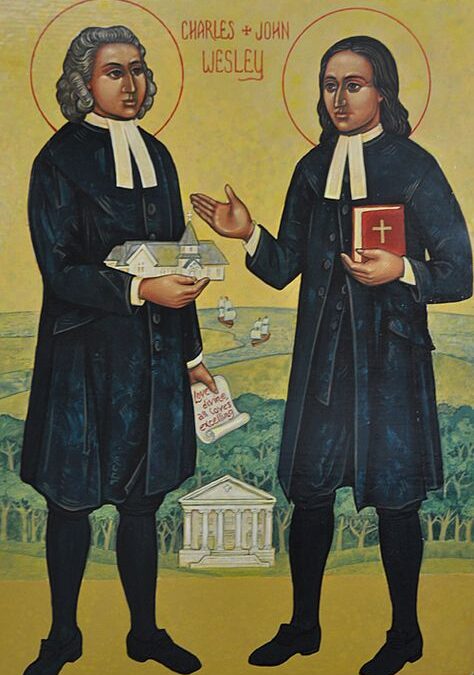
I have more recently come to the conclusion that to properly understand the work that the Lord did through John (and his brother Charles), we must come to a deeper understanding of the Anglican heritage that formed and shaped him, and that he remained a member of his entire life.
Yes, we are all compelled and encouraged by John’s Aldersgate experience where he felt his heart strangely warmed. His Fetter Lane experience where he was empowered for the Methodist revival. We love to talk about the excitement of how God used him to transform England, and the rest of the world through his preaching. But that is just the fruit on the tree. We cannot forget to look at the trunk so to speak.
This is why I now consider myself an Anglo-Methodist…if that’s even a thing.
I am Methodist in my theology. I understand the proper application of the quadrilateral, am greatly informed by Wesley’s sermons & hymnody (John & Charles), and know that Christ is calling us to entire sanctification, where we are made perfect in love. Yet, this Methodist understanding is not a house unto itself. It is built on something older that we often don’t think of. Methodism in its own right as a movement is an outgrowth of Anglicanism. The precepts of Wesley’s understanding were wholly Anglican. With a few exceptions and modifications, the foundational articles of religion for Methodism were that of the Anglican Church.
The English expression of Christianity always had a unique flavor to it as it had been disconnected from Rome for some period of time before being brought back in following the fall of the Roman Empire. This is why during the reformation, while the situation that led to it’s separation was the monarchies desire to annul a marriage, the theological differences had already made the path to separation from Rome more likely to happen in the Isles. There is so much that can be said, but that would be outside the scope of this article. There are many articles, videos and books that cover the Anglican background and tradition that was the foundation of John Wesley’s life.
Another key aspect of this process has been the involvement of the Book of Common Prayer (BCP). First introduced to me on my trip to Israel by some trip-mates who were ACNA, the BCP has become an integral and core part of my personal spiritual devotion, and is the form of worship at the church I am pastor of.
The language of the BCP, its prayers and liturgies have been the second largest influence on the English language after the King James Bible. The BCP was the centerpiece of spiritual discipline for Wesley aside from the Bible. In John’s sermons, the quotations of the Psalms are not from the 1611 KJV, but from the Coverdale Psalter, an older English translation of part of the Bible that is found in the 1662 BCP. At Fetter Lane, when the Holy Spirit fell in a special way, it was the Te Deum Laudums, a historical canticle of the Church that is found in the BCP that the group of those gathered sang in unison as response to the work done in that moment.
As Methodism made its way to America, John produced a volume titled, “The Sunday Service of the Methodists”, which was for all intents and purposes a slightly modified BCP made for the Methodist movement. Even to this day, the traditional service order found in the United Methodist, Free Methodist, and other hymnals and service books is a BCP prayer or Eucharist service with a few changes.
So for myself, while Methodism is the core of my theology, and understanding of the Christian faith, I have found it to be augmented and modified with an overtone of the tradition that formed its founder. The discipline, flow and beauty of the Daily Office is in various ways shaping my personal devotion. Participating weekly in celebration of the Lord’s Supper utilizing elements that Wesley himself would have been familiar with and utilized has been encouraging and brought life to my walk with Christ, and Lord willing for my congregation. In a constantly updating and changing world, the stability has been grounding and restful.
So what does all of this mean for us today? Well first, we are not just standing by ourselves. Our heritage is found within the Anglican tradition. It formed and shaped the Wesley brothers, and we would be remiss to not acknowledge, or at least understand where we have come from. For all my brothers and sisters that are connected to the Wesley’s, my ask is simple. Come to understand and appreciate the religious foundations that underpinned the Methodist revival. This doesn’t mean you have to use the BCP, ascribe to the 39 Article of Religion, or practice liturgical worship. But it means we should have a functional understanding of the framework of spiritual discipline and life that Wesley lived in. As we continue to pray and seek God to work afresh in the Methodist movement, part of what we must rediscover is where John himself started and work from there into whatever He has for the next generation.
Recently I was accused on intellectualism by someone I have always looked up to.
In the background/tradition I was raised, one of the worst things to be called was intellectual. It meant that you were now, rather than “relying on the Holy Spirit to be revealed truth”, simply falling prey to the decptions of reason.
What is amazing about the name that I had now been given (again, a title resvered for those obviously not aligned with the Holy Spirit) was because of 1 phrase, from a single paragraph on a Facebook post I had made about baptim, that included a statement that allowed for infant baptism.
Sadly, without any further discussion, investigations or questions to myself, I was now labelled in a way that in the world I grew up in would strip me of any legitimacy because it would be known I no longer touted the party line.
Here is really where we run into the error of contemporary fundamentalism.
Fundamentalism histocially as a philosophy in Christianity came about in response to the raoid liberalizatiom that took place in many parts of the Church in the late 18th & 19th centuries. Famous responders like Machen called faithful Christians to the fundamentals of the faith.
But what has come about, especially in the last 100 years is a difficult thing to reckon with. A good friend of mine often says, “fundamentalism has a pathological need for certainty”. What has transpired in the last century is the tranaformatiom of movement that was responding to the errors of its day (such as the social gospel), has become a self protective silo often dosconnected from the rest of the Church in thought and tradition.
Now, this person who messaged and accused me of intellectualism I consider a brother in Christ. He loves the Lord, and the Church, and I only have the greatest love for him because he has been an example of Christ.
Yet, the theological and philisophical framework he inhabits (what I grew up in) has no tolerance or understanding for anything outside of its frame of reference. I would primarily tie it to the fundamemtalist underpinnings of the Latter Rain movement of the late 1940’s which if derived from.
In my own personal journey I am in a very different place than I was. While I am unchanged in the core Gospel message found in the Apostle’s creed, my positions on a good many things have changed and shifted. Not because I’ve decidely become intellectual. Frankly, it’s because of those who are much smarter and closer to Christ than I am (both spiritually and historically).
As the theologian Thomas Oden, more often than not look to the Early Church Fathers. Because they represent the earliest time to the life of Jesus, a number of them being disciples of the original apostles, what they have to say is very compelling.
Because of this focus, I now hold to theological positions that are looked down upon at best, if not written off as ignorant and not faithful (real presence in the Eucharist & infant baptism to name two). And yet, the consistant witness of the Church catholic through history beckons me, and is farore compelling than a British Bible teacher who has been dead for over a decade (if you know, you know).
To my brother in Christ who messaged me. Reach back out. Take the time to chat with me. There is no ill will, just a desire to talk and come to a common place of understanding. My goal isn’t to be intellectual, never has been. Im just a fool for Christ.