
This article was originally written for and posted on HolyJoys.org
s as having deep spiritual symbolism. What we see in historic sanctuaries, such as those in older Anglican, Methodist, and Presbyterian churches, represents a blend of practical development and profound spiritual significance. This blend contributes to the richness of Christian worship and continually points us toward the central work of Christ through the gospel.
The Two-Fold Testimony of Scripture
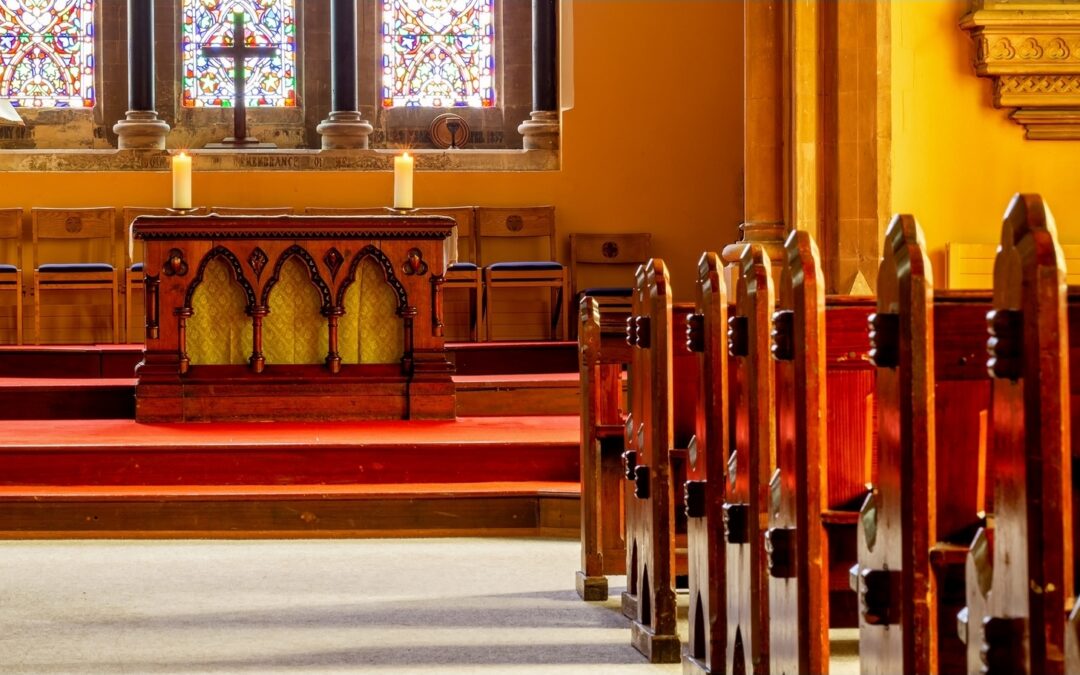
Step into most churches shaped by the church’s historic liturgy and you are likely to see two candles, one placed on each side of or on top of the altar or communion table. Over time, the two candles came to be associated with the proclamation of Scripture. When facing the altar, the candle on the right became known as the Epistle Candle, and the one on the left became the Gospel Candle. This grew out of the historic practice of reading the Epistle from one side of the chancel (the front portion of the church) and the Gospel from the other, an arrangement still visible in some older churches and described in medieval ceremonial guides (e.g., Ordo Romanus I).
This practice also reflects the shape of older lectionaries such as the one found in the 1662 Book of Common Prayer which assigned only two readings for the Eucharistic liturgy: an Epistle and a Gospel. The modern four-reading pattern (OT, Psalm, Epistle, Gospel), familiar in most churches today, only became standard after the liturgical reforms of the 20th century, especially following The Second Vatican Council. So here we see the close weaving together of tradition and practicality: candles originally needed for light eventually became markers of the very structure of the liturgy.
The Two Natures of Christ
Beyond their connection to Scripture readings, the two altar candles also came to symbolize the two natures of Christ, His full divinity and His full humanity, as defined by the Council of Chalcedon in A.D. 451. The church has long sought to confess visually what she proclaims verbally: Jesus Christ is one Lord, “acknowledged in two natures, without confusion, without change, without division, without separation” (Chalcedonian Definition). Thus, the dual candles become a small but meaningful reminder that the One whose presence we invoke at the altar is both God and Man, fully divine Light and fully human flesh, united for our salvation.
The church has long sought to confess visually what she proclaims verbally.
The Light that Gathers and Sends Us
Even the way the candles are lit and extinguished carries meaning. Many traditional services begin with a processional, as clergy, deacons, and acolytes (those assisting in the service) enter the sanctuary in reverence. Often, an acolyte will carry the light itself—sometimes taken from a sanctuary lamp or another ever-burning flame within the church—and use it to ignite the altar candles. This represents Christ, the Light of the World (John 8:12), entering into the midst of His people as worship begins.
Likewise, when the service concludes with the recessional, the light is carried out again. This action reminds us that Christ does not remain “on the altar” when worship ends; rather, He goes out with His people, sending them into the world as bearers of His light. In this way, the extinguishing or carrying out of the candles becomes a liturgical sign of the Great Commission—Christ’s light shining in the world through His Church.
Beauty in Worship
Finally, candles add beauty to Christian worship. While beauty is a profoundly underasked question in our age, there is a reason why the United States has a four billion dollar candle industry! We love candles not just because of the aroma, but because they are beautiful. We certainly don’t need their light, but we are captivated by the mood that’s created by a flickering light. Using candles in the church is a way to beautify the place where we worship our supremely beautiful God.
Using candles in the church is a way to beautify the place where we worship our supremely beautiful God.
Living Catechesis
For some, the use of candles and related practices may appear quaint or overly ceremonial. But far from being empty rituals, they serve as a living catechesis. They teach us—silently, consistently, and beautifully—truths about Christ, the Scriptures, and the mission of the Church. They connect us to the unfathomably long story of Christian worship, where objects once needed for simple visibility have become symbols that illuminate the gospel. Technology may change, and with it many of our daily habits. But within the worship of the Church, candles remain steady witnesses: to the enduring unity of practicality and spirituality; to the two-fold testimony of Scripture; to the two natures of Christ; to the Light that both gathers us and sends us out; and to the beauty of our God. They help us to reconnect not only with our past, but with the One who is the same yesterday, today, and forever.
Candle Options and Where to Buy Them
If your church doesn’t currently use altar candles but you’d like to begin, the internet offers a wide range of options. You can choose traditional wax candles or oil-based ones. Wax candles often come in paraffin (cheaper) or beeswax (more expensive but longer-burning, cleaner, and more “traditional”). Oil-based candles—either refillable or with disposable cartridges—are convenient if you want low-maintenance, reusable lighting. Which type you choose will depend on your church’s budget, how often you use candles, and the aesthetic or symbolic tone that you want for worship.
Once you pick a fuel source, you’ll need candlesticks or candle holders appropriate to your altar space. Even a simple brass or wooden pair can be a good starting point, with the option to upgrade later. The goal isn’t luxury, but to add reverence, symbolic meaning, and beauty to worship.
While there are numerous church suppliers you could utilize (and of course you could always go to Amazon!), there are several well-established online vendors where you can order altar candles (wax or oil) and related church supplies. For the best quality, customer service, and a history of supplying the Church, these are wonderful companies to support:
- Burgess Church Supply
- Concordia Supply
- T. H. Stemper Co.
- Autom Church Supply
- Church Supply Warehouse
- CM Almy
- Cokesbury