Easter is just around the corner, and for the first time I’ll have the honor of administering the sacrament of baptism on Easter Sunday, one of the traditional days the Church has welcomed those into the Church. The discussion and debates in the church over baptism are a fascinating one. For every Christian, baptism is the universally recognized entrance into life in the people of God, but especially since the Reformation, certain elements of the Church, while acknowledging its importance, have lessened its impact, and flattened the reality and beauty of baptism to a simple, “tell people that you love Jesus.” But what Scripture, and the history and tradition of the Church demonstrates, it is so much more than that.
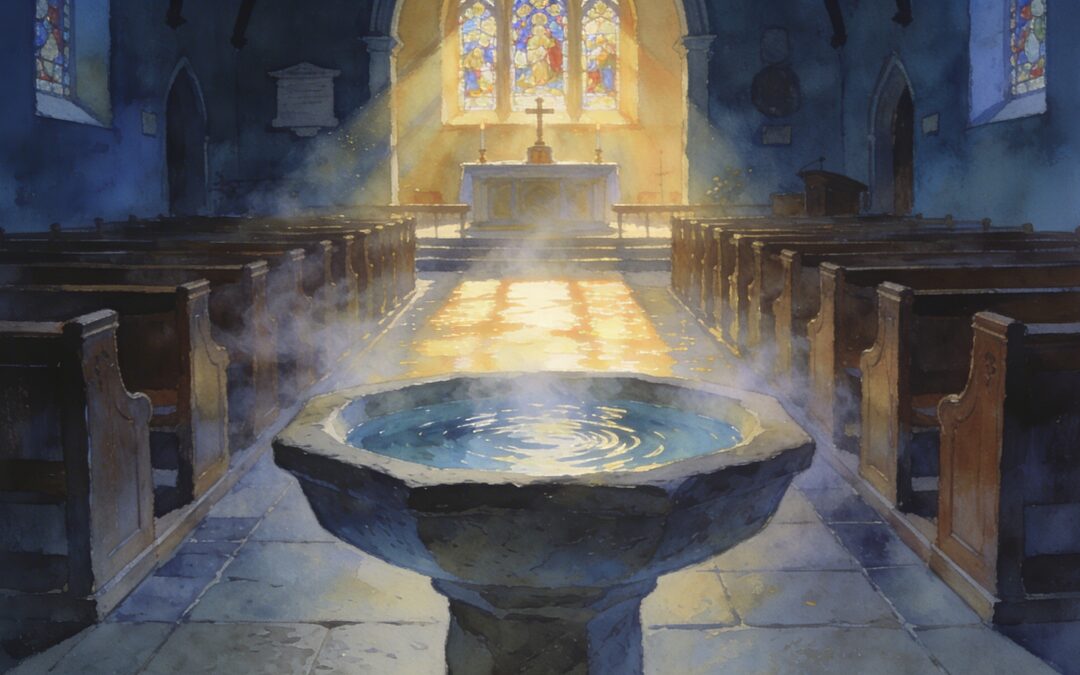
Before addressing anything more specifically, I want to quickly touch the base that Baptism is a Sacrament. In the Free Methodist Church, the denomination I am in, we recognize the two sacraments of Christ, the Eucharist and Baptism. They are the means of grace that Christ has given His Church. Eucharist (Communion or the Lord’s Supper), as spoken of by John Wesley is the ongoing and continual means by which God provides grace to the Christian in their life (see his sermon The Duty of Constant Communion). And, it is Baptism, as spoken of above, that serves as the rite of entrance into the people of God. In my church, the baptismal font is located at the back of the sanctuary, in direct line with the chancel of the altar, representing the truth that you must first pass through baptism to come into the life of the Church.
The word sacrament in this discussion is important because it focuses on the work of God that takes place as we engage in these means that Christ has given us. Yes, we are commanded to keep them in obedience to His word (Christ’s command to baptize in the Great Commission, and His command to keep the table in continual remembrance of Him). It is the witness of Scripture and the early undivided Church that these acts are much more than us doing, they are the avenue and channel of God to work in and through His people. Physicality matters because we are in a physical world, and God stepped in through the incarnation. So thus, God does not stop working through the physical, rather He has given to His people physical signs through which His graces flow. This is why I distinctively use the language of sacrament, rather than something else such as ordinance.
Now back to the main discussion.
Of all the verses, one of the most controversial is 1 Peter 3:21, “this water symbolizes baptism that now saves you also—not the removal of dirt from the body but the pledge of a clear conscience toward God. It saves you by the resurrection of Jesus Christ.” In this verse, Peter does not mince words—he articulates something that should cause modern evangelicals, especially those of a “believer’s baptism only” persuasion, to slow down and read again. “Baptism now saves you.” It’s hard to argue that Peter could have spoken more plainly. But immediately, he anticipates our misunderstanding: it is not “the removal of dirt from the body.” It’s not a magical washing, or a mere ritual dealing with externals. Peter wants us to understand that baptism’s efficacy is grounded not in ritual precision but in the resurrection of Jesus Christ. In other words, baptism saves, not because of water alone, but because in baptism we are united to the saving work of Christ—the same Christ who plunged into death and rose up into new life.
The apostle’s words echo other deep currents running through the New Testament. Paul declares in Romans 6 that “all of us who have been baptized into Christ Jesus were baptized into his death.” Baptism links the believer personally and mysteriously with the passion and resurrection of the Lord. It is not simply a symbol we perform to show our commitment; it is a real participation in Christ’s own redemptive act. Through it, we are joined to his dying and rising—our old self is buried, and a new self, reborn by grace, comes into being. In this way, baptism is not an optional external mark, but an entrance into life in Christ, a sacramental sharing in his work of salvation.
Here is where much of our modern understanding falters. We have come to think of baptism primarily as an expressive act—something we do to communicate something about ourselves: our faith, our repentance, our decision. But biblically and historically, baptism is primarily receptive. It is something God does in and for us. Yes, we approach in faith; yes, it is a sign of commitment to follow Christ—but at its core, baptism is an encounter with the divine initiative, not a declaration of human resolve.
This shift in emphasis is not a matter of semantics. It shapes our entire theology of grace and discipleship. If baptism is my declaration, then my faith stands primarily on the strength of my sincerity and memory of having “made a decision.” But if baptism is Christ’s act toward me, then my faith stands on divine promise and covenant faithfulness. The former centers on my experience, the latter on God’s grace. And this distinction lies close to the heart of the Reformation concern: that our salvation rests not on our performance but on the steadfast mercy of God.
John Wesley, of course, understood this sacramental tension well. In his sermon The New Birth, he draws together faith and baptism in a deeply practical way. He insists that baptism is both a sign and a means of grace—a vehicle through which God works regeneration. But he also recognizes that the waters alone do not automatically confer salvation; they must be received by faith. Wesley’s nuanced view allowed for both divine action and human response, and it serves the Church today as a helpful corrective to both extremes: the notion that baptism functions mechanically without faith, and the opposing view that it is merely a symbol without power.
Throughout Scripture, water is not a neutral or comforting image—it is chaotic, cleansing, and creative all at once. From the primordial deep in Genesis, to the floodwaters in Noah’s day, to the Red Sea and the Jordan River, God repeatedly uses water as the boundary between old life and new creation. It both destroys and delivers. Peter, drawing on the Noah narrative in the preceding verses of 1 Peter 3, connects baptism directly to this cosmic pattern: just as Noah passed through the waters of judgment into a new world, so too we are borne through the waters of baptism into the new creation of Christ.
The early Church Fathers grasped this profoundly. Tertullian, writing in the second century, called baptism the “seal of faith,” by which the Spirit marks and protects the believer. Cyril of Jerusalem described baptism as a “participation in the death and resurrection of Christ,” an event so transformative that he instructed catechumens to remove their garments before baptism as a sign of laying aside the old self, and then clothe themselves anew as a symbol of their resurrection life. These ancient witnesses saw baptism not as an addendum to salvation but as its visible threshold—the place where the promises of God and the faith of the believer meet in a sacrament of grace.
When I think about standing by the baptismal font this Easter, I can’t help but reflect on how baptism folds each of us into the larger story of redemption. It is not merely our story, it is Christ’s story, into which we are grafted. That’s why the baptismal liturgy traditionally includes the Apostles’ Creed, confessing the faith “once delivered to the saints.” In being baptized, a person doesn’t just say, “I believe in Jesus.” They are, more profoundly, saying, “I believe in the God of Abraham, Isaac, and Jacob; I believe in the Father, Son, and Holy Spirit, and I take my place among His people.”
The Church, in her wisdom, locates baptism at this communal crossroads. It’s never a private ceremony, because baptism ushers us into the Body of Christ. We are baptized into one Body, as Paul says in 1 Corinthians 12:13. The Church becomes the womb from which new Christians are born and the family into which they are adopted. That’s why the placement of the font in your church, Joel—at the entrance, aligned with the altar—is so fitting. The believer enters through those waters to approach the table of grace, joining in the full life of the Church.
This brings us, inevitably, to the question of who should be baptized. For many evangelicals, the assumption is that baptism belongs strictly to those old enough to make a personal declaration of faith. And yet, the witness of the early Church and of Scripture itself offers a broader perspective. When Peter finishes preaching on Pentecost, his message concludes with a promise: “The promise is for you and for your children and for all who are far off” (Acts 2:39). Households are baptized, not just individuals. The covenantal logic that once applied to circumcision now unfolds in baptism. It is the sign of belonging to the covenant community—a sign that anticipates faith as much as it springs from it.
This doesn’t mean that faith is unimportant; rather, it means baptism operates within the economy of grace. For infants, it is a sign planted in hope, to be nurtured and fulfilled by future faith. For adults, it is the sacramental seal of faith received. In both cases, what matters is not the sequence of events but the grace of God uniting them.
John Wesley himself baptized infants with full conviction, but always with pastoral care, urging parents and the Church to raise those baptized children in the nurture of the faith. In that sense, baptism begins a process, not ends one. It marks the beginning of the journey of sanctifying grace, that ongoing “going on to perfection” that Wesley so cherished.
Peter’s grounding phrase, “by the resurrection of Jesus Christ,” cannot be overemphasized. Baptism saves because Christ’s resurrection gives it power. Every baptism is, in fact, a mini-Easter. The movement down into the waters mirrors the death and burial of Jesus; the rising up out of them signifies participation in his resurrection. This is why the early Church baptized converts at sunrise, and often on Easter—those being baptized would literally face the East, toward the rising sun, confessing that they were turning away from the darkness of sin and turning toward the Light of Christ.
Theologically, this resurrection motif tells us that baptism is not a static act but a dynamic participation in life eternal. We are not simply cleansed of sin, we are set free for righteousness. The grace received in baptism calls and empowers us to live differently. As Paul reminds us, “just as Christ was raised from the dead through the glory of the Father, we too may live a new life” (Romans 6:4). Baptism, then, is both forgiveness and new vocation. It is an identity-forming event.
Every time a Christian witnesses a baptism or dips their fingers into the font and makes the sign of the cross, it is a renewal of that truth: “I have died with Christ; I have been raised with Him.” Baptism, while once-for-all, continues to shape the believer’s spiritual imagination. Martin Luther, when plagued by temptation or despair, would often cry out, “I am baptized!”—not “I was baptized,” but “I am.” The reality of that moment endured for him as a present-tense grace.
So when the Free Methodist Church, or any church, remembers the baptized, it is a way of re-rooting our faith not in our wavering emotions but in God’s covenantal promise. Whether we were baptized as infants or as adults, in a river or a font, the same divine life is at work. God’s act remains true even when ours falter. Baptism allows us to locate our lives within that steadiness, to live out of an identity that has already been defined by God’s promise.
What, then, does it mean to “live baptismally”? It means living daily out of the truth that we have been united to Christ. It means resisting sin not from guilt or fear but from identity: “that is not who I am anymore.” It means recognizing the Church not as a voluntary association of like-minded individuals but as the family into which we were birthed through water and Spirit. It means approaching the table each week as those who have entered through the font—as resurrection people who have been called out of darkness into marvelous light.
To live baptismally is also to live missionally. The Great Commission does not end with “make disciples”; it continues, “baptizing them… and teaching them.” Baptism and discipleship are inseparable. Every act of evangelism, every act of mercy, every proclamation of the gospel flows from our baptismal identity—those who have been joined to Christ and sent to embody His Kingdom in the world.
As the early Church would declare at the baptismal font: “You are buried with Christ; you are raised with Christ; you are sealed by the Spirit; you belong to God.” This is not mere poetic flourish—it is the substance of Christian life.
So when Peter writes, “baptism now saves you,” he is not contradicting the gospel of grace, he is articulating it sacramentally. Baptism does not replace faith; it embodies it. It does not operate apart from the resurrection; it manifests it. It does not substitute obedience; it initiates it. The water does not save by itself, but by the divine power that has chosen to work through it.
This Easter, as you prepare to stand beside the font and welcome new believers into the family of faith, you participate in an unbroken story stretching back to the Jordan River, to Pentecost, to the empty tomb. The water that splashes from the font bears witness to the same grace that parted seas and burst forth from graves. It is the water through which the Spirit hovers once again, bringing new creation from chaos. And every drop proclaims the gospel in miniature: Christ has died. Christ is risen. Christ will come again.