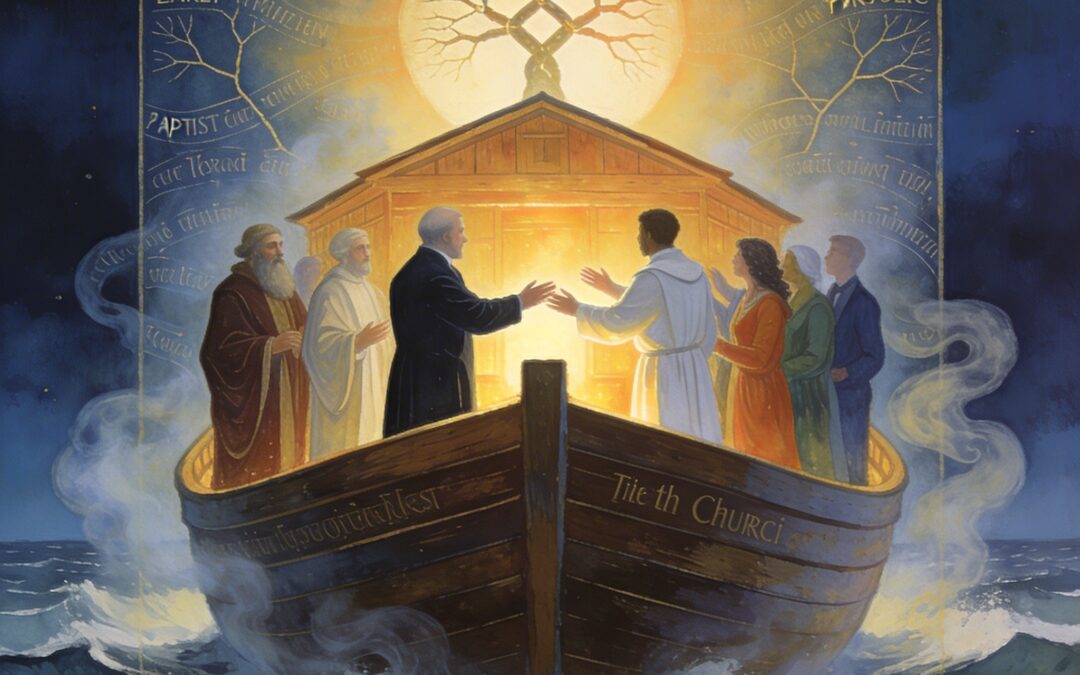
One of the prayers I think every Christian prays for that echoes the words of Christ from St. John’s Gospel, chapter 17: “I pray that they will all be one, just as you and I are one—as you are in me, Father, and I am in you. And may they be in us so that the world will believe you sent me.” (v.21). Where things get sticky is what we all mean by “one.” If you are a Roman Catholic, Orthodox, or Anglican, your ecclesiology (theology of the Church) differs from that of your run-of-the-mill Evangelical or Baptist. For the traditional Christian, the Church is often visualized as an ark (like Noah’s ark) that is sailing through history, with people getting on and off as time passed. Whereas, in a low-church understanding, “the Church” is not a single entity, but a blueprint found in the Bible that is made to be reproduced. Because of these different understandings, the answer to the prayer to “be one” looks different.
In the New Testament, the Church is described as a body—many members, but one life. The image St. Paul gives in 1 Corinthians 12 goes far beyond metaphor: it is the reality of what the Holy Spirit does with the people of God. There aren’t multiple bodies of Christ, only one. When we are baptized, we are joined not merely to Christ but to one another, across all ages, cultures, and nations. Congregations are expressions of that one Body, not separate bodies with their own identity. To be a Christian, then, is never an individual or local affair—it is to belong to something both visible and historical.
But the Church through time has not always lived that reality well. It has divided again and again—sometimes for tragic reasons, sometimes for necessary ones. In truth, some divisions have been like emergency surgeries: painful, but at times necessary to save life. Others, however, have been the result of human ego, political pressure, or differing cultural forms. Once the crisis passes, though, the call remains the same—to heal what has been torn.
Take, for example, our own Methodist heritage. John Wesley never intended to start a new church. A lifelong Anglican priest, he described the Methodist movement as an effort “to reform the nation, particularly the Church, and to spread scriptural holiness throughout the land.” Methodism in its origin was not a schism—it was a renewal movement within the Church of England. Lay preachers, class meetings, and field preaching were ways to reawaken the life of grace in ordinary believers. It was only after the American Revolution, when Anglican clergy were scarce and Wesley reluctantly sent Thomas Coke to ordain new ministers for the colonies, that Methodism took on a distinct ecclesial form—the Methodist Episcopal Church. Even then, Wesley saw Methodism as a continuation of the one Church, not a replacement for it. The split was pastoral and practical, not theological.
A century later, the Free Methodist Church emerged from the Methodist Episcopal Church in the 1860s. The reasons were morally serious and historically necessary: a stand against slavery sympathizers, a desire for “free seats” when pew rentals had become a social barrier for the poor, and a concern to preserve holiness preaching when the larger body was becoming formal and complacent. B. T. Roberts and others didn’t separate to rebel, but to stay faithful to the Spirit’s movement within Methodism itself. The goal was not to leave the people called Methodists—it was to keep their original fire alive.
This is where we must recover a patristic vision of the Church: not as disconnected islands of believers floating independently through time, but as one unified body moving inexorably through history under Christ’s headship. The early fathers—like Ignatius, Irenaeus, and Cyprian—taught that the Church is a single, organic reality, handed down from the apostles, growing and correcting itself across generations. Splits may scar the body, but they do not create new bodies; the one Church persists, calling her wounded members back into communion. For low-church Protestants, this doesn’t mean hierarchy or ritualism—it means seeing our local assembly as a vital part of that ancient, living organism, linked by baptism, creed, and Scripture to every faithful Christian from Pentecost to today.
But the question we must ask today, with gratitude for those who came before us, is whether the reasons that once made divisions necessary still remain. The Church of England that Wesley knew is not the same as the Anglicanism that exists today. Interestingly, the Anglican Church in North America (ACNA) has been deeply shaped by the kind of Spirit-led, Scripture-centered renewal that Methodism championed in the eighteenth century. Anyone looking at ACNA congregations can see strong echoes of early Methodism’s heartbeat—biblical preaching, small-group discipleship, evangelistic zeal, and a hunger for holiness. In a sense, Wesley’s children have helped their Anglican mother recover her vitality. Perhaps that mutual influence is a sign that old wounds might be ready for healing.
Likewise, within Methodism itself, we find new alignments forming. The rise of the Global Methodist Church (GMC) represents a desire to reclaim both scriptural faithfulness and Wesleyan integrity. The brokenness that once split Methodism in the nineteenth century over moral and doctrinal drift may be resolving in our own time through renewed clarity, holiness, and mission. If the theological and moral crises that once necessitated fracture have given way to faithful reform, then perhaps it is time to ask not how to multiply more branches, but how those branches might graft once more into one living tree.
Christian unity doesn’t mean uniformity. It doesn’t mean abandoning our distinctives. It means recognizing that the Body of Christ is one—not only across geography, but across history. It means realizing that our hope lies not in our denominational franchises but in our shared participation in the life of Christ. If the Free Methodist, the Global Methodist, and the Anglican find themselves proclaiming the same gospel and pursuing the same holiness, perhaps it is time to start praying and working toward a visible unity that testifies to the world: Jesus truly is Lord.
Our divisions may have had their reasons, but when those reasons die, so should our excuses for staying apart. The Church is one Body, sailing through time like an ark on God’s mission of redemption. It’s time for those who have stepped off along the way to start rowing toward one another again—until the ship of the Church, battered but unsinkable, carries us all home together.