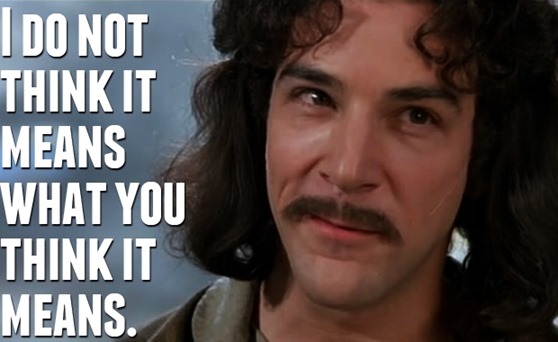
“You keep using that word; I do not think it means what you think it means.”
It is one of the most iconic lines in modern cinema. In The Princess Bride, Inigo Montoya delivers this line in response to Vizzini’s constant use of the word “inconceivable,” a word he clearly does not understand, given how frequently he misapplies it. The humor works because the audience recognizes the gap between the word’s meaning and its usage.
That line often comes to mind when I encounter discussions, especially online, about what are commonly called “Second Commandment violations,” or “2CV” for short.
The argument usually runs like this: because Exodus 20:4 says, “You shall not make for yourself a carved image, or any likeness of anything that is in heaven above…,” any depiction of Jesus, whether in painting, film, or other media, is a direct violation of God’s command and therefore sinful.
To that, I find myself thinking: you keep using that word; I do not think it means what you think it means.
The biggest pitfall with this interpretation is not sincerity. Those who hold this position are often deeply committed believers who want to avoid idolatry at all costs. That instinct is good and worth honoring. But sincerity alone does not guarantee accuracy.
Where this position begins to break down is in two key areas.
First, it fails to read the commandment in context, and not just immediate context, but canonical context.
Sound biblical interpretation requires us to ask not only, “What does this verse say?” but also, “How does Scripture itself apply and clarify this command?” The Second Commandment does not stand alone as an abstract prohibition. It is embedded within a covenantal framework and immediately explained: “You shall not bow down to them or serve them” (Ex. 20:5). The concern is not merely the existence of images, but how they are used.
But the context deepens even further.
In Exodus 32, Israel violates this very commandment with the golden calf. What is striking is not simply that they made an image, but what they claimed about it: “These are your gods, O Israel, who brought you up out of the land of Egypt!” (Ex. 32:4). This is not so much the introduction of a new deity as it is a false representation of the true one, an attempt to render Yahweh visible, controllable, and immediate. That is the heart of the violation.
And then, almost immediately after this, God commands the construction of the tabernacle, which includes images.
In Exodus 25, the Ark of the Covenant is to be fashioned with golden cherubim overshadowing the mercy seat. In Exodus 26, cherubim are woven into the very fabric of the tabernacle curtains. Later, Solomon’s temple is adorned with carved cherubim, palm trees, and open flowers (1 Kings 6:23–29). These are not incidental decorations. They are divinely commanded elements within Israel’s worship.
Even more striking is the bronze serpent in Numbers 21. God commands Moses to make it, and those who look upon it in faith are healed. Yet in 2 Kings 18:4, Hezekiah destroys it because it had become an object of idolatrous devotion.
That example is decisive.
The problem was not that an image existed. The image was commanded by God. The problem was that the image was misused. It shifted from sign to substitute.
So whatever Exodus 20:4 forbids, it cannot be a blanket prohibition on all visual representation. Scripture itself does not allow that conclusion.
The issue is not images. It is idolatry.
Second, it ignores what idol worship actually looked like in the ancient world.
In that world, images were not simply artistic representations. They were understood to participate in the reality they depicted. Through ritual acts, an idol was believed to become a dwelling place of the deity. Offerings were made to it. Prayers were directed toward it. The image functioned not as a reminder, but as a localized presence of the god.
This is the backdrop of the Second Commandment.
God is not prohibiting art. He is prohibiting the construction of rival presences, attempts to represent Him in ways that make Him manageable, containable, or subject to human control. The commandment guards the freedom and transcendence of God.
At this point, an important question arises: what about traditions that use images devotionally, such as icons and statues?
Here we need both clarity and charity.
Before critiquing Catholic or Orthodox practice, we must represent those traditions honestly. It is easy to construct a strawman by assuming that bowing before an image automatically equals worship, or that such practices are simply paganism in Christian dress. But those claims do not reflect how these traditions understand themselves. As Christians, we are called not only to truth, but to truthfulness.
Both Roman Catholic and Eastern Orthodox theology carefully distinguish between worship (latria), which is due to God alone, and veneration (dulia), which is honor given to saints, with a unique form (hyperdulia) accorded to Mary. The Second Council of Nicaea (787) articulated that honor given to an image passes to its prototype. The image is not the endpoint, but a means of directing honor toward Christ or His saints.
In the Eastern Orthodox tradition especially, this is often expressed through the language of the icon as a “window.” An icon is not understood as a container of the divine, but as a witness that opens the viewer toward a greater reality. It is something one looks through, not merely at. The purpose of the icon is not to localize Christ, but to direct the heart and mind toward Him.
This is deeply tied to the theology of the Incarnation. If the Son of God has truly taken on visible, tangible human flesh, then He can be depicted. The icon becomes, in this sense, a visual confession that the invisible God has made Himself known in Christ. As John of Damascus put it, “I do not worship matter; I worship the Creator of matter who became matter for my sake.”
That is a serious and historically grounded position, and it deserves to be engaged on its own terms.
At the same time, from a Protestant perspective, several concerns remain.
The distinction between worship and veneration, while theologically precise, is not always easily maintained in practice. The Reformers were responding to real pastoral conditions in which the line between honoring and functionally relying upon images had become blurred.
This is strongly reflected in the 39 Articles of Religion of the Church of England, XXII. Of Purgatory. The Romish Doctrine concerning Purgatory, Pardons, Worshipping and Adoration, as well of Images as of Relics, and also Invocation of Saints, is a fond thing, vainly invented, and grounded upon no warranty of Scripture, but rather repugnant to the Word of God.
Further, even the “window” language, helpful as it is, raises a question of pastoral caution. Windows are meant to be looked through, but human nature has a way of lingering on the glass. What is intended as a means of directing attention to Christ can, over time or in certain contexts, become an object of misplaced focus.
Here again, the bronze serpent provides a helpful biblical parallel. What God once commanded and used for good can, when misdirected, become an occasion for idolatry.
Finally, the New Testament offers no clear mandate or example of the use of images in the worshiping life of the Church. While that silence does not settle the question, it does suggest that such practices are not essential and should therefore be approached with care.
So we should avoid two equal and opposite errors. We must not misrepresent our Catholic and Orthodox brothers and sisters. At the same time, we must not ignore real pastoral dangers.
The question is not simply whether an image can function as a window.
The question is whether, in practice, it consistently remains one.
The Second Commandment is not violated by the mere existence of an image of Christ.
Scripture itself includes divinely commanded images, even within the holiest spaces of worship. The commandment, therefore, cannot be about representation as such. It is about the misuse of representation, treating something created as if it were the Creator, attempting to bring God under our control, or substituting a manageable image for the living and holy God.
To have a painting of Jesus, to portray Him in film, or to use visual depictions for teaching is not, in itself, a sin. The question is not whether an image exists, but what role it plays.
Does it point beyond itself to the risen Christ revealed in Scripture, or does it subtly replace Him?
The true danger is not that we might depict Christ. It is that we might reduce Him, whether in image or in imagination, to something safer, smaller, and more controllable than He truly is.
And that is precisely what the Second Commandment was given to prevent.