One of the most fascinating sociological phenomenons is the food offerings at Chinese-American restaurants. While there may be some local variations, these usually independently owned establishments share so much commonality in their menus that I can expect to get just about the same order of sesame chicken just about anywhere. There’s been no grand conspiracy of these restaurants coming together and pick their menus. But organically, over the last several generations, American Chinese food has found some sort of equilibrium where the menus are all about the same.
In American church culture there is something very similar going on here. Despite denomination or theological differences, many of the worship services across the West look the same: an energetic welcome, opening song, announcements, more worship songs, prayer, sermon, and then a closing song, sometimes paired with an altar call. I have seen online and have been in these services. Sometimes the church is Baptist, Methodist, Reformed, or non-denominational, yet they share a common “house style” that has quietly become the default American evangelical liturgy, no matter what the denomination’s actual theology or history might say.
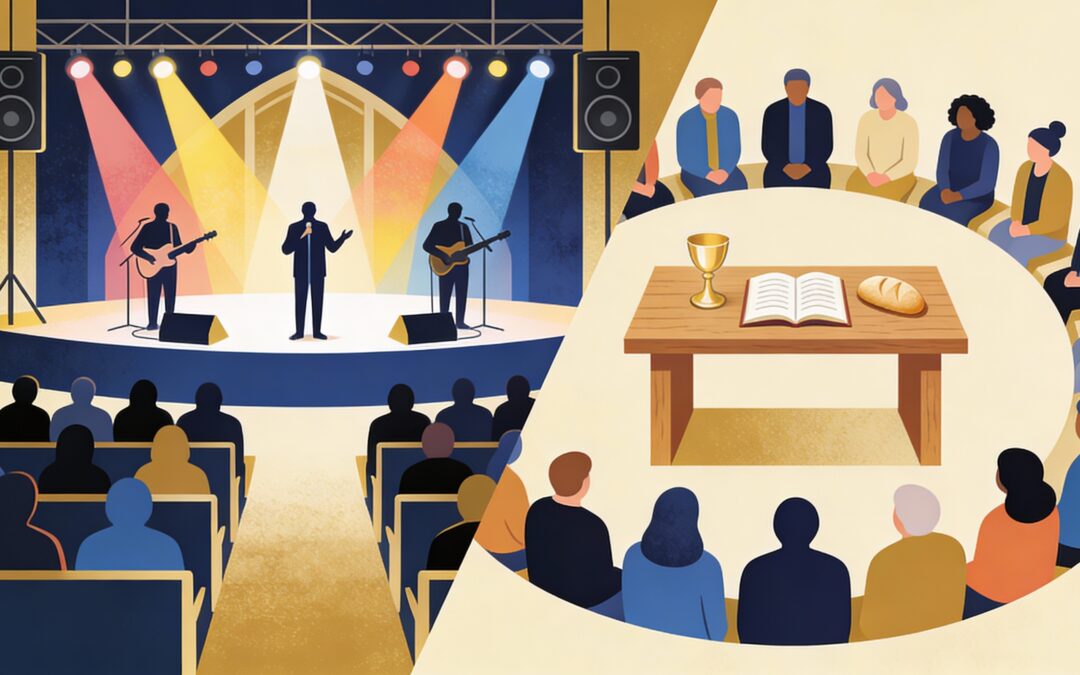
There wasn’t a giant gathering of pastors who all agreed, “This is now how church must look.” Just like the takeout menu, this pattern emerged over time. Revivalism taught churches to center everything on visible “decisions” and emotional urgency. Modern sound systems and lighting made it easy to turn the front of the sanctuary into a small concert stage. Church growth experts told leaders to strip out anything that might feel unfamiliar or “churchy” to seekers. And so, slowly, a template took shape: a block of music, a block of speaking, maybe a response song at the end, and very little else.
In the Free Methodist heritage, one of our original distinctives is, “free to worship in the Holy Spirit.” This distinctive comes from our origin story in the mid-1800s, when B. T. Roberts and others broke from the Methodist Episcopal Church over things like slavery, pew rentals, and a kind of buttoned-up formalism that seemed more interested in pleasing wealthy pew-holders than in pleasing God. “Free” meant, among other things, that the poor didn’t have to rent a pew to have a place in the sanctuary, that laypeople and especially women could use their gifts in the assembly, and that worship wouldn’t be suffocated by cold performance or social respectability.
What “free to worship in the Holy Spirit” did not originally mean was “free from the church’s historic practices of Word and sacrament.” The early Free Methodists saw themselves as continuing “original Methodism,” not inventing an entirely new kind of Christianity. And original Methodism, in John Wesley’s own practice, was both revivalist and sacramental. Wesley preached in fields and on street corners, organized small groups, and also remained an Anglican priest who used set forms of prayer and insisted on regular Communion as one of the chief “means of grace.”
Wesley even wrote a famous sermon called “The Duty of Constant Communion,” where he argues that Christians ought to receive the Lord’s Supper as often as they possibly can. He doesn’t treat Communion as a rare symbol but as a regular, God-given channel of grace—a habit that actually shapes the Christian life. For him, to neglect the Table when it is offered is either to ignore Christ’s command or to ignore one of the main ways Christ cares for his people. That is the sacramental DNA that sits underneath our broader Wesleyan tradition.
Fast-forward to the present, and a lot of our Free Methodist services look far more like the generic American evangelical template than like anything recognizably Wesleyan. Instead of a gathered people formed week by week through Scripture, confession, creed, intercession, and frequent Communion, we often have a band set, a sermon, and an altar moment, with Communion tacked on occasionally when the calendar or local habit demands it. The shape of the service quietly catechizes us. It answers the question, “What is church for?” long before the preacher says a word.
If the whole service is built around the sermon and a decision moment, then church starts to feel like an event where individuals come to receive a religious talk and then make a personal choice. If the biggest energy is in the music set, church starts to feel like a spiritual concert with a TED Talk in the middle. But in a Wesleyan and wider historic Christian frame, the church is not just a weekly event. It is the baptized people who are gathered, forgiven, instructed, and fed with Christ’s own life in Word and sacrament, and then sent into the world.
That is where the “Chinese menu” analogy bites a little. No one confuses General Tso’s chicken with the full depth and variety of regional Chinese cooking. It’s a simplified, American-shaped version that settled into place because it works in a particular context. In the same way, the default evangelical order of service “works” in a narrow sense: it is reproducible, marketable, easy to explain, and familiar. But it is not the fullness of the Free Methodist or Wesleyan inheritance, and it may not be the best pattern for forming people in deep holiness over a lifetime.
The tragedy is that our own founding distinctives actually call us to more, not less. Freeing worship from the control of the wealthy and from stiff, performative formalism was meant to open the doors wide—to the poor, to lay gifts, to the Spirit’s prompting—not to cut us off from the very practices that rooted Wesley and the early Methodists in the wider Church. Free seats and full participation make the most sense when you remember that baptism and Communion are the great “levelers”: moments when every person, regardless of status, stands on the same ground of grace.
So the question becomes: do we want our services to be shaped mainly by what “works” in the American religious marketplace, or by what actually tells the truth about what the church is? A Free Methodist congregation that takes its heritage seriously does not have to become a museum of antique Anglicanism. But it does have to wrestle with the fact that Wesley’s own vision was one where the Spirit moves powerfully through very ordinary, very repeatable means—Scripture, prayer, baptism, and the Supper—woven into a recognizable pattern week after week.
If American Chinese food found its equilibrium menu by accident, perhaps we have done something similar in our worship. The good news is that menus can change. No one restaurant has to fix the whole system. A local church can begin, quietly and patiently, to recover a different center: to bring the Table back to the heart of Sunday, to pray not only in our own words but with the words of the wider Church, to order the service so that people are drawn into God’s story rather than just into a string of religious moments.
Over time, that kind of “menu” will form a different kind of people. Not consumers chasing the next moving worship set, but men and women, teenagers and children, learning to live out of their baptism, to expect Christ to meet them at his Table, and to see their whole lives as an extension of what happens when the church gathers. That, it seems, is much closer to what our own distinctive tries to say: not just free to do whatever we want on a Sunday morning, but truly free to worship in the Holy Spirit.