This article was writte nfor, and originally posted on HolyJoys.org
Names are important because they carry meaning and history with them. When the name for something changes, more than just the name can be lost. Part of its identity can be lost, even if the thing remains. I grew up talking about “the cigarette lighter” in cars (something that I burned my fingers on a number of times as an overly curious child). Today, it’s now just called a “12 volt power outlet” or “charger port.” As a non-smoker, I welcome the development. But the point is this: With the change of name, its original purpose is no longer evident.
When it comes to the church, changes in names are more serious and worthy of reflection. For hundreds of years, there were established terms for the parts of the church’s architecture. In recent years, many of these terms have fallen out of use in some contexts. Other terms have been brought in to replace them. This article explores a few of these largely forgotten terms and considers what might have been lost along with the change in name.
From “Chancel” to “Stage”
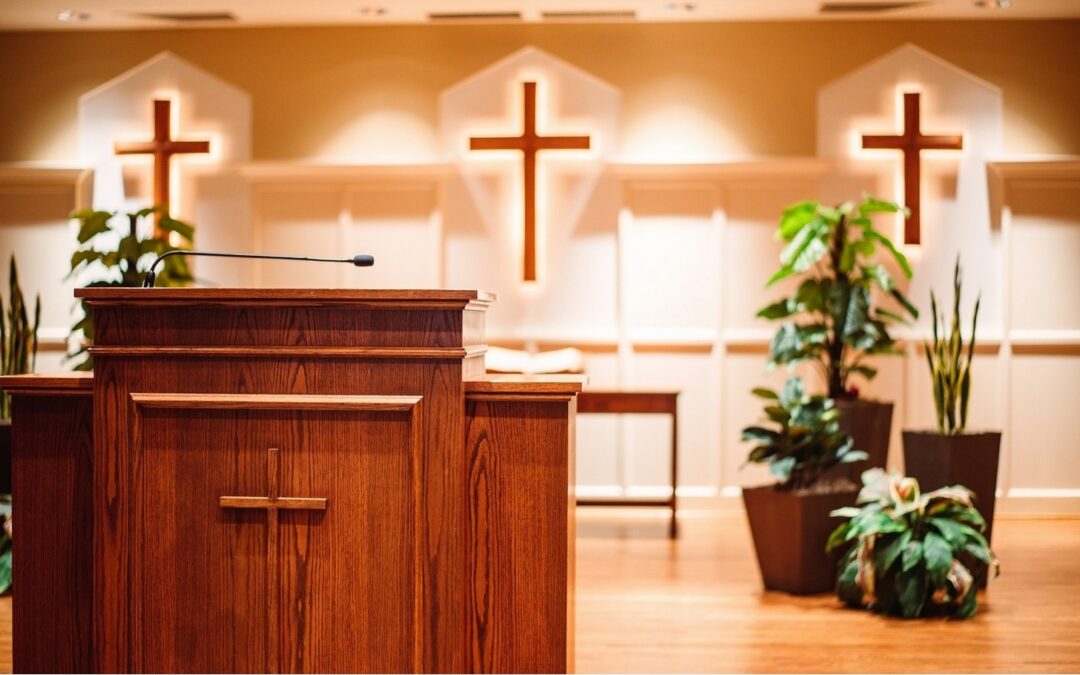
One of the most striking examples of this is the name for the place in the church where the primary activity of the service takes place. Today, it is most commonly called “the stage” or “the platform.” Traditionally, this area of the church has been called the chancel. The chancel is the area where the pulpit, lectern, and altar or communion table are placed, and where the choir, musicians, and clergy conduct most of the service. The term chancel originates from French usage of late Latin meaning lattice, since in many medieval and traditional churches, the chancel area is sectioned off by a lattice-type wall that you can see through, but that defines a distinction of space. Whether or not a church has a lattice-type wall, the point is that for much of history, churches had a special name for this sacred part of the church.
When we abandon traditional language and begin to refer to the front part of the church as a “stage,” something subtle shifts in our imagination. A stage is for performers. A stage is where you watch people do something for you. A stage implies an audience, spotlights, and a certain transactional relationship: you come, they do, you leave. And while no one means any harm by the language, the word itself quietly undercuts the very thing worship is meant to express.
The word “stage” quietly undercuts the very thing worship is meant to express.
The chancel, on the other hand, does not carry the implication of a performance. It carries the weight of a story. The word reminds us that this space is not just where things happen but where holy things happen. It is the place where prayers are offered, Scripture is proclaimed, the sacraments are administered, and the people of God gather near the mysteries that sustain them. A chancel is not a platform; it is a place set apart.
Reintroducing a word such as “chancel”—even softly, and at first within our own imaginations—can deepen our conviction that the church is not a theater. It is a sanctuary—another word that has suffered its own slow fade into generic meaning. A sanctuary is a place of safety, a place marked for the presence of God, a place where heaven and earth meet. When we reduce the sanctuary to an “auditorium,” we risk losing that sense of sacred encounter. An auditorium is where you attend. A sanctuary is where you are received.
From “Nave” to “Seating Area”
Another example is the nave—the central seating area where the congregation gathers. The word comes from the Latin navis, meaning “ship.” Many have never heard the term, but for centuries Christians understood the nave to symbolize the “ship” or “ark” of the Church, carrying the faithful through the storms of the world, as the ark was used by God to save Noah and his family. Some traditional churches are even designed as a long rectangle or as a half-circle to reinforce this theology.
While it may seem like a small thing to say “nave” instead of “seating area,” the older term reminds us that the church is for our salvation (see David Fry’s article “What is the Church’s Role in Our Salvation?”). In the church, we encounter the Savior who can keep us from drowning (queue walking on the water!). The word “nave” also reminds us that our Christian life is not static. We are going somewhere. Together. We are being carried by a grace not our own through the storms of life by the grace and mercy of God that is given to His people.
From “Narthex” to “Lobby”
Finally, consider the narthex, which is now commonly called the “entryway, “vestibule, “or “lobby” of the church. The narthex once symbolized the place of preparation, the threshold between the ordinary world and the holy drama of worship. It was the space where catechumens waited, where penitents stood, where newcomers took their first breath of the church’s life. When we call it the lobby, we lose the sense that worship begins before we ever sit down. We forget that crossing that threshold is itself an act of intention.
More Than Just Tradition
None of this is about being archaic for the sake of being archaic. It’s about remembering that the church is not just a building with functional parts but a space sanctified to God for sacred purposes with meaning-laden sections. The old words don’t just describe; they invite. They teach. They remind us that our faith has depth, that our worship has a lineage, and that we stand in a long procession of believers who use these spaces not simply as rooms but as signs.
The church is not just a building with functional parts but a space sanctified to God for sacred purposes with meaning-laden sections.
When language changes, the identity of a thing sometimes changes with it. And so part of our task in a distracted, rootless age is to recover not only the practices of the church but the vocabulary that helps shape our imagination of what the church is. Of course, we can just use vocabulary without intention and knowledge of the depths that it represents, and that certainly is a danger. But isn’t that true of any word or phrase that we use? That shouldn’t stop us from appreciating the rich meanings that our brothers and sisters in the faith have found through the ordinary means of architecture and construction—things that point us to Christ and the gospel.
Once you see the chancel as the chancel, the nave as the nave, or the narthex as the narthex, it’s hard to ever see them again as just a stage, seating area, or lobby. And even if you don’t use the traditional names, finding other meaningful words can help to sanctify the church’s space and carry meaning forward for a new generation. A small shift could be the beginning of recovering something we didn’t realize we lost.