One of the things that has increasingly bothered me in recent years is that basic ice‑breaker question people ask when religion comes up: “So, are you Christian or Catholic?”
Most of the time I know what they mean. They’re trying to ask, “Are you Protestant or Roman Catholic?” But the way it actually gets phrased reveals something deeper. It sets “Christian” and “Catholic” over against one another as if they were two different species. “Christian” becomes the default, and “Catholic” becomes the oddity that has to be explained.
That way of talking grates on me now, because if words mean anything at all, Roman Catholics are just as much my brothers and sisters in Christ as any other person who truly belongs to Jesus. They are baptized into the same Triune Name. They confess the same Lord’s Prayer. Many of them read the same Scriptures with deep reverence and cling to the same crucified and risen Christ. So when someone asks, “Do you think Catholics are really Christians?”, I’ve come to answer, “I know as many saved Catholics as I know unsaved Protestants.”
That line isn’t meant to be provocative. It’s simply honest. Over the years I’ve met Catholics whose repentance, charity, and love for Christ would put a lot of our supposedly ‘gospel‑centered’ circles to shame. And I’ve met plenty of Protestants who can rattle off all the slogans about grace and faith and justification and yet show no sign that they have actually bowed the knee to Christ. Denominational labels don’t magically sort wheat from tares.
And yet, in large parts of the evangelical, fundamentalist, and hard‑line Reformed world I grew up around, the default assumption was that Rome is not just wrong but essentially beyond the pale. The largest and oldest Western body of Christians is quietly, or not so quietly, filed under “not really part of Christ’s body.” Rome isn’t just in error; Rome is apostate.
I understand how people get there, because that was my default for a long time. I had been catechized into a very particular picture of Catholicism. The list went something like this:
- Catholics worship Mary, who is basically a pagan goddess in a blue robe.
- They pray to a whole pantheon of saints like a set of lesser gods and goddesses.
- The Mass is a piece of ritual magic—transubstantiation—where a priest “conjures” Jesus into the bread.
- They don’t really trust God for forgiveness, so they have to crawl into a confessional and tell a man their sins.
- Their statues, icons, relics, scapulars, holy water, and medals are just Christianized idols and talismans.
When you rehearse that catalogue often enough, it becomes very hard to imagine Catholics as Christians at all. They look like polite pagans who have stapled the name “Jesus” over top of a pre‑Christian religion. You can tolerate them as neighbours, maybe, but you don’t instinctively think of them as family.
What I did not realise at the time was how much that entire way of imagining Catholicism has been shaped by a particular story about “pagan roots” and “pagan survivals” that we’ve absorbed from the culture around us. We think we’re just being biblical and Reformation‑faithful, but our mental furniture has been arranged by someone else.
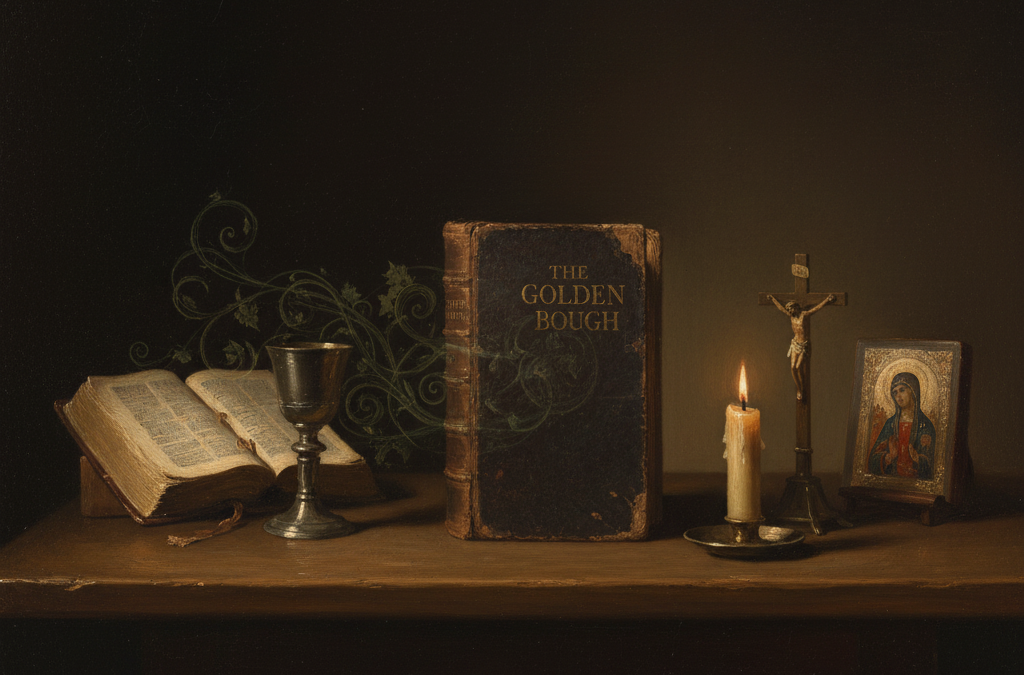
One of the main furniture‑arrangers was Sir James George Frazer, the author of The Golden Bough. Frazer grew up in strict Scottish Presbyterianism and later rejected Christianity altogether. He wanted to show that religion, Christian and pagan alike was an early, mistaken stage in humanity’s development, something that would eventually be swept away by science. To do that, he spun a powerful narrative: at the heart of many religions, he said, is a “dying and rising god” or sacred king, whose death and rebirth guarantees the fertility of the earth and the survival of the tribe.
Into that narrative he threw pagan gods like Osiris, Adonis, and Tammuz. And then, very deliberately, he threw Jesus. The crucifixion and resurrection became, in his telling, another iteration of the same old myth. Easter became a spring fertility festival with a Christian gloss. Christmas became a baptised solstice feast. The whole Christian year became a patchwork of older pagan festivals that the church had simply painted over.
Once that framework is in place, Catholic‑looking Christianity is the easiest target. If you’re hunting for “pagan survivals,” you go where there are feasts, processions, saints’ days, Marian statues, relics in altars, candles and bells and incense. You re‑read all of those things as evidence that the church never really left the old fertility cults behind. “Mary is just the mother goddess in a new dress. The saints are the old local gods with new names. The Mass is a cleaned‑up version of temple sacrifice. Relics are magic bones. Feast days are old seasonal festivals with Christian labels.”
Now, specialists have spent the last hundred years poking holes in Frazer’s grand theory. His “dying and rising gods” turn out to be far less uniform than he imagined. His historical connections between specific ancient rites and specific Christian practices often vanish when you actually trace the sources. His neat story about Christmas and Easter simply being taken wholesale from pagan festivals is, at best, oversimplified. And his underlying assumption that religion is just bad science in fancy dress reads more like late‑Victorian self‑confidence than like a sober description of how human beings actually worship.
But even though the academic world has moved on, Frazer’s way of thinking has stuck in the cultural imagination. It’s there when neo‑pagans talk about “taking back” Easter and Christmas. It’s there when atheists insist that Christianity is nothing but “recycled paganism.” It’s there in the way internet skeptics gleefully circulate charts “proving” that Mary is Isis and the saints are the old gods under new titles. And it’s there, more quietly but just as really, in the way many evangelicals and fundamentalists talk about Catholicism as essentially a pagan religion with a Christian coat of paint.
Here’s the uncomfortable part: a lot of us Protestants have borrowed Frazer’s conclusions without knowing it, and then baptised them as “discernment.” We look at Catholic practices and assume that any resemblance to something we once read about in a documentary or a meme must mean direct borrowing. We assume that if you can find an ancient mother‑and‑child statue somewhere, then Mary must be a goddess. If you can find a pre‑Christian spring festival, then Easter must be stolen. If you can find any pagan use of bread and wine, then the Eucharist must be a sun‑god ritual.
We rarely stop to ask the harder questions:
- What do Catholics themselves say they are doing when they celebrate the Mass or honour Mary or ask a saint to pray for them?
- How did these practices actually arise in Christian history, out of what texts, arguments, pastoral concerns, and controversies?
- Where do they align with, or diverge from, Scripture as read in the early Church, not just as filtered through modern polemic?
From an Anglo-Methodist, Reformation‑shaped perspective, Scripture still has to be the final measure of doctrine and practice. That means there will be places where we say, “No, we cannot follow Rome there.” We may be convinced that certain Marian dogmas go beyond the Word, that particular formulations about sacrifice at the Mass obscure the sufficiency of Christ’s cross, or that some ways of using relics and sacramentals invite superstition. Those aren’t small matters, and we shouldn’t pretend they are.
But if Scripture is our final standard, then truthfulness is not optional either. We are not free to put words in our neighbour’s mouth or to invent origin‑stories that flatter our side. “You shall not bear false witness against your neighbour” doesn’t come with a footnote that says, “unless your neighbour is Roman Catholic.”
So here is where I’ve landed.
First, some may suspect I am on the road to “swim the Tiber”, a coloquial phrase for someone who converts to Catholicism. That’s not where I’m at. I am firmly convinved of why I am a Protestant. Even as my own understanding of the Christian faith has been more deeply enriched by a balanced and Biblical understanding of the authority of tradition, it has only resolved me more to be a Protestant as the expression of the classical Christian consensus, or the “faith once delivered to all the saints” (Jude).
With that, I can, and do, remain committed to the Reformation’s call to weigh every teaching by the written Word of God. I can be frank about my disagreements with Rome where I believe Rome has erred. But I am no longer willing to prop up those disagreements with sloppy talk about “pagan roots” that I haven’t actually investigated, or with caricatures of Catholic belief that crumple the moment I ask a thoughtful Catholic to explain what they really confess.
I still hear the question, “Are you Christian or Catholic?”, and it still bothers me. Not because I’ve become indifferent about doctrine, but because I have become more jealous for the truth. I know as many saved Catholics as I know unsaved Protestants. That simple observation forces me to slow down. It reminds me that Christ’s grace does not honour our party lines as much as we might hope, and that my first allegiance is to Him, the truth, before it is to any half‑remembered stories about who stole what from which pagan festival.