I remember I was standing at the counter of a gun store in Athens, PA talking to the owner. At the time I was attending a Bible school in the Southern Tier of New York, and there wasn’t really anything to do. This particular store was the closest location to the school I went to, and while I never bought anything, I would browse, and eventually struck up a friendship with the owner. After the first visit she talked about being a Christian herself, so theology and the Bible were regular parts of the conversation when I would come visit.
Then one day she said something that was really strange. “Our pastor is talking about Genesis 6, and how angelic beings came and created hybrids that eventually became demons.” I was kind of shocked and didn’t know what to do with this information. I had never heard of such a thing before. And while I had read the Bible a bunch of times (I was in Bible school after all), this particular episode was nothing I had ever heard of. I then started digging into the resources I had available to be at the school, and when I presented her with the explanations that these books (now looking back on them poorly researched commentaries on the Bible that was more personal opinion than grounded interpretation), she quickly and expertly took apart the thin arguments I presented her. That conversation particular ended, and I continued on with life.
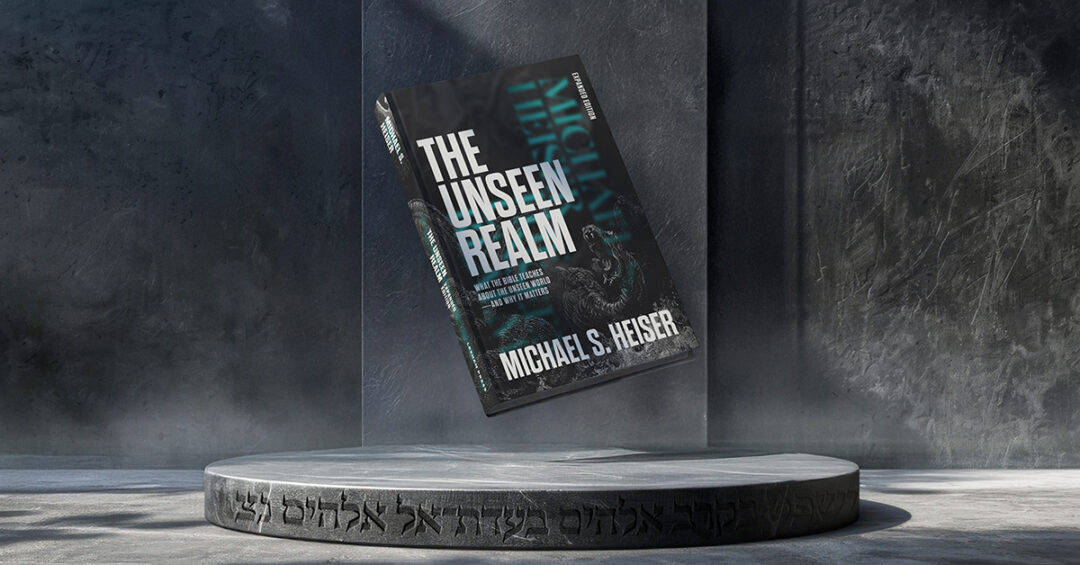
Several years later my brother started talking about this book called The Unseen Realm, and this guy Michael Heiser. At this point, I was slowly being dispelled of the fundamentalist underpinnings of Biblical interpretation, my mind was now open for serious scholarship on Scripture, and I started watching videos and listening to podcast episodes from this Heiser guy.
I was immediately captivated. His basic premise was, “if it’s weird, it’s important.”
The Bible, whether we acknowledge it or not is full of a lot of weird stuff that we simply can’t just explain away. We like to try, to may our interpretations of the Bible fit our neat evangelical, contemporary, post-enlightenment categories of theology and the world. But, as Heiser points out, if we take the Bible seriously, as it was meant to be taken, we get dispelled of that very quickly.
While I grew up in a Charismatic and Pentecostal background, which assumes the reality of angels, demons and the like, in reality the understanding was very flat and two dimensional. A standard dualism was baked into the cake, and much of what I thought was found in the Bible, later turned out to be stuff from Milton’s Paradise Lost, that had simply been subsumed into the Biblical narrative, without actually being found in the text itself.
But then I started to see the big picture that Heiser was starting to present. And once I got my hands on a copy of The Unseen Realm, so many different pieces started to fall into place.
This idea of a Divine Council Worldview, which predominately is derived from Psalm 82, and Deuteronomy 32 (though is thoroughly replete throughout Scripture) fleshes out the truly supernatural worldview of the authors and recipients of the Biblical text. And what was most captivating, was that this understanding of Scripture was holistic in taking into account all the weird stuff that we find, without having to bend over backwards to make other data points fit. More than that, it wasn’t just coherent with the Gospel message, it actually strengthened the mission of Christ, and what our role as the Church is in the world.
Sadly, Michael Heiser passed away in 2023 from cancer. Though, throughout his entire time of treatment, he kept making content, and writing. Since his passing, much of the content that he had been working on has been compiled and been rolled into his original magnum opus; The Unseen Realm: Expanded Edition. The additional 20,000 words of content help flesh out, and further contextualize the Divine Council Worldview.
For anyone who has not read the book, or is familiar with the concept of the divine council, I highly recommend that you take the dive. When we take seriously the context the Scriptures were written in, we begin to see how everything falls into place, where before some stuff might seem weird or untoward to our modern sensibilities.
For those who have already read Heiser, the expanded edition is well worth getting as it adds additional notes, context & application of the expansive content already found in the book.
Heiser has had one of the greatest impacts on my understanding of God, and His work in the world. and for that I am eternally grateful. I hope you will come to see the blessing that Heiser was and is to the church as his legacy lives on through The Michael S. Heiser foundation, run by his widow, AWKNG School of Theology, The Divine Council Worldview Podcast and so many other resources.
The Unseen Realm: Expanded Edition releases on October 1, but early shipping is available if ordered through Logos.
I grew up in Canada, so I didn’t get the experience of saying the pledge of allegiance every day. But as in the US we did sing the national anthem every morning, facing the national flag in the room as part of our daily routine. Every morning we sang the words, “God keep our land, glorious and free!”. While Canada certainly could learn a thing or two from that line right now, I’m not here to comment on that. Nevertheless, we all have these common things that bind us together in a certain identity. We know that they know, and because of that there is a shared understanding of who we are.
Then we get to the world of Christian worship, and the plethora of styles that exist in the world today. This isn’t wholly a bad thing. Before becoming a lead pastor, I led worship in a contemporary context, and there were certain things I loved about it. But one thing that nagged at the back of my head was, “what is the connection with what we are doing with the rest of the Church?”.
For most in the modern American evangelical world, more traditional styles of worship can often be looked at with suspicion (often being suspected of “being too Catholic”), or maybe kind of laughed at as antiquated. But there are many things that we in evangelicalism can learn from the faithful worship of our brothers & sisters in ages past.
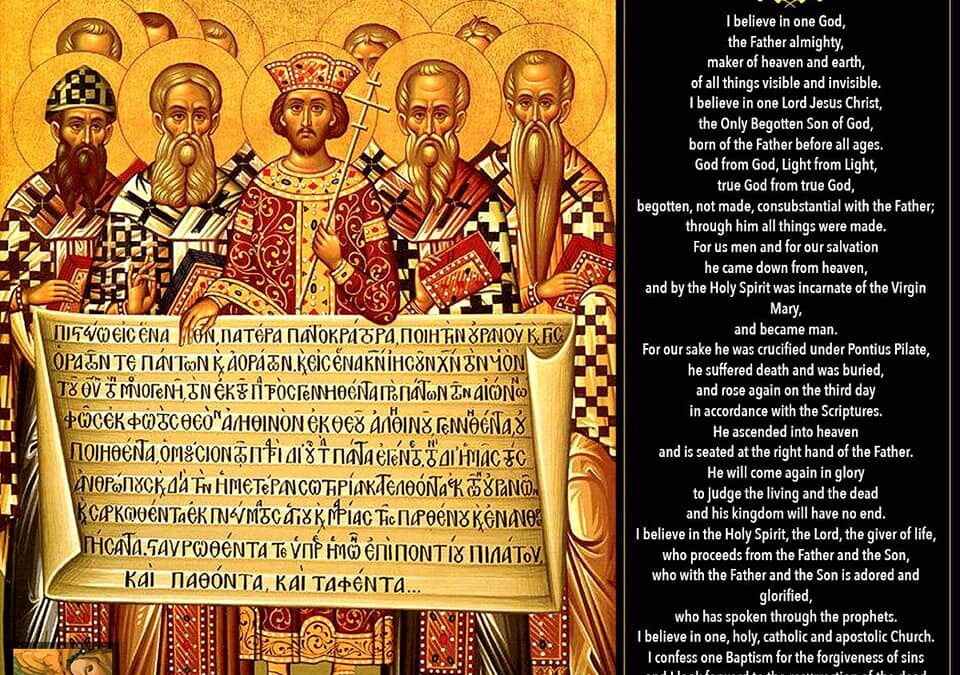
One of these key elements of worship is the reciting of an ecumenical creed. Even since the earliest days of the Church, a variety of concise statements of belief have been used as a part of preparation for baptism, and in worship. The two main creeds that are often used are the Apostle’s Creed, or the Nicene Creed. Both of these creeds accepted by all orthodox Christian throughout history, contain the core truths of the Christian faith.
Why is reciting a creed even important?
First, historically the creeds have been placed in the order of worship for churches as a check on the clergy. In Anglican liturgy, the creed follows the sermon. This is placed there as a statement and question, “does what was just preached line up with what we just said?” In many churches there can be problematic theology that is presented from the pulpit, and having the core creed of Christian doctrine help work as a ruler that the sermon can be compared too. Though sadly this is not a sure fire way, because there are many more traditional denominations and traditions that are wholly caved the liberal and woke ideology, despite saying the creeds weekly.
Secondly, creeds provide a foundation of right belief, and an inoculation against bad ideas. A good friend of mine was raised Roman Catholic. He learned the creeds from a young age, and even during his teen years when he wasn’t really following Christ, he encountered a preacher who was sharing aberrant theology. Despite not actively living the Christian life, my friend was still inoculated from these ideas, because he instantly recognized that what was being said did not line up with the creed in certain areas. Now again, as stated above, this is not a 100% sure thing. You can know the creed, and choose to ignore what it is actually saying. But, I would argue that for most Christians, knowing the creeds would be a beneficial thing.
We live in an age with a million messages hitting our brain every singly day. Facebook, Instagram, TikTok, Reddit, Youtube and the list goes on and on…not to mention traditional advertising on billboards and TV commercials. We are constantly being messaged to.For us as followers of Christ, the creeds provide to us messaging that we can get on board with. Something that we can remember and look to, as a sure thing as to the truth of the Christian faith.
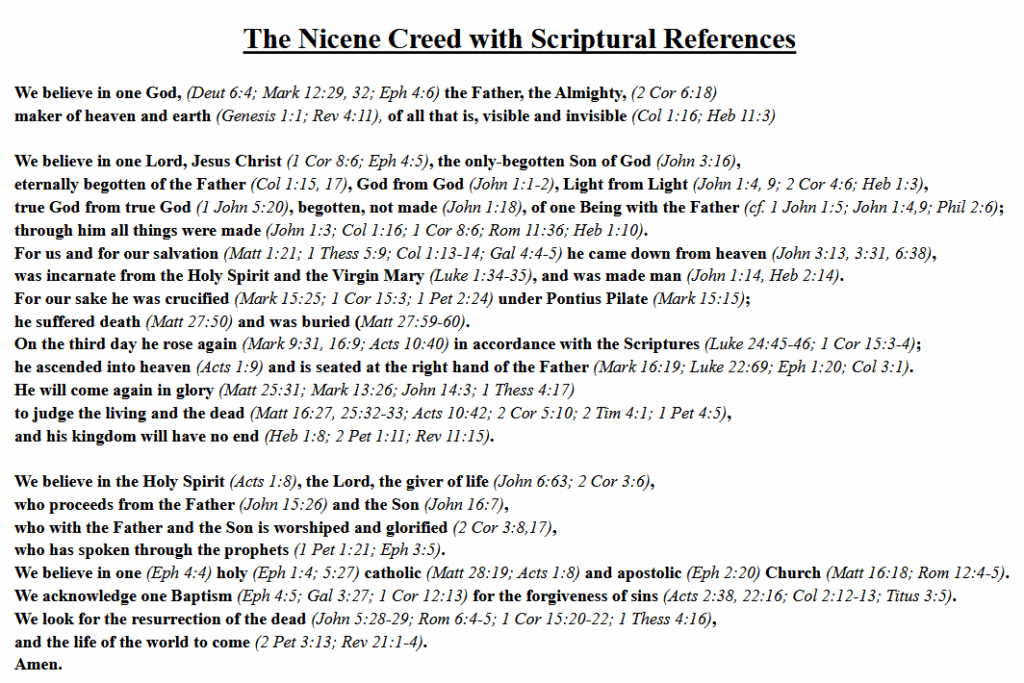
Below is a photo showing the Scriptural references that are found in the Nicene Creed. The creeds are not just “concocted words of men”, but are synthesized and condensed truths from Scripture, organically presented to systematically present the truths of, and the general flow of the Gospel message. The creeds help ground and center us in a crazy world.
The creeds help provide a guard rail against bad theology. You see, the tricky little secret that many don’t think about, is that heretical ideas use the same Scripture. Yes, ideas are over weighted in their importance, or incorrect translations or ideas are added to the text, but nevertheless the Bible is used as a proof-text for bad ideas. The creeds help us in telling us that as we read God’s holy and inspired Word, the correct interpretation and understanding of them will be found inside of the bounds of the creeds.
But how can all of this work in a contemporary setting? Good question!
As I had mentioned, I had been leading worship in a contemporary worship setting up until the beginning of 2025. For the entire last year I led worship, we recited the Apostle’s Creed every single week as part of our time of worship. And other than a little confusion about the word ‘catholic’, it integrated really well.
It can, and I would argue should be done. As Christians we have a beautiful and rich heritage in the creeds, but for many Christians there is complete ignorance that they even exist. But so much benefit is being missed out on. There are so many different ways for contemporary worship settings to use the creeds.
In recent years there have been a bunch of fantastic contemporary worship songs coming out based on or directly quoting the ecumenical creeds of the Church. I Believe by Phil Wickham, We Believe by the Newsboys, The God We Love (Nicene Creed) by CityAlight, This I Believeby Hillsong just to name a few. Use these songs, often! If a worship leader or pastor doesn’t feel that reciting a creed regularly can work for some reason, sing these songs.
But in the end, I believe firmly that EVERY church should in some way shape or form should recite a creed every single week. I always led it at the beginning, before going in to the worship set. But that is just one example, there are a multitude of ways that they can be added in, and practically it can take 30 seconds. The Apostle’s Creed is an easy one because it is shorter, but for most the Nicene Creed is the “gold standard” that the Church historic has used.
In our day and age having a good handle on the truths of the Christian faith is more important than ever, which means we need the creeds more than ever. Their usage will be enriching for all, because not only are we being taught and reminded of the Gospel, and the work of Christ, but we are being connected to Christians all around the world, and throughout history. There is continuity, there is connection, there is family.
A key theme in the literary genre of fantasy fiction is that of enchantment, or being enchanted. It usually has a magical overtone by which someone or something is imbued with special power or qualities that makes them stand out from everything else around them. Almost every magical story has an enchanted forest where the magical, mythological and fanciful creatures reside, and the protagonist usually has to go in order to continue their quest intentionally or by circumstance. It is in these places that is separated by the hum drum of the world around them, and their eyes are open to what is really going on. This is exemplified in the story of Prince Caspian, written by C.S. Lewis. Caspian enters the “dark forest” where we encounters the truth of the creatures of Narnia, and his true purpose is given to him to free the true Narnians from the oppression surrounding them. Caspian’s imagination is enchanted with what is really going on, and he can move forward in clarity to whatever is next, and into his true calling.
We live in a world that has lost all of its enchantment. Materialism, secularism and modernism have stamped out our ability to have almost any imagination. We are only concerned with what is physically in front of us..and outside of that anything doesn’t have much importance. Sure, we make ascent to the existence of a spiritual world that exists, but there is no real practical application to how we live our day to day lives.
A friend of mine put it this way. “We have made a fasutian bargain with technology. We know everything about the physical world, but we have lost the sense and knowledge of our spiritual selves, which makes us human.” I love technology & science. We have all been blessed by the wisdom that God has given humanity to understand the creation, and from that to harness it for the betterment of human living. But in that we have forgotten the truth of the spiritual world. We live as if our Christian faith is an add-on to our lives, that is part of what we do, rather than understanding that our faith is the understanding of everything.
Just as Prince Caspian experienced, we all need to take a little stroll into the enchanted forest, to have our eyes opened to what is really going on. We live in a world, that while made up of physical things, is really a world of spiritual beings and realities that interact via a physical reality. Our imaginations need to be re-enchanted with the worldview of Scripture, to see beyond the near-sighted reality of material existence, and understand that there is more.
But how can we do this? What can pull us out of our material slumber, and enable us to see the light that is above the low clouds of secularism?
One thing that I have found amazingly helpful is the Lord’s Prayer. While often spoken of as just a pattern on how to pray, this prayer is really a deeply Scriptural and theologically rich prayer that realigns our imagination and vision to how Christ desires His people to see the world around us. In this prayer we begin to see and understand that while stuff is going on around us, our call as followers of ‘The Way’ is to subvert our normal human reaction, and to work in a way that points to Christ’s Kingdom that is in, but not of this world. More of this concept can be explored in the book “Liturgy in the Wilderness” by D.J. Marotta.
This is just a small first step, but the first step is usually the biggest one. Christ calls us to look at the world around us in a different way. Not just as a place that exists with power dynamics and limited opportunities for redemption. But rather as a place that is the field of battle of epic proportions of powerful spiritual forces desiring us to image themselves, rather than the Creator of all things. There isn’t a demon under every lampshade, but there are demonic forces that try often to divert us away from our true calling. And in that same thought there are angels that seek to aid us in keeping us true to the One True King, Jesus.
It might sound crazy. But this is the real world that we live in. So let’s take a jaunt into the enchanted forest and begin to see what is really going on.
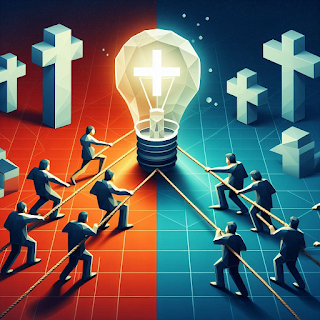
Many in the Church feel there is
really only one of two options. We either give in to the political and philosophical
ideas of the right-wing in order to pursue God’s call for the Church. Others
feel to give into the political and philosophical ideas of the left-wing as the
way to pursue God’s call for the Church. What’s crazy about all of this is that
for those on both sides (myself included) we often don’t even realize that we
are doing it!
For the right it’s the presupposition that
most evangelicals who presume the American dream is an extension of the Gospel if
our nation follows God, waiting to be raptured from trouble. For the left, it’s
the idea that the liberation the Gospel speaks of needs to be exerted
politically for the oppressed using any means necessary to bring in the New
Heavens and the New Earth. Is there some truth contained in both sides. Sure.
But both sides are often taken too far into error that loses the saltiness that
Christ’s followers are supposed to have, trading it in for dichotomy of
politically exclusive choices.
Liberation is certainly a theme in the
Scriptures. God leads His chosen people from Egypt. Once slaves, they were
taught how to be free people, being distinct from the nations around them.
Likewise, the Gospel provides us with liberation from the powers of sin and hell,
giving us the freedom to live truly as God intended us to. But what we
unfortunately see from many of the ideas espoused by those in the Liberation
theology camp is a dangerous blend of Christianity’s call to pursue justice and
help for the needy into a Marxist infused political machine that doesn’t
distinguish itself from the excesses of the political left. Justice without
truth isn’t really justice at all.
Likewise, the far right gives into its
own excesses by shrugging its shoulders much of the time at pain and suffering,
expecting to be whisked away from tribulation at any moment. So often the
vision is really focused inwards, not paying attention to the ways the Church
has historically served as a demonstration of the love of Christ. There has
been no greater witness of the Gospel throughout history than the physical ways
Christians have put themselves out of comfort to work for others good, in the
same way Christ did for us. Often, the issues our society is facing are dealt
with suspicion and fear, rather than understanding and love that leads to
truth. Justice without love isn’t really justice at all.
All of this means living life in
tension. To not give into the ever-encompassing ideas of one side exclusively makes
you a target for both sides. But to do so is to deny dividing points the world
gives us, and instead shows the third way that Christ offers. When we start
with the cross, we know that all of us are guilty. We are all oppressors who
will sin against another image bearer of God. There are no exceptions. And at
the same time we are all under the thumb of sin, desperately in need of
liberation and freedom that is only found in Christ.
The only truly innocent victim was Christ; the only unredeemable
oppressor is the devil; and the only perfect liberator is God. – Biblical
Critical Theory, Christopher Watkin
Doesn’t it
sometimes feel like the way things are handled in our greater world of politics
just isn’t cutting it? The endless and vicious circle of talking points, ad hominin
attacks and a victory at all costs mindset that hurts anyone in the way. This
has been part of the steady polarization we see in the culture around us in the
West, particularly in the United States.
CS Lewis famously wrote, “If we find ourselves with a desire that
nothing in this world can satisfy, the most probable explanation is that we
were made for another world.”
This fits perfectly in line with the message given to not just the
Christians of the early church in the New Testament, but also to the natural
nation of Israel. Their way of life commanded by God was meant to distinguish
themselves in the culture around them as a people doing things differently.
From having no standing military, a king who was a humble servant of the
people, a priesthood with no means of amassing political or economic power, and
a redemption and jubilee system that ensured that even the disadvantaged were
able to maintain and provide for themselves.
What does this
maybe look like in our day? We feel uneasy or unsettled that the answers our
political systems are providing don’t seem to fit the mold we see in Scripture.
We want to see not just
Then throw in
the mix our fallen humanities insatiable desire for power. In Scripture (both Old
and New Testament) this desire is often personified with the city of Babylon. A
place of idolatry, power and wealth that conquered and commanded other nations.
This desire for power is something every human is susceptible to.
When Christ
came an inaugurated the “Kingdom of Heaven”, things would never be the same.
The systems of this world are turned upside down with how things would be run.
Think of the Sermon on the Mount as the constitution or founding document,
where we see how citizens of this Kingdom are to represent and follow the King
in a new way of life.
Now, back to
that Lewis quote. When he talks about another world, this is not something
being said about just living and being in heaven. That is a myopic and shallow
understanding of God’s Kingdom. That different world is what God intends for
His creation. A Kingdom, a people transformed and changed by Him who make a
world that is known by its love and different way of doing things, not enslaved
to the grasping for power that we see, attempt and experience here and now.
The Kingdom of
Heaven has been inaugurated, and is waiting to be consummated. It is not
finalized, but it is working. Slowly and surely through history it is growing
and changing the world around it bringing us back to how God intended it.




.png)